 Merrill Lynch: Nats will privatise ACC
Written By:
- Date published:
12:18 pm, July 2nd, 2008 - 93 comments
Categories: national, privatisation, workers' rights -
Tags: ACC, merryl lynch, PriceWaterhouseCoopers
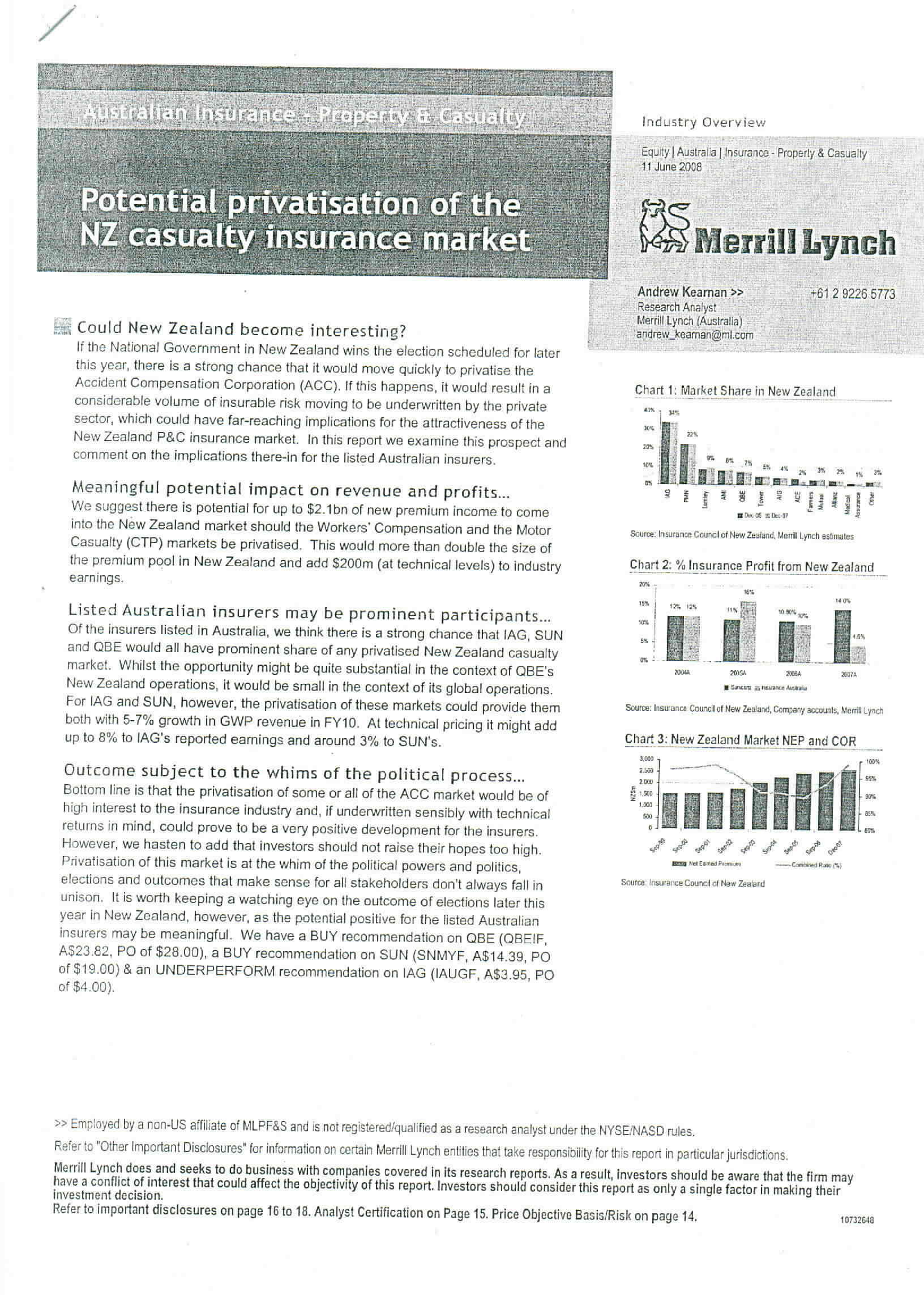
It’s refreshing to see some proper investigative journalism in this morning’s Dominion Post, with a revelation from Vernon Small that while National continues to try and downplay ACC and talk about “no privatisation in the first term,” a report from John Key’s old firm Merrill Lynch suggests National’s privatisation plans are an open secret among Aussie insurance companies, who are lining up for windfall profits.
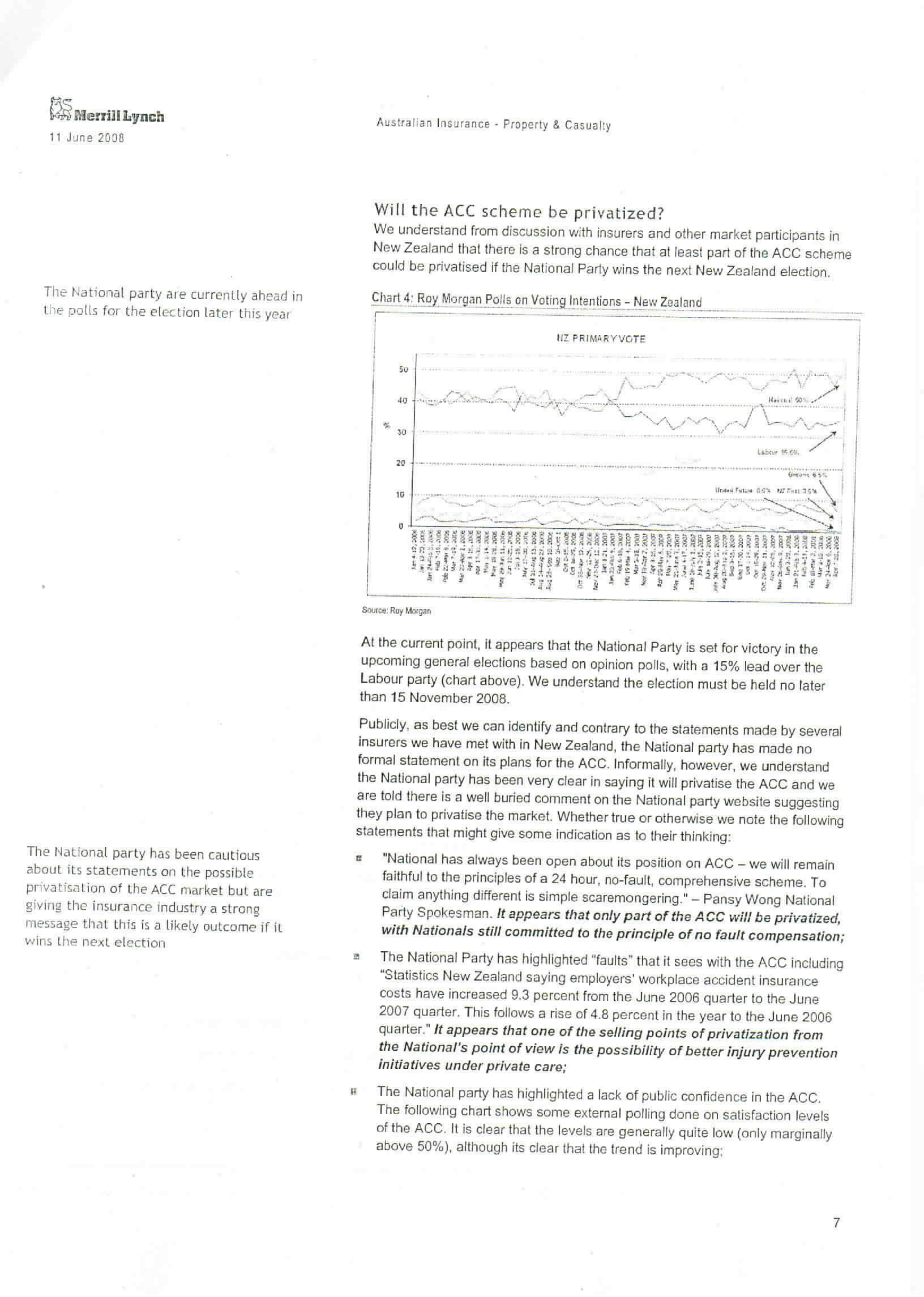
“Publicly, as best we can identify, and contrary to the statements made by several insurers we have met with in New Zealand, the National Party has made no formal statement on its plans for the ACC,” the report by analyst Andrew Kearnan says.
“Informally, however, we understand the National Party has been very clear in saying it will privatise the ACC.”
It is expected such a privatisation programme would involve the handing over of the workers’ compensation and motor casualty accounts to private insurers, worth $2.1 billion in new ‘premium’ income to the Aussie insurance companies.
The cost of this will of course fall to ordinary Kiwis, who will be forced to pay higher premiums for reduced coverage, as both Merrill Lynch and PriceWaterhouseCoopers point out. Clearly this is not a party with New Zealanders’ best interests at heart.
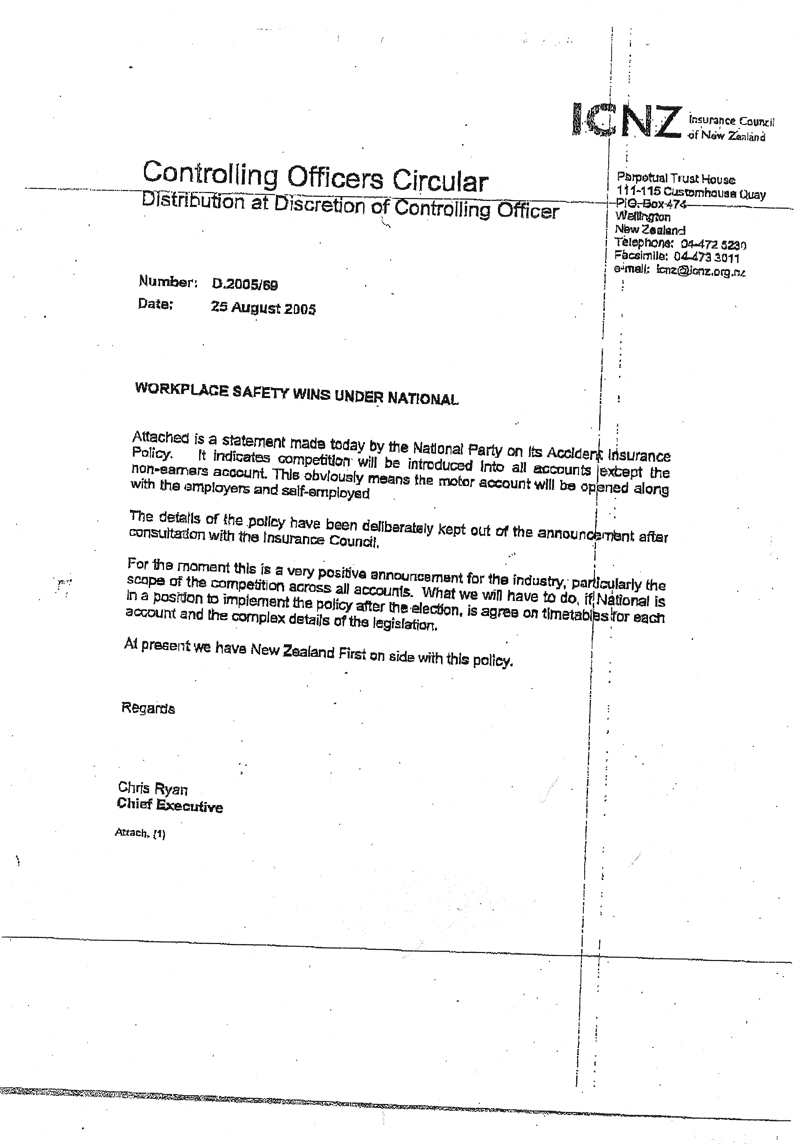
It doesn’t take a rocket scientist to figure out National’s telling the public one thing and its backers in the insurance industry another on this one. You’ll recall this is exactly what happened last election when National met secretly with the private insurance lobby to collude on ACC policy, which was then deliberately withheld from the public to avoid political fallout.
Ultimately it worked for National last election – even when the damning memo leaked it was lost in the bustle and confusion of the election campaign and voters went to the polls none the wiser. National’s hoping to get away with the same trick this time; it’s up to the media to make sure that doesn’t happen.
UPDATE: Selected pages from the Merryl Lynch report [JPEG, 300k] are available by clicking the thumbnails below:
 __________
93 comments on “Merrill Lynch: Nats will privatise ACC ”
- Comments are now closed
Links to post
- Comments are now closed
Recent Comments


- Backbone, revisited
 The schools are on holiday and the sun is shining in the seaside village and all day long I have been seeing bunches of bikes; Mums, Dads, teens and toddlers chattering, laughing, happy, having a bloody great time together. Cheers, AT, for the bits of lane you’ve added lately around the ...5 hours ago
 - Ministers are not above the law
 Today in our National-led authoritarian nightmare: Shane Jones thinks Ministers should be above the law: New Zealand First MP Shane Jones is accusing the Waitangi Tribunal of over-stepping its mandate by subpoenaing a minister for its urgent hearing on the Oranga Tamariki claim. The tribunal is looking into the ...6 hours ago
 - What’s the outfit you can hear going down the gurgler? Probably it’s David Parker’s Oceans Sec...
 Buzz from the Beehive Point of Order first heard of the Oceans Secretariat in June 2021, when David Parker (remember him?) announced a multi-agency approach to protecting New Zealand’s marine ecosystems and fisheries. Parker (holding the Environment, and Oceans and Fisheries portfolios) broke the news at the annual Forest & ...6 hours ago
 - Will politicians let democracy die in the darkness?
 Bryce Edwards writes – Politicians across the political spectrum are implicated in the New Zealand media’s failing health. Either through neglect or incompetent interventions, successive governments have failed to regulate, foster, and allow a healthy Fourth Estate that can adequately hold politicians and the powerful to account. ...9 hours ago
 - Matt Doocey doubles down on trans “healthcare”Citizen Science writes – Last week saw two significant developments in the debate over the treatment of trans-identifying children and young people – the release in Britain of the final report of Dr Hilary Cass’s review into gender healthcare, and here in New Zealand, the news that the ...10 hours ago
- A TikTok Prime Minister.
 One night while sleeping in my bed I had a beautiful dreamThat all the people of the world got together on the same wavelengthAnd began helping one anotherNow in this dream, universal love was the theme of the dayPeace and understanding and it happened this wayAfter such an eventful day ...11 hours ago
 - Texas Lessons
 This is a guest post by Oscar Simms who is a housing activist, volunteer for the Coalition for More Homes, and was the Labour Party candidate for Auckland Central at the last election.
...
14 hours ago - Bernard's pick 'n' mix of the news links at 6:06 am
 The top six news links I’ve seen elsewhere in the last 24 hours as of 6:06 am on Wednesday, April 17 are:Must read: Secrecy shrouds which projects might be fast-tracked RNZ Farah HancockScoop: Revealed: Luxon has seven staffers working on social media content - partly paid for by taxpayer Newshub ...16 hours ago
 - Fighting poverty on the holiday highway
 Turning what Labour called the “holiday highway” into a four-lane expressway from Auckland to Whangarei could bring at least an economic benefit of nearly two billion a year for Northland each year. And it could help bring an end to poverty in one of New Zealand’s most deprived regions. The ...17 hours ago
 - Bernard's six-stack of substacks at 6:26 pm
 Tonight’s six-stack includes: launching his substack with a bunch of his previous documentaries, including this 1992 interview with Dame Whina Cooper. and here crew give climate activists plenty to do, including this call to submit against the Fast Track Approvals bill. writes brilliantly here on his substack ...1 day ago
 - At a glance – Is the science settled?
 On February 14, 2023 we announced our Rebuttal Update Project. This included an ask for feedback about the added "At a glance" section in the updated basic rebuttal versions. This weekly blog post series highlights this new section of one of the updated basic rebuttal versions and serves as a ...1 day ago
 - Apposite Quotations.
 1 day ago
 - What’s a life worth now?
 You're in the mall when you hear it: some kind of popping sound in the distance, kids with fireworks, maybe. But then a moment of eerie stillness is followed by more of the fireworks sound and there’s also screaming and shrieking and now here come people running for their lives.Does ...1 day ago
 - Howling at the MoonKarl du Fresne writes – There’s a crisis in the news media and the media are blaming it on everyone except themselves. Culpability is being deflected elsewhere – mainly to the hapless Minister of Communications, Melissa Lee, and the big social media platforms that are accused of hoovering ...1 day ago
- Newshub is Dead.
 I don’t normally send out two newsletters in a day but I figured I’d say something about… the news. If two newsletters is a bit much then maybe just skip one, I don’t want to overload people. Alternatively if you’d be interested in sometimes receiving multiple, smaller updates from me, ...1 day ago
 - Seymour is chuffed about cutting early-learning red tape – but we hear, too, that Jones has loose...Buzz from the Beehive David Seymour and Winston Peters today signalled that at least two ministers of the Crown might be in Wellington today. Seymour (as Associate Minister of Education) announced the removal of more red tape, this time to make it easier for new early learning services to be ...1 day ago
- Bryce Edwards: Will politicians let democracy die in the darkness?
 Politicians across the political spectrum are implicated in the New Zealand media’s failing health. Either through neglect or incompetent interventions, successive governments have failed to regulate, foster, and allow a healthy Fourth Estate that can adequately hold politicians and the powerful to account. Our political system is suffering from the ...1 day ago
 - Was Hawkesby entirely wrong?David Farrar writes – The Broadcasting Standards Authority ruled: Comments by radio host Kate Hawkesby suggesting Māori and Pacific patients were being prioritised for surgery due to their ethnicity were misleading and discriminatory, the Broadcasting Standards Authority has found. It is a fact such patients are prioritised. ...1 day ago
- PRC shadow looms as the Solomons head for electionPRC and its proxies in Solomons have been preparing for these elections for a long time. A lot of money, effort and intelligence have gone into ensuring an outcome that won’t compromise Beijing’s plans. Cleo Paskall writes – On April 17th the Solomon Islands, a country of ...1 day ago
- Climate Change: Criminal ecocideWe are in the middle of a climate crisis. Last year was (again) the hottest year on record. NOAA has just announced another global coral bleaching event. Floods are threatening UK food security. So naturally, Shane Jones wants to make it easier to mine coal: Resources Minister Shane Jones ...1 day ago
- Is saving one minute of a politician's time worth nearly $1 billion?
 Is speeding up the trip to and from Wellington airport by 12 minutes worth spending up more than $10 billion? Photo: Lynn Grieveson / The KākāTL;DR: The six news items that stood out to me in the last day to 8:26 am today are:The Lead: Transport Minister Simeon Brown announced ...1 day ago
 - Long Tunnel or Long Con?Yesterday it was revealed that Transport Minister had asked Waka Kotahi to look at the options for a long tunnel through Wellington. State Highway 1 (SH1) through Wellington City is heavily congested at peak times and while planning continues on the duplicate Mt Victoria Tunnel and Basin Reserve project, the ...2 days ago
- Smoke And Mirrors.
 You're a fraud, and you know itBut it's too good to throw it all awayAnyone would do the sameYou've got 'em goingAnd you're careful not to show itSometimes you even fool yourself a bitIt's like magicBut it's always been a smoke and mirrors gameAnyone would do the sameForty six billion ...2 days ago
 - What is Mexico doing about climate change?This is a re-post from Yale Climate Connections The June general election in Mexico could mark a turning point in ensuring that the country’s climate policies better reflect the desire of its citizens to address the climate crisis, with both leading presidential candidates expressing support for renewable energy. Mexico is the ...2 days ago
- State of humanity, 2024
 2024, it feels, keeps presenting us with ever more challenges, ever more dismay.Do you give up yet? It seems to ask.No? How about this? Or this?How about this?When I say 2024 I really mean the state of humanity in 2024.Saturday night, we watched Civil War because that is one terrifying cliff we've ...2 days ago
 - Govt’s Wellington tunnel vision aims to ease the way to the airport (but zealous promoters of cycl...Buzz from the Beehive A pet project and governmental tunnel vision jump out from the latest batch of ministerial announcements. The government is keen to assure us of its concern for the wellbeing of our pets. It will be introducing pet bonds in a change to the Residential Tenancies Act ...2 days ago
- The case for cultural connectednessA recent report generated from a Growing Up in New Zealand (GUiNZ) survey of 1,224 rangatahi Māori aged 11-12 found: Cultural connectedness was associated with fewer depression symptoms, anxiety symptoms and better quality of life. That sounds cut and dry. But further into the report the following appears: Cultural connectedness is ...2 days ago
- Useful context on public sector job cutsDavid Farrar writes – The Herald reports: From the gory details of job-cuts news, you’d think the public service was being eviscerated. While the media’s view of the cuts is incomplete, it’s also true that departments have been leaking the particulars faster than a Wellington ...2 days ago
- Gordon Campbell On When Racism Comes Disguised As Anti-racismRemember the good old days, back when New Zealand had a PM who could think and speak calmly and intelligently in whole sentences without blustering? Even while Iran’s drones and missiles were still being launched, Helen Clark was live on TVNZ expertly summing up the latest crisis in the Middle ...2 days ago
- Govt ignored economic analysis of smokefree reversal3 days ago
- True Blue.
 True loveYou're the one I'm dreaming ofYour heart fits me like a gloveAnd I'm gonna be true blueBaby, I love youI’ve written about the job cuts in our news media last week. The impact on individuals, and the loss to Aotearoa of voices covering our news from different angles.That by ...3 days ago
 - Who is running New Zealand’s foreign policy?While commentators, including former Prime Minister Helen Clark, are noting a subtle shift in New Zealand’s foreign policy, which now places more emphasis on the United States, many have missed a key element of the shift. What National said before the election is not what the government is doing now. ...3 days ago
- 2024 SkS Weekly Climate Change & Global Warming News Roundup #15A listing of 31 news and opinion articles we found interesting and shared on social media during the past week: Sun, April 7, 2024 thru Sat, April 13, 2024. Story of the week Our story of the week is about adults in the room setting terms and conditions of ...3 days ago
- Feline Friends and Fragile Fauna The Complexities of Cats in New Zealand’s Conservation Efforts

Cats, with their independent spirit and beguiling purrs, have captured the hearts of humans for millennia. In New Zealand, felines are no exception, boasting the highest national cat ownership rate globally [definition cat nz cat foundation]. An estimated 1.134 million pet cats grace Kiwi households, compared to 683,000 dogs ...
3 days ago - Or is that just they want us to think?
 Nice guy, that Peter Williams. Amiable, a calm air of no-nonsense capability, a winning smile. Everything you look for in a TV presenter and newsreader.I used to see him sometimes when I went to TVNZ to be a talking head or a panellist and we would yarn. Nice guy, that ...4 days ago
 - Fact Brief – Did global warming stop in 1998?Skeptical Science is partnering with Gigafact to produce fact briefs — bite-sized fact checks of trending claims. This fact brief was written by Sue Bin Park in collaboration with members from our Skeptical Science team. You can submit claims you think need checking via the tipline. Did global warming stop in ...4 days ago
- Arguing over a moot point.
 I have been following recent debates in the corporate and social media about whether it is a good idea for NZ to join what is known as “AUKUS Pillar Two.” AUKUS is the Australian-UK-US nuclear submarine building agreement in which … Continue reading ...4 days ago
 - No Longer Trusted: Ageing Boomers, Laurie & Les, Talk Politics.4 days ago
- Mortgage rates at 10% anyone?
 No – nothing about that in PM Luxon’s nine-point plan to improve the lives of New Zealanders. But beyond our shores Jamie Dimon, the long-serving head of global bank J.P. Morgan Chase, reckons that the chances of a goldilocks soft landing for the economy are “a lot lower” than the ...4 days ago
 - Sad tales from the leftMichael Bassett writes – Have you noticed the odd way in which the media are handling the government’s crackdown on surplus employees in the Public Service? Very few reporters mention the crazy way in which State Service numbers rocketed ahead by more than 16,000 during Labour’s six years, ...4 days ago
- In Whose Best Interests?On The Spot: The question Q+A host, Jack Tame, put to the Workplace & Safety Minister, Act’s Brooke van Velden, was disarmingly simple: “Are income tax cuts right now in the best interests of lowering inflation?”JACK TAME has tested another MP on his Sunday morning current affairs show, Q+A. Minister for Workplace ...4 days ago
- Don’t Question, Don’t Complain.
 It has to start somewhereIt has to start sometimeWhat better place than here?What better time than now?So it turns out that I owe you all an apology.It seems that all of the terrible things this government is doing, impacting the lives of many, aren’t necessarily ‘bad’ per se. Those things ...4 days ago
 - Auckland faces 25% water inflation shock
 Three Waters became a focus of anti-Government protests under Labour, but its dumping by the new Government hasn’t solved councils’ funding problems and will eventually hit the back pockets of everyone. Photo: Lynn Grieveson/Getty ImagesTL;DR: The six news items that stood out to me at 8:06 am today are:The Government ...5 days ago
 - Small accomplishments and large ironies
 5 days ago
 - The Song of Saqua: Volume VII
 In order to catch up to the actual progress of the D&D campaign, I present you with another couple of sessions. These were actually held back to back, on a Monday and Tuesday evening. Session XV Alas, Goatslayer had another lycanthropic transformation… though this time, he ran off into the ...5 days ago
 - Accelerating the Growth Rate?
 There is a constant theme from the economic commentariat that New Zealand needs to lift its economic growth rate, coupled with policies which they are certain will attain that objective. Their prescriptions are usually characterised by two features. First, they tend to be in their advocate’s self-interest. Second, they are ...5 days ago
 - The only thing we have to fear is tenants themselves
 1. Which of these acronyms describes the experience of travelling on a Cook Strait ferry?a. ROROb. FOMOc. RAROd. FMLAramoana, first boat ever boarded by More Than A Feilding, four weeks after the Wahine disaster2. What is the acronym for the experience of watching the government risking a $200 million break ...5 days ago
 - Peters talks of NZ “renewing its connections with the world” – but who knew we had been discon...Buzz from the Beehive The thrust of the country’s foreign affairs policy and its relationship with the United States have been addressed in four statements from the Beehive over the past 24 hours. Foreign Affairs Minister Winston Peters somewhat curiously spoke of New Zealand “renewing its connections with a world ...5 days ago
- Muldoonism, solar farms, and legitimacyNewsHub had an article yesterday about progress on Aotearoa's largest solar farm, at "The Point" in the Mackenzie Country. 420MW, right next to a grid connection and transmission infrastructure, and next to dams - meaning it can work in tandem with them to maximise water storage. Its exactly the sort ...5 days ago
- NZTA does not know how much it spends on conesBarrie Saunders writes – Astonishing as it may seem NZTA does not know either how much it spends on road cones as part of its Temporary Traffic Management system, or even how many companies it uses to supply and manage the cones. See my Official Information Act request ...5 days ago
- If this is Back on Track – let's not.
 I used to want to plant bombs at the Last Night of the PromsBut now you'll find me with the baby, in the bathroom,With that big shell, listening for the sound of the sea,The baby and meI stayed in bed, alone, uncertainThen I met you, you drew the curtainThe sun ...5 days ago
 - Welfare: Just two timid targets from the National governmentLindsay Mitchell writes – The National Government has announced just two targets for the Ministry of Social Development. They are: – to reduce the number of people receiving Jobseeker Support by 50,000 to 140,000 by June 2029, and – (alongside HUD) to reduce the number of households in emergency ...5 days ago
- The Hoon around the week to April 12Photo: Lynn Grieveson / The KākāTL;DR: The podcast above features co-hosts Bernard Hickey and Peter Bale, along with regular guests Robert Patman on Gaza and AUKUS II, Merja Myllylahti on AUT’s trust in news report, Awhi’s Holly Bennett on a watered-down voluntary code for lobbyists, plus special guest Patrick Gower ...6 days ago
- A Dead Internet?
 Hi,Four years ago I wrote about a train engineer who derailed his train near the port in Los Angeles.He was attempting to slam thousands of tonnes of screaming metal into a docked Navy hospital ship, because he thought it was involved in some shady government conspiracy theory. He thought it ...6 days ago
 - Weekly Roundup 12-April-2024Welcome back to another Friday. Here’s some articles that caught our attention this week. This Week in Greater Auckland On Wednesday Matt looked at the latest with the Airport to Botany project. On Thursday Matt covered the revelation that Auckland Transport have to subsidise towing illegally parked cars. ...6 days ago
- Weekly Roundup 12-April-2024Welcome back to another Friday. Here’s some articles that caught our attention this week. This Week in Greater Auckland On Wednesday Matt looked at the latest with the Airport to Botany project. On Thursday Matt covered the revelation that Auckland Transport have to subsidise towing illegally parked cars. ...6 days ago
- Antarctic heat spike shocks climate scientistsA ‘Regime Shift’ could raise sea levels sooner than anticipated. Has a tipping point been triggered in the Antarctic? Photo: Juan Barreto/Getty Images TL;DR: Here’s the top six news items of note in climate news for Aotearoa-NZ this week, and a discussion above that was recorded yesterday afternoon between and ...6 days ago
- Skeptical Science New Research for Week #15 2024Open access notables Global carbon emissions in 2023, Liu et al., Nature Reviews Earth & Environment Annual global CO2 emissions dropped markedly in 2020 owing to the COVID-19 pandemic, decreasing by 5.8% relative to 2019 (ref. 1). There were hopes that green economic stimulus packages during the COVD crisis might mark the beginning ...6 days ago
- Everything will be just fine
 In our earlier days of national self-loathing, we made a special place for the attitude derided as she’ll be right.You don't hear many people younger than age Boomer using that particular expression these days. But that doesn’t mean there are not younger people in possession of such an attitude.The likes of ...6 days ago
 - Farmers and landlords are given news intended to lift their confidence – but the media must muse o...Buzz from the Beehive People working in the beleaguered media industry have cause to yearn for a minister as busy as Todd McClay and his associates have been in recent days. But if they check out the Beehive website for a list of Melissa Lee’s announcements, pronouncements, speeches and what-have-you ...6 days ago
- National’s war on rentersWhen the National government came into office, it complained of a "war on landlords". It's response? Start a war on renters instead: The changes include re-introducing 90-day "no cause" terminations for periodic tenancies, meaning landlords can end a periodic tenancy without giving any reason. [...] Landlords will now only ...6 days ago
- DrawnA ballot for two Member's Bills was held today, and the following bills were drawn: Repeal of Good Friday and Easter Sunday as Restricted Trading Days (Shop Trading and Sale of Alcohol) Amendment Bill (Cameron Luxton) Consumer Guarantees (Right to Repair) Amendment Bill (Marama Davidson) The ...6 days ago
- At last some scienceEle Ludemann writes – Is getting rid of plastic really good for the environment? Substituting plastics with alternative materials is likely to result in increased GHG emissions, according to research from the University of Sheffield. The study by Dr. Fanran Meng from Sheffield’s Department of Chemical and Biological Engineering, ...6 days ago
- Something important: the curious death of the School Strike 4 Climate MovementThe Christchurch Mosque Massacres, Covid-19, deep political disillusionment, and the jealous cruelty of the intersectionists: all had a part to play in causing School Strike 4 Climate’s bright bubble of hope and passion to burst. But, while it floated above us, it was something that mattered. Something Important. ...6 days ago
- The day the TV media died…Peter Dunne writes – April 10 is a dramatic day in New Zealand’s history. On April 10, 1919, the preliminary results of a referendum showed that New Zealanders had narrowly voted for prohibition by a majority of around 13,000 votes. However, when the votes of soldiers still overseas ...6 days ago
- What's the point in Melissa Lee?
 While making coffee this morning I listened to Paddy Gower from Newshub being interviewed on RNZ. It was painful listening. His hurt and love for that organisation, its closure confirmed yesterday, quite evident.As we do when something really matters, he hasn’t giving up hope. Paddy talked about the taonga that ...6 days ago
 - Bernard's Top 10 'pick 'n' mix' at 10:10 am on Thursday, April 11
 TL;DR: Here’s the 10 news and other links elsewhere that stood out for me over the last day, as at 10:10 am on Wednesday, April 10:Photo by Iva Rajović on UnsplashMust-read: As more than half of the nation’s investigative journalists are sacked, Newsroom’s Tim Murphy shows what it takes to ...6 days ago
 - Gordon Campbell On Winston Peters’ Pathetic Speech At The UNGood grief, Winston Peters. Tens of thousands of Gazans have been slaughtered, two million are on the brink of starvation and what does our Foreign Minister choose to talk about at the UN? The 75 year old issue of whether the five permanent members should continue to have veto powers ...7 days ago
- Subsidising illegal parkingHopefully finally over his obsession with raised crossings, the Herald’s Bernard Orsman has found something to actually be outraged at. Auckland ratepayers are subsidising the cost of towing, storing and releasing cars across the city to the tune of $15 million over five years. Under a quirk in the law, ...7 days ago
- When 'going for growth' actually means saying no to new social homesTL;DR: These six things stood out to me over the last day in Aotearoa-NZ’s political economy, as of 7:06 am on Thursday, April 11:The Government has refused a community housing provider’s plea for funding to help build 42 apartments in Hamilton because it said a $100 million fund was used ...7 days ago
- https://www.politik.co.nz/?p=12733As the public sector redundancies rolled on, with the Department of Conservation saying yesterday it was cutting 130 positions, a Select Committee got an insight into the complexities and challenges of cutting the Government’s workforce. Immigration New Zealand chiefs along with their Minister, Erica Stanford, appeared before Parliament’s Education and ...7 days ago
- Bernard's six-stack of substacks at 6:06 pm on Wednesday, April 10
 TL;DR: Six substacks that stood out to me in the last day:Explaining is winning for journalists wanting to regain trust, writes is his excellent substack. from highlights Aotearoa-NZ’s greenwashing problem in this weekly substack. writes about salt via his substack titled: The Second Soul, Part I ...1 week ago
 - EGU2024 – Picking and chosing sessions to attend virtuallyThis year's General Assembly of the European Geosciences Union (EGU) will take place as a fully hybrid conference in both Vienna and online from April 15 to 19. I decided to join the event virtually this year for the full week and I've already picked several sessions I plan to ...1 week ago
- But here's my point about the large irony in what Luxon is saying
 Grim old week in the media business, eh? And it’s only Wednesday, to rework an old upbeat line of poor old Neil Roberts.One of the larger dark ironies of it all has been the line the Prime Minister is serving up to anyone asking him about the sorry state of ...1 week ago
 - Govt gives farmers something to talk about (regarding environmental issues) at those woolshed meetin...Buzz from the Beehive Hard on the heels of three rurally oriented ministers launching the first of their woolshed meetings, the government brought good news to farmers on the environmental front. First, Agriculture Minister Todd McClay announced an additional $18 million is being committed to reduce agricultural emissions. Not all ...1 week ago




- Release: Dark day for Kiwi kids as a third of Govt cuts affect them
 News that 1000 jobs at the Ministry of Education and Oranga Tamariki could go is devastating for future generations of New Zealanders. ...8 hours ago
 - Release: Alarm as Government signals further blow to school lunchesMore essential jobs could be on the chopping block, this time Ministry of Education staff on the school lunches team are set to find out whether they're in line to lose their jobs. ...11 hours ago
- Release: Quick, submit – stop Govt’s dodgy approvals billThe Government is trying to bring in a law that will allow Ministers to cut corners and kill off native species, Labour environment spokesperson Rachel Brooking said. ...1 day ago
- Government throws coal on the climate crisis fire
 The Government’s policy announced today to ease consenting for coal mining will have a lasting impact across generations. ...1 day ago
 - Release: Public transport costs to double as National looks at unaffordable roading project insteadCancelling urgently needed new Cook Strait ferries and hiking the cost of public transport for many Kiwis so that National can announce the prospect of another tunnel for Wellington is not making good choices, Labour Transport Spokesperson Tangi Utikere said. ...2 days ago
- Release: Cost of living in Auckland still not a priorityA laundry list of additional costs for Tāmaki Makarau Auckland shows the Minister for the city is not delivering for the people who live there, says Labour Auckland Issues spokesperson Shanan Halbert. ...3 days ago
- Greens look to fast-track submissions on harmful lawThe Green Party has today launched a step-by-step guide to help New Zealanders make their voice heard on the Government’s democracy dodging and anti-environment fast track legislation. ...5 days ago
- Release: Govt should stop making people’s lives harder and build more homesThe National Government’s proposed changes to the Residential Tenancies Act will mean tenants can be turfed from their homes by landlords with little notice, Labour housing spokesperson Kieran McAnulty said. ...6 days ago
- Release: Melissa Lee missing in action on mediaThe action Melissa Lee promised to protect democracy and the media sector is missing, Media and Communications spokesperson Willie Jackson said. ...6 days ago
- Landlord Government leaves little hope for rentersThe Government’s announcement on tenancy rules prove that it does not care about renters. ...6 days ago
- Opportunity to build a more sustainable economyGreen Party co-leader Marama Davidson is calling on all parties to support a common-sense change that’s great for the planet and great for consumers after her member’s bill was drawn from the ballot today. ...6 days ago
- Significant step forward in fixing cruel and unjust pastA significant milestone has been reached in the fight to strike an anti-Pasifika and unfair law from the country’s books after Teanau Tuiono’s members’ bill passed its first reading. ...1 week ago
- Missed opportunity but NZ will surely one day recognise the right to a sustainable environmentNew Zealand has today missed the opportunity to uphold the right to a clean, healthy, and sustainable environment, says James Shaw after his member’s bill was voted down in its first reading. ...1 week ago
- Release: Don’t cut our lunches – clear message sent to GovernmentTens of thousands of people are demanding the Government commits to fully funding free and healthy school lunches. ...1 week ago
- Release: Govt makes U-turn on Suicide Prevention OfficeLabour welcomes the Government’s U-turn on the closure of the Suicide Prevention Office, says Labour Mental Health spokesperson Ingrid Leary. ...1 week ago
- CCC issues warning over further climate delayToday’s advice from the Climate Change Commission paints a sobering reality of the challenge we face in combating climate change, especially in light of recent Government policy announcements. ...1 week ago
- Luxon targets lame and lousy example of leadershipIf talk is cheap, Chris Luxon’s “targets” are bankrupt. ...1 week ago
- Luxon targets are lousy example of leadershipIf talk is cheap, Chris Luxon’s “targets” are bankrupt. ...1 week ago
- Release: Commitment to disability communities missing from Govt prioritiesMinister for Disability Issues Penny Simmonds appears to have delayed a report back to Cabinet on the progress New Zealand is making against international obligations for disabled New Zealanders. ...1 week ago
- Methane target review is dangerous duplicationThe Government’s newly announced review of methane emissions reduction targets hints at its desire to delay Aotearoa New Zealand’s urgent transition to a climate safe future, the Green Party said. ...2 weeks ago
- Release: Government must commit to school building project for disabled studentsThe Government must commit to the Maitai School building project for students with high and complex needs, to ensure disabled students from the top of the South Island have somewhere to learn. ...2 weeks ago
- Release: National must take mental health seriouslyMental Health Minister Matt Doocey and his Government colleagues have made a meal of their mental health commitments, showing how flimsy their efforts to champion the issue truly are, says Labour Mental Health spokesperson Ingrid Leary. ...2 weeks ago
- Referendums for Māori wards a racist step backwardsThe Government's imposed referendum on Māori wards is a racist step backwards for Māori representation, and disregards Te Tiriti o Waitangi. ...2 weeks ago
- Release: Job losses at Health not worth it for tax cutsNew Zealand will feel the harm of the National Government’s reckless cuts to jobs at the health ministry for generations, says Ayesha Verrall. ...2 weeks ago
- Press release: No Māori initiatives in Government’s nothing planMāori are yet to see anything from this Government except cuts, reversals and taking our people backwards, Māori Development spokesperson Willie Jackson said. ...2 weeks ago
- Thirty six point PR spinThe Government’s ‘36 point’ plan for the next three months is as pointless as it is hollow. ...2 weeks ago
- Thirty six point PR spinThe Government’s ‘36 point’ plan for the next three months is as pointless as it is hollow. ...2 weeks ago
- Thirty six point PR spinThe Government’s ‘36 point’ plan for the next three months is as pointless as it is hollow. ...2 weeks ago
- Release: Social housing off Government’s to-do listThe Coalition Government’s refusal to commit to ongoing funding for social housing is seeing the sector pull back on developments and families watch their dreams of securing a home fade away, says Labour Housing spokesperson Kieran McAnulty. ...2 weeks ago
- Release: Less money in most people’s pockets this AprilChanges to minimum wage and benefit indexation means many New Zealanders will get less this year, as the Government gives a big tax break to landlords instead. ...2 weeks ago
- Thailand and NZ to agree to Strategic Partnership
 Prime Minister Christopher Luxon and his Thai counterpart, Prime Minister Srettha Thavisin, have today agreed that New Zealand and the Kingdom of Thailand will upgrade the bilateral relationship to a Strategic Partnership by 2026. “New Zealand and Thailand have a lot to offer each other. We have a strong mutual desire to build ...5 hours ago
 - Government consults on extending coastal permits for portsRMA Reform Minister Chris Bishop and Transport Minister Simeon Brown have today announced the Coalition Government’s intention to extend port coastal permits for a further 20 years, providing port operators with certainty to continue their operations. “The introduction of the Resource Management Act in 1991 required ports to obtain coastal ...9 hours ago
- Inflation coming down, but more work to doToday’s announcement that inflation is down to 4 per cent is encouraging news for Kiwis, but there is more work to be done - underlining the importance of the Government’s plan to get the economy back on track, acting Finance Minister Chris Bishop says. “Inflation is now at 4 per ...9 hours ago
- School attendance restored as a priority in health adviceRefreshed health guidance released today will help parents and schools make informed decisions about whether their child needs to be in school, addressing one of the key issues affecting school attendance, says Associate Education Minister David Seymour. In recent years, consistently across all school terms, short-term illness or medical reasons ...11 hours ago
- Unnecessary bureaucracy cut in oceans sectorOceans and Fisheries Minister Shane Jones is streamlining high-level oceans management while maintaining a focus on supporting the sector’s role in the export-led recovery of the economy. “I am working to realise the untapped potential of our fishing and aquaculture sector. To achieve that we need to be smarter with ...13 hours ago
- Patterson promoting NZ’s wool sector at International CongressAssociate Agriculture Minister Mark Patterson is speaking at the International Wool Textile Organisation Congress in Adelaide, promoting New Zealand wool, and outlining the coalition Government’s support for the revitalisation the sector. "New Zealand’s wool exports reached $400 million in the year to 30 June 2023, and the coalition Government ...1 day ago
- Removing red tape to help early learners thriveThe Government is making legislative changes to make it easier for new early learning services to be established, and for existing services to operate, Associate Education Minister David Seymour says. The changes involve repealing the network approval provisions that apply when someone wants to establish a new early learning service, ...2 days ago
- RMA changes to cut coal mining consent red tapeChanges to the Resource Management Act will align consenting for coal mining to other forms of mining to reduce barriers that are holding back economic development, Resources Minister Shane Jones says. “The inconsistent treatment of coal mining compared with other extractive activities is burdensome red tape that fails to acknowledge ...2 days ago
- McClay reaffirms strong NZ-China trade relationshipTrade, Agriculture and Forestry Minister Todd McClay has concluded productive discussions with ministerial counterparts in Beijing today, in support of the New Zealand-China trade and economic relationship. “My meeting with Commerce Minister Wang Wentao reaffirmed the complementary nature of the bilateral trade relationship, with our Free Trade Agreement at its ...2 days ago
- Prime Minister Luxon acknowledges legacy of Singapore Prime Minister LeePrime Minister Christopher Luxon today paid tribute to Singapore’s outgoing Prime Minister Lee Hsien Loong. Meeting in Singapore today immediately before Prime Minister Lee announced he was stepping down, Prime Minister Luxon warmly acknowledged his counterpart’s almost twenty years as leader, and the enduring legacy he has left for Singapore and South East ...2 days ago
- PMs Luxon and Lee deepen Singapore-NZ tiesPrime Minister Christopher Luxon held a bilateral meeting today with Singapore Prime Minister Lee Hsien Loong. While in Singapore as part of his visit to South East Asia this week, Prime Minister Luxon also met with Singapore President Tharman Shanmugaratnam and will meet with Deputy Prime Minister Lawrence Wong. During today’s meeting, Prime Minister Luxon ...2 days ago
- Antarctica New Zealand Board appointmentsForeign Minister Winston Peters has made further appointments to the Board of Antarctica New Zealand as part of a continued effort to ensure the Scott Base Redevelopment project is delivered in a cost-effective and efficient manner. The Minister has appointed Neville Harris as a new member of the Board. Mr ...2 days ago
- Finance Minister travels to Washington DCFinance Minister Nicola Willis will travel to the United States on Tuesday to attend a meeting of the Five Finance Ministers group, with counterparts from Australia, the United States, Canada, and the United Kingdom. “I am looking forward to meeting with our Five Finance partners on how we can work ...2 days ago
- Pet bonds a win/win for renters and landlordsThe coalition Government has today announced purrfect and pawsitive changes to the Residential Tenancies Act to give tenants with pets greater choice when looking for a rental property, says Housing Minister Chris Bishop. “Pets are important members of many Kiwi families. It’s estimated that around 64 per cent of New ...2 days ago
- Long Tunnel for SH1 Wellington being consideredState Highway 1 (SH1) through Wellington City is heavily congested at peak times and while planning continues on the duplicate Mt Victoria Tunnel and Basin Reserve project, the Government has also asked NZ Transport Agency (NZTA) to consider and provide advice on a Long Tunnel option, Transport Minister Simeon Brown ...3 days ago
- New Zealand condemns Iranian strikesPrime Minister Christopher Luxon and Foreign Minister Winston Peters have condemned Iran’s shocking and illegal strikes against Israel. “These attacks are a major challenge to peace and stability in a region already under enormous pressure," Mr Luxon says. "We are deeply concerned that miscalculation on any side could ...3 days ago
- Huge interest in Government’s infrastructure plansHundreds of people in little over a week have turned out in Northland to hear Regional Development Minister Shane Jones speak about plans for boosting the regional economy through infrastructure. About 200 people from the infrastructure and associated sectors attended an event headlined by Mr Jones in Whangarei today. Last ...5 days ago
- Health Minister thanks outgoing Health New Zealand ChairHealth Minister Dr Shane Reti has today thanked outgoing Health New Zealand – Te Whatu Ora Chair Dame Karen Poutasi for her service on the Board. “Dame Karen tendered her resignation as Chair and as a member of the Board today,” says Dr Reti. “I have asked her to ...5 days ago
- Roads of National Significance planning underwayThe NZ Transport Agency (NZTA) has signalled their proposed delivery approach for the Government’s 15 Roads of National Significance (RoNS), with the release of the State Highway Investment Proposal (SHIP) today, Transport Minister Simeon Brown says. “Boosting economic growth and productivity is a key part of the Government’s plan to ...5 days ago
- Navigating an unstable global environmentNew Zealand is renewing its connections with a world facing urgent challenges by pursuing an active, energetic foreign policy, Foreign Minister Winston Peters says. “Our country faces the most unstable global environment in decades,” Mr Peters says at the conclusion of two weeks of engagements in Egypt, Europe and the United States. “We cannot afford to sit back in splendid ...5 days ago
- NZ welcomes Australian Governor-GeneralPrime Minister Christopher Luxon has announced the Australian Governor-General, His Excellency General The Honourable David Hurley and his wife Her Excellency Mrs Linda Hurley, will make a State visit to New Zealand from Tuesday 16 April to Thursday 18 April. The visit reciprocates the State visit of former Governor-General Dame Patsy Reddy ...5 days ago
- Pseudoephedrine back on shelves for WinterAssociate Health Minister David Seymour has announced that Medsafe has approved 11 cold and flu medicines containing pseudoephedrine. Pharmaceutical suppliers have indicated they may be able to supply the first products in June. “This is much earlier than the original expectation of medicines being available by 2025. The Government recognised ...6 days ago
- NZ and the US: an ever closer partnershipNew Zealand and the United States have recommitted to their strategic partnership in Washington DC today, pledging to work ever more closely together in support of shared values and interests, Foreign Minister Winston Peters says. “The strategic environment that New Zealand and the United States face is considerably more ...6 days ago
- Joint US and NZ declarationApril 11, 2024 Joint Declaration by United States Secretary of State the Honorable Antony J. Blinken and New Zealand Minister of Foreign Affairs the Right Honourable Winston Peters We met today in Washington, D.C. to recommit to the historic partnership between our two countries and the principles that underpin it—rule ...6 days ago
- NZ and US to undertake further practical Pacific cooperationForeign Minister Winston Peters has announced further New Zealand cooperation with the United States in the Pacific Islands region through $16.4 million in funding for initiatives in digital connectivity and oceans and fisheries research. “New Zealand can achieve more in the Pacific if we work together more urgently and ...6 days ago
- Government redress for Te Korowai o WainuiāruaThe Government is continuing the bipartisan effort to restore its relationship with iwi as the Te Korowai o Wainuiārua Claims Settlement Bill passed its first reading in Parliament today, says Treaty Negotiations Minister Paul Goldsmith. “Historical grievances of Te Korowai o Wainuiārua relate to 19th century warfare, land purchased or taken ...6 days ago
- Focus on outstanding minerals permit applicationsNew Zealand Petroleum and Minerals is working to resolve almost 150 outstanding minerals permit applications by the end of the financial year, enabling valuable mining activity and signalling to the sector that New Zealand is open for business, Resources Minister Shane Jones says. “While there are no set timeframes for ...6 days ago
- Applications open for NZ-Ireland Research CallThe New Zealand and Irish governments have today announced that applications for the 2024 New Zealand-Ireland Joint Research Call on Agriculture and Climate Change are now open. This is the third research call in the three-year Joint Research Initiative pilot launched in 2022 by the Ministry for Primary Industries and Ireland’s ...6 days ago
- Tenancy rules changes to improve rental marketThe coalition Government has today announced changes to the Residential Tenancies Act to encourage landlords back to the rental property market, says Housing Minister Chris Bishop. “The previous Government waged a war on landlords. Many landlords told us this caused them to exit the rental market altogether. It caused worse ...6 days ago
- Boosting NZ’s trade and agricultural relationship with ChinaTrade and Agriculture Minister Todd McClay will visit China next week, to strengthen relationships, support Kiwi exporters and promote New Zealand businesses on the world stage. “China is one of New Zealand’s most significant trade and economic relationships and remains an important destination for New Zealand’s products, accounting for nearly 22 per cent of our good and ...6 days ago
- Freshwater farm plan systems to be improvedThe coalition Government intends to improve freshwater farm plans so that they are more cost-effective and practical for farmers, Associate Environment Minister Andrew Hoggard and Agriculture Minister Todd McClay have announced. “A fit-for-purpose freshwater farm plan system will enable farmers and growers to find the right solutions for their farm ...1 week ago
- New Fast Track Projects advisory group namedThe coalition Government has today announced the expert advisory group who will provide independent recommendations to Ministers on projects to be included in the Fast Track Approvals Bill, say RMA Reform Minister Chris Bishop and Regional Development Minister Shane Jones. “Our Fast Track Approval process will make it easier and ...1 week ago
- Pacific and Gaza focus of UN talksForeign Minister Winston Peters says his official talks with the United Nations Secretary-General Antonio Guterres in New York today focused on a shared commitment to partnering with the Pacific Islands region and a common concern about the humanitarian catastrophe in Gaza. “Small states in the Pacific rely on collective ...1 week ago
- Government honours Taranaki Maunga dealThe Government is honouring commitments made to Taranaki iwi with the Te Pire Whakatupua mō Te Kāhui Tupua/Taranaki Maunga Collective Redress Bill passing its first reading Parliament today, Treaty Negotiations Minister Paul Goldsmith says. “This Bill addresses the commitment the Crown made to the eight iwi of Taranaki to negotiate ...1 week ago
- Enhanced partnership to reduce agricultural emissionsThe Government and four further companies are together committing an additional $18 million towards AgriZeroNZ to boost New Zealand’s efforts to reduce agricultural emissions. Agriculture Minister Todd McClay says the strength of the New Zealand economy relies on us getting effective and affordable emission reduction solutions for New Zealand. “The ...1 week ago
- 110km/h limit proposed for Kāpiti ExpresswayTransport Minister Simeon Brown has welcomed news the NZ Transport Agency (NZTA) will begin consultation this month on raising speed limits for the Kāpiti Expressway to 110km/h. “Boosting economic growth and productivity is a key part of the Government’s plan to rebuild the economy and this proposal supports that outcome ...1 week ago
- New Zealand Biosecurity Awards – Winners announcedTwo New Zealanders who’ve used their unique skills to help fight the exotic caulerpa seaweed are this year’s Biosecurity Awards Supreme Winners, says Biosecurity Minister Andrew Hoggard. “Strong biosecurity is vital and underpins the whole New Zealand economy and our native flora and fauna. These awards celebrate all those in ...1 week ago
- Attendance action plan to lift student attendance ratesThe Government is taking action to address the truancy crisis and raise attendance by delivering the attendance action plan, Associate Education Minister David Seymour announced today. New Zealand attendance rates are low by national and international standards. Regular attendance, defined as being in school over 90 per cent of the ...1 week ago
- World must act to halt Gaza catastrophe – PetersForeign Minister Winston Peters has told the United Nations General Assembly (UNGA) in New York today that an immediate ceasefire is needed in Gaza to halt the ongoing humanitarian catastrophe. “Palestinian civilians continue to bear the brunt of Israel’s military actions,” Mr Peters said in his speech to a ...1 week ago
- Speech to United Nations General Assembly: 66th plenary meeting, 78th sessionMr President, The situation in Gaza is an utter catastrophe. New Zealand condemns Hamas for its heinous terrorist attacks on 7 October and since, including its barbaric violations of women and children. All of us here must demand that Hamas release all remaining hostages immediately. At the ...1 week ago
- Ministry of Education plans to cut 565 roles
 It makes the proposal the biggest single slash to a public service agency so far. ...1 hour ago
 - Oranga Tamariki proposes to cut more than 400 jobsAbout 1900 roles would be affected overall - either changed or disestablished - in the "scope of restructuring work". ...1 hour ago
- Politics with Michelle Grattan: Independent MP Dai Le on the church attack in her electorate
 Source: The Conversation (Au and NZ) – By Michelle Grattan, Professorial Fellow, University of Canberra After the stabbing of Bishop Mar Mari Emmanuel in an Assyrian Orthodox Church in Wakeley on Monday, and the killings in Bondi Junction shopping centre just two days earlier, many people in Sydney and in ...2 hours ago
 - Government issues guidelines for when sick children should be kept home from schoolCovid-19? Symptoms including fever, vomiting, diarrhoea or head lice? Your children should be at home, new government guidelines say. ...3 hours ago
- Australia’s long-sought stronger environmental laws just got indefinitely deferred. It’s back to...Source: The Conversation (Au and NZ) – By Euan Ritchie, Professor in Wildlife Ecology and Conservation, School of Life & Environmental Sciences, Deakin University We’ve long known Australia’s main environmental protection laws aren’t doing their job, and we know Australians want better laws. Labor was elected promising to fix them. ...4 hours ago
- AI is making smart devices – watches, speakers, doorbells – easier to hack. Here’s how to stay...Source: The Conversation (Au and NZ) – By Chao Chen, Deputy Director, Enterprise AI and Data Analytics Hub, RMIT Univeristy, RMIT University Ivan Bandura/Unsplash From asking our smart speakers for the weather to receiving personalised advice from smartwatches, devices powered by artificial intelligence (AI) are increasingly streamlining our routines ...4 hours ago
- Police Association members reject latest government pay offerPolice Association says members are looking for a sincere effort by the government to address the cost of living crisis and recognise the increasing dangers officers faced. ...4 hours ago
- Global coral bleaching caused by global warming demands a global responseSource: The Conversation (Au and NZ) – By Britta Schaffelke, Manager International Partnerships and Co-ordinator of the Global Coral Reef Monitoring Network (GCRMN), Australian Institute of Marine Science Bleached coral at the Keppel Islands in the southern Great Barrier Reef in early March 2024. © AIMS | Eoghan Aston ...4 hours ago
- The beginnings of modern science shaped how philosophers saw alien life – and how we understand it...Source: The Conversation (Au and NZ) – By Philip C. Almond, Emeritus Professor in the History of Religious Thought, The University of Queensland Wikipedia Speculation about extraterrestrials is not all that new. There was a vibrant debate in 17th-century Europe about the existence of life on other planets. ...5 hours ago
- Families including someone with mental illness can experience deep despair. They need supportSource: The Conversation (Au and NZ) – By Amanda Cole, Lead, Mental Health, Edith Cowan University In the aftermath of the tragic Bondi knife attack, Joel Cauchi’s parents have spoken about their son’s long history of mental illness, having been diagnosed with schizophrenia at age 17. They said they were ...5 hours ago
- How Fast-track Consenting Might Impact The Environment – Expert Reaction
 Submissions on the Fast-track Approvals Bill close at the end of Friday. The law would allow major infrastructure projects to bypass lengthy resource consenting processes – being assessed instead by an expert panel , with Ministers ultimately having ...5 hours ago
 - Changes To ECE RegulationsIn QPEC's view, the Coalition changes to ECE announced mid-April are exactly the opposite of what is needed The Issue David Seymour is loosening regulations and qualifications for Early Childhood Centres, removing government signoff for new ...6 hours ago
- NZDSN Opinion: Organisations Must Do Better For Disabled New ZealandersWe at New Zealand Disability Support Network applaud the Commerce Commission for filing proceedings against One NZ for their latest failure on 111 Contact Code. It doesn’t take much to think of harmful or fatal scenarios for people with disabilities ...6 hours ago
- Caviar Before Children"Caviar before children is what has happened today!” says Pat Newman spokesperson for Te Tai Tokerau Principals Association "The cuts to day to both the Ministry of Education and Oranga Tamariki, point to a government hell bent on delivering tax ...6 hours ago
- Gone By Lunchtime: Aukus ruckus reveals division on foreign policy direction
 Is New Zealand’s trumpeted independent foreign policy in peril? Helen Clark has raised the alarm over New Zealand inching towards a pillar two status with Aukus, warning of a “profoundly undemocratic” direction of travel away from the independent foreign policy forged over four decades. Peters, foreign minister today and for ...6 hours ago
 - Inspectorate Report Shows Prisoners Denied Entitlement To Daily Time Out Of CellsA report from the Office of the Inspectorate shows that prisoners in three units at Auckland Prison were not able to leave their cells every day for many months. For up to nine months (until mid-July 2023), prisoners in three units were denied ...7 hours ago
- 'I thought we were friends': Dave Letele reveals falling out with PM Christopher LuxonCommunity leader Dave Letele considered Christopher Luxon a friend - until the PM reacted badly to an open letter he signed decrying racism. ...7 hours ago
- Watch: Luxon defends hosting Myanmar officials at ASEAN conferencePrime Minister Christopher Luxon says the government condemns outright the Myanmar coup, and NZ is simply following the policy set by ASEAN. ...7 hours ago
- You could help minimise harm in a public attack. Here’s what it means to be a ‘zero responder’Source: The Conversation (Au and NZ) – By Milad Haghani, Senior Lecturer of Urban Mobility, Public Safety & Disaster Risk, UNSW Sydney The tragic Westfield attack in Sydney highlights the vulnerability of crowded public spaces. Six people were killed and many were injured by a knife-wielding attacker in a short ...7 hours ago
- Could not getting enough sleep increase your risk of type 2 diabetes?Source: The Conversation (Au and NZ) – By Giuliana Murfet, Casual Academic, Faculty of Health, University of Technology Sydney Andrey_Popov/Shutterstock Not getting enough sleep is a common affliction in the modern age. If you don’t always get as many hours of shut-eye as you’d like, perhaps you were concerned ...7 hours ago
- Ministry of Education to cut 565 roles, more than 400 to go at Oranga TamarikiThe announcement comes hours after Oranga Tamariki announced it was axing 400 roles. ...8 hours ago
- Ministers announce plan to extend port permits by 20 yearsPorts are having their permits for pre-RMA activities extended so they won't need to obtain new ones before September 2026. ...8 hours ago
- ‘Coffee table books or Dune’: Secrets from the bookshop floorWelcome to The Spinoff Bookseller Confessional, in which we get to know Aotearoa’s booksellers. This week: Lisa Jean O’Reilly, bookseller at Unity Books Auckland. The weirdest question/request you’ve had on the shop floor Last week a couple came into the store, holding hands, and asked if we stock any practical ...8 hours ago
- Brutal Day Of Govt Cuts, Axing Support For Children And Young PeopleOranga Tamariki and Ministry of Education propose scrapping 1012 jobs ...8 hours ago
- The High Court is hearing another high-stakes immigration case. Can people be forced to assist in th...Source: The Conversation (Au and NZ) – By Sara Dehm, Senior lecturer, international migration and refugee law, University of Technology Sydney Starting today, the High Court will hear a case to decide if the government’s indefinite detention of a bisexual Iranian man is lawful, partly because he is unwilling to ...8 hours ago
- Why Australia’s Olympic funding changes might widen the gap between rich and poor sportsSource: The Conversation (Au and NZ) – By John Cairney, Head of Human Movement and Nutrition Sciences, The University of Queensland The Australian Olympic Committee (AOC) has proposed a new strategy to bolster the financial health of Olympic sports, ranging from minor sports such as table tennis to dominant codes ...8 hours ago
- Large Scale Cuts At Education Ministry Will Have Negative Impacts On Schools And ChildrenThe cuts will affect both the daily running of schools and early childhood education services, and will make support for students even more difficult to access. ...8 hours ago
- Watch live: Prime Minister Christopher Luxon in ThailandThe Prime Minister Christopher Luxon is taking questions ahead of a meeting with his Thai counterpart. ...9 hours ago
- Indigenous businesses are worth billions but we don’t know enough about themSource: The Conversation (Au and NZ) – By Michelle Evans, Associate Professor, The University of Melbourne Indigenous businesses generate about A$16 billion a year in revenue and employ more than 116,000 people – almost as many as the massive Coles retail group. But the contribution of these businesses to the ...9 hours ago
- NEW POLL: Strong Support For Inflation Adjustment Of Tax Brackets To End The Stealth TaxA new Taxpayers’ Union — Curia poll has revealed that New Zealanders – at a ratio of five to one – support inflation adjustment of income tax brackets. 67% of respondents supported inflation adjustments while just 13% were opposed. ...9 hours ago
- Watch live: Ministers announce plan to extend port permits by 20 yearsPorts are having their permits for pre-RMA activities extended so they won't need to obtain new ones before September 2026. ...9 hours ago
- Time For Associate Minister Of Education To Reveal His School Lunches Magic TrickIt’s time for him to explain how he will do this, what the consequences will be and what evidence he has that these changes will achieve the same results. ...9 hours ago
- Letter From Te Hunga Roia Maori O Aotearoa / NZ Maori Law Society Re Cabinet BreachTe Hunga Roia Māori o Aotearoa | the New Zealand Māori Law Society are concerned about recent comments made by Minister Shane Jones in respect of the Waitangi Tribunal. We consider that his comments breach the principle of the separation of powers ...9 hours ago
- Tolerate Online Abuse Or Resign: How The Law Fails Women MPsAs women MPs face social media vitriol, where are the plans to combat it? Human rights law expert Dr Cassandra Mudgway explores the global issue in a free talk. ...10 hours ago
- Inflation Data Shows Need For A Plan On Climate And PopulationData today shows headline CPI inflation at 4%, continuing the fall begun in March 2023. Rises are concentrated in particular sectors – especially services. This data also shows that that the minimum wage increase will be half the rate of inflation ...10 hours ago
- Myles Thomas: Newshub, TVNZ job cuts: We now have the worst TV in the Western worldCOMMENTARY: By Myles Thomas The announced closure of Television New Zealand’s last primetime current affairs programme seems to be the final nail in the coffin for New Zealand’s television credibility. Coming a day after the announcement of the closure of Newshub, it shows that Kiwis have the worst television and ...10 hours ago
- Woolworths chief Brad Banducci couldn’t give senators his company’s ‘return on equity’. What...Source: The Conversation (Au and NZ) – By Sean Pinder, Associate Professor, Finance , The University of Melbourne During yesterday’s senate inquiry into supermarket pricing, Greens senator Nick McKim threatened to hold outgoing Woolworths chief executive Brad Banducci in contempt for refusing to directly answer questions about the company’s profitability. ...10 hours ago
- Netflix’s Ripley is the most controversial adaptation yet – it’s also the bestPip Adams reviews the Netflix adaptation Patricia Highsmith’s famous novel, which is dividing critics. Recently, 1,000 victims of human trafficking were freed from scam factories in Myanmar. While tech billionaires live off the profits from selling the information their platforms produce, these factory workers use this same information to engage ...10 hours ago
- Let the games begin – coalition negotiations underway in HoniaraBy Koroi Hawkins, RNZ Pacific editor in Honiara Polls have opened today in Solomon Islands. “Today is polling day. Polling Station opens at 7 am and closes at 4 pm. Be at the correct polling station and be in the voting line before 4 pm,” a text message from the ...11 hours ago
- Government Spending Still Driving Cost Of Living SkywardResponding to today’s release of the latest Consumer Price Index (CPI) figures, Taxpayers’ Union Policy and Public Affairs Manager, James Ross, said: “Domestic inflation is still punishing Kiwis, with non-tradeable inflation – the aspect most ...11 hours ago
- Annual Inflation At 4.0 PercentNew Zealand's consumers price index increased 4.0 percent in the 12 months to the March 2024 quarter, according to figures released by Stats NZ today. The 4.0 percent increase follows a 4.7 percent increase in the 12 months to the December 2023 quarter. ...11 hours ago
- Review: Don’t let ‘based on a video game’ put you off FalloutA gaming novice explains why you should watch the latest big video game adaptation to hit our screens. Gamers, avert your eyes. The extent of my gaming experience is graduating from Sims University in lieu of finishing my master’s degree, and you’re about to read what I thought about the ...11 hours ago
- Two wheels, to where? Exploring the North Shore by bikeWe spoke with three people from the North Shore about why they love to cycle, and their favourite cycle routes. The North Shore of Tāmaki Makaurau has many cycleways and green parks to choose from. The biking community in the area is relatively large, and the occasional bike on the ...11 hours ago
- Job cuts at Oranga Tamariki hit more than 400 rolesMore than 400 jobs are likely to go at the children's ministry, RNZ understands. ...12 hours ago
- Women MPs Acknowledge Report Highlighting Increased Harassment Of MPs“The research reflects the real experiences of women in politics, and I would like to acknowledge the mahi by the researchers in highlighting this,” Ikaroa-Rawhiti MP Cushla Tangaere-Manuel said. ...13 hours ago
- Choice and control: the NDIS was designed to give participants choice, but mandatory registration co...Source: The Conversation (Au and NZ) – By Sam Bennett, Disability Program Director, Grattan Institute Shutterstock/Benjamin Crone Many Australians with disability feel on the edge of a precipice right now. Recommendations from the disability royal commission and the NDIS review were released late last year. Now a draft NDIS ...13 hours ago
- Introducing some of our 100 new sea friendsA scientific expedition has found 100 previously unknown New Zealand marine species. Who are these creatures from the depths of the Bounty Trough? A big lipped, dark eyed, slimy limp fish. A juicy, elongated orb with 16 little legs, four bouncing from its topside and a mouth pouting with stubby ...13 hours ago
- Is a 24-hour Home and Away channel the answer to subscription fatigue?Source: The Conversation (Au and NZ) – By Alexa Scarlata, Research Fellow, Media & Communications, RMIT University Do you find yourself endlessly scrolling through streaming channels, wondering what to watch among the hundreds (or thousands) of options? Do you worry about spending more money on yet another subscription just to ...13 hours ago
- Light pollution affects coastal ecosystems too – this underwater ‘canary’ is warning of the im...Source: The Conversation (Au and NZ) – By Kathleen Laura Sterup, Postgraduate in Marine Biology, Te Herenga Waka — Victoria University of Wellington Wikimedia Commons/Luca Davenport-Thomas, CC BY-SA In the early 20th century, canaries were used as early warning systems in coal mines to alert miners to rising levels ...14 hours ago
- Biden is cancelling millions of student debts – here’s what to expect from AlbaneseSource: The Conversation (Au and NZ) – By Peter Martin, Visiting Fellow, Crawford School of Public Policy, Australian National University So weighed down have Americans become by student debt, and so potent a political issue has it become in the US, that President Biden plans to waive interest or write ...14 hours ago
- Melissa Lee ‘really, really happy’ about deal to keep the news on ThreeStuff will provide a news service for Warner Brothers Discovery on Three. As the industry awaits much-anticipated work to address sector-wide issues, the responsible minister says she’s very happy about the deal. News to continue but job losses likely to be significant News will continue ...14 hours ago
- Contractor and consultant bill still high in police and NZTAThe government is pushing to cut spending, but money was still going out of non-core areas in the latest figures. ...15 hours ago
- Stuff takes a big risk on Newshub
 The bosses of Stuff and TV3 have been lauding their newly minted deal as a win for democracy and something to celebrate during a grim period for local media. While it is true that a slimmed down news service on Three is better than nothing, it is hardly strengthening our ...16 hours ago
 - Abuse of MPs increased to 98% in 2022 – studyHarassment of MPs increased on nearly every measure over eight years, with 98 percent now reporting some kind of harassment, a study has found. ...16 hours ago
- Public service cuts: Number of job losses set to rise to more than 2000Oranga Tamariki and the Ministry of Education are to make announcements about their plans for meeting demands to save money. ...16 hours ago
- Massey takes risk in bid for international studentsCash-strapped Massey University is taking a risk in Singapore, as it looks for ways to claw back lucrative international students The post Massey takes risk in bid for international students appeared first on Newsroom. ...16 hours ago
- Could Te Kuha coal mine be a candidate for ‘goodbye Freddy’?Expert evidence gathered over years shows what might be lost if a proposed West Coast coal mine gets Government approval The post Could Te Kuha coal mine be a candidate for ‘goodbye Freddy’? appeared first on Newsroom. ...17 hours ago
- Why aren’t vulnerable babies being protected from RSV in Aotearoa?Each year, hundreds of New Zealand babies are hospitalised with this common respiratory virus, and health experts are concerned that preventative drugs used overseas are not being funded here. As winter approaches and people spend more time indoors, respiratory viruses start circulating. One common bug is RSV, or respiratory syncytial ...17 hours ago
- Australia’s cash availability crisis creating an NZ monopolyHit by low demand for physical money, Australian cash-in-transit giant Armaguard is selling its NZ wing after rejecting an A$26m bailout The post Australia’s cash availability crisis creating an NZ monopoly appeared first on Newsroom. ...17 hours ago
- What the Post Office scandal can teach the Christchurch attacks inquiryOpinion: It only needs one person to stand up against injustice, but it requires a culture of inquiry for the truth to come out The post What the Post Office scandal can teach the Christchurch attacks inquiry appeared first on Newsroom. ...17 hours ago
- Health education contracts on the chopping blockPharmac has opted not the renew the contract for educational resource He Ako Hiringa The post Health education contracts on the chopping block appeared first on Newsroom. ...17 hours ago
- Olympic sailor doubles as Am Cup gamerAs a kid, Erica Dawson never owned one of those annoying little Tamagotchi digital pets. As a teen, she wasn’t the slightest bit interested in home video games and wasn’t addicted to playing Angry Birds on her phone, either. But now, on the cusp of entering her 30s, Dawson has ...17 hours ago
- Daily crossword, Wednesday 17 AprilThe post Daily crossword, Wednesday 17 April appeared first on Newsroom. ...17 hours ago
- Newsroom daily quiz, Wednesday 17 AprilLoading…(function(i,s,o,g,r,a,m){var ql=document.querySelectorAll('A[quiz],DIV[quiz],A[data-quiz],DIV[data-quiz]'); if(ql){if(ql.length){for(var k=0;k<ql.length;k++){ql[k].id='quiz-embed-'+k;ql[k].href="javascript:var i=document.getElementById('quiz-embed-"+k+"');try{qz.startQuiz(i)}catch(e){i.start=1;i.style.cursor='wait';i.style.opacity='0.5'};void(0);"}}};i['QP']=r;i[r]=i[r]||function(){(i[r].q=i[r].q||[]).push(arguments)},i[r].l=1*new Date();a=s.createElement(o),m=s.getElementsByTagName(o)[0];a.async=1;a.src=g;m.parentNode.insertBefore(a,m)})(window,document,'script','https://take.quiz-maker.com/3012/CDN/quiz-embed-v1.js','qp'); Got a good quiz question? Send Newsroom your questions. The post Newsroom daily quiz, Wednesday 17 April appeared first on Newsroom. ...17 hours ago
- From colour to climate change – a scientist’s journeyOpinion: I find myself now spending most of my academic retirement period explaining the science behind climate change to my local communities. What was the life journey that brought me to this role? As a young child I remember being fascinated first thing in the morning by the pure blues ...17 hours ago
- The dark side of the beauty industryThere is nothing to stop someone from buying a laser machine online and setting up a shop offering treatments for skin. Or injecting derma filler into a client’s face. No qualifications are needed for either treatment, but when it goes wrong the results can be life changing, even life threatening. ...17 hours ago
- Govt urged to protect seabirds on the brink of extinctionAlbatross are being accidentally caught and killed by NZ fishing vessels at a rate 350 percent higher than previously reported The post Govt urged to protect seabirds on the brink of extinction appeared first on Newsroom. ...17 hours ago
- 14 (!) crucial questions about Stuff replacing Newshub, asked and (mostly) answeredBased on interviews with the heads of Stuff and Warner Bros Discovery, along with staff across both organisations, Duncan Greive presents an in-depth primer on the biggest news media deal in years. With additional reporting by Stewart Sowman-Lund Why did Stuff win out over NZME? This is in many ways ...17 hours ago
- Critical minerals receive multi-million dollar support under Future Made in Australia policySource: The Conversation (Au and NZ) – By Michelle Grattan, Professorial Fellow, University of Canberra Two major critical minerals projects in Queensland and South Australia are to receive hundreds of millions of dollars in federal government loans as part of the Albanese government’s new Future Made in Australia policy. ...21 hours ago
- Water theft laws and penalties in the Murray-Darling Basin are a dog’s breakfast. Here’s how we ...Source: The Conversation (Au and NZ) – By Adam James Loch, Associate Professor, University of Adelaide Water is one of Australia’s most valuable commodities. Rights to take water from our nation’s largest river system, the Murray-Darling Basin, are worth almost A$100 billion. These rights can be bought and sold or ...24 hours ago
- Massey University signs agreement confirming plan to set up Singapore branchMassey University says its Singapore campus will provide education services to students who do not want to study in New Zealand. ...24 hours ago
- After a second knife attack in Sydney, how can parents talk to their kids and help them feel safe?Source: The Conversation (Au and NZ) – By Elizabeth Westrupp, Associate Professor in Psychology, Deakin University In the space of three days, there have been two devastating knife attacks in Sydney. Your child may have seen these on the news or social media. Or they might be hearing about it ...1 day ago
- Why is the Sydney church stabbing an act of terrorism, but the Bondi tragedy isn’t?Source: The Conversation (Au and NZ) – By Greg Barton, Chair in Global Islamic Politics, Alfred Deakin Institute for Citizenship and Globalisation, Deakin University Just days after the deadly Westfield Bondi attacks, a second knife attack in Sydney has generated widespread shock and grief. This time, a 16-year-old entered an ...1 day ago
- Masses of scalloped hammerheads have returned to one of Australia’s busiest beaches. But we don’...Source: The Conversation (Au and NZ) – By Olaf Meynecke, Research Fellow in Marine Science and Manager Whales & Climate Program, Griffith University A juvenile hammerhead at Burleigh Beach, watched by snorkellers Olaf Meynecke, CC BY-NC-ND For the second year in a row, over 100 hammerheads have gathered at one ...1 day ago
- Have New Zealanders been misled about AUKUS, is involvement a foregone conclusion?Analysis - New Zealand involvement in pillar two of the military deal would represent a seismic shift. ...1 day ago

Im not holding my breath. Unfortunately all the Australian Businesses are getting tired of having to “overpay” monkeys when they were getting a great deal on wages back in the 90’s. Cheap labour and all.
Can’t see this appearing on the front page anytime soon.
Why am I not surprised?
Slippery John may well be known as “dirty John” by the time the election rolls around.
pohutukawakid: Because National have never made any honest pretence of wanting to privatise (or open up to private competition) ACC?
L
So will the private insurers be able to add levies to my petrol, my income tax, my car AND my mototcycle registration or will I get to see exactly what my insurance is costing me?
Can I more easily put a private insurers ass in a sling when they send my patient details to the wrong person than I could put a govt agencies ass in a sling?
Can clients of an insurer vote with thier feet if that insurer is difficult to deal with or treats with the arrogance only a monopoly can get away with?
Come on guys, get ya shit together. There is no problem with a public funded default provider that covers low income earners and un-waged people – but fund that provider with tax payers money via an annual appropriation so that we can all see what it really costs us.
Questions:
How would sports injuries and other non covered events be covered?
ACC has its faults for sure, what are the benefits to the consumer?
capthca:factor that
Burt –
The issue here is that the National Party is telling people they’ll do one thing when actually they plan to do the opposite. What do you think about that?
I’m not so sure that allowing private companies into workplace insurance is such a bad thing – provided that the minimum cover required is written in law and is standardised as what is provided now.
My own experience (with health insurance) has been that private insurers provide a significantly better value for money than NZ govt.
burt: You still haven’t given any sort of rebuttal to this line of argument: http://www.thestandard.org.nz/?p=2182#comment-61320
L
That’s a sound argument Lew.
Question: wouldn’t that be alleviated if the employers were required by law to purchase insurance at a set level of cover? Then the true cost of risky jobs would become part of the business cost – which should eventually lead to those jobs being made safer.
RNZ story here:
http://www.radionz.co.nz/news/latest/200807021301/2069f698
And the NZ Govt press release:
http://www.scoop.co.nz/stories/PA0807/S00039.htm
Private insurance is great especially since it will provide worse cover, cost more, and you’ll be paying for their lawyers and investigators to try and deny you payment when you’re in hospital (it’s bad enough when your car’s been stolen or house robbed, but when you’re sick or damaged – no thanks!), instead of funding a no-fault system. I can see why you’re enamoured with the idea, burt.
“The report notes that average premiums in New Zealand are lower than in Australia, despite providing higher (universal and no-fault) coverage.”
Truly awful, cheap premuims AND better coverage.
Burt – genuine question – can’t you just go online and find the operating expenditure for ACC?
jbc – wouldn’t the government still have to set the levels of insurance for different industries? If they did this, some would still be more expensive to insure – wouldn’t that make it more expensive to employ, say, builders? Making it a business cost would man that they have to save money elsewhere – wages are always a soft target…
If the ACC figures are accurate.
Net income 3.29 Billion, claims liability 13.7 Billion.
It seems that the only way a private insurer could make money from ACC in NZ would be to provide vastly less cover or only insure those at lower risk.
ACC is not perfect but before signing up for a private public enterprise (if that is indeed what happens) it will be important to know what it entails. I wonder if ACC would be good question for referendum ?
And ZB report here: http://www.newstalkzb.co.nz/newsdetail1.asp?storyID=140094
forgetaboutthelastone
Actually I’m desensitised to that aspect of it. Ummm, it’s been a while since I was naive enough to believe that what politicians say is what they mean, I’ll think about that for a while. I need to consider it from the perspective that what I vote for might be what I get rather than just give [xyz-party] a mandate to do what they want once they have the levers of power in their hands. I’ll get back to you once I’ve considered that fairy tale.
Lew,
You are correct, I didn’t answer. The answer is however simple, public fund low income/unwaged peoples insurance (via tax rebates, benefits, entitlements, vouchers etc std public funding strategies for individuals) via private insurers or a state owned insurer. Get over the “private business must not profit from public money’ issues and look at the cost of providing the cover/service. “State Insurance’ was set up as a Govt owned watchdog over the foreign owned insurance companies that were charging ridiculous prices for insurance in the early days of NZ settlement. Have they failed because only the “low value’ clients used them? Did they keep the foreign companies in check? Perhaps you could reframe you comment with that “insurance fact’ as a backdrop rather than making up a pile of puff and bluster to support status quo with state owned monopolies.
matthew; sure, some industries would be more expensive to insure than others. good. one way of looking at this would be as a cost of employment, I can see that. However the govt has introduced other measures which increase the cost of employment (annual leave, penal rates, etc) and that these might push down wages was not a concern.
Matthew Pilott
Well yes, but how much is it costing me Matthew? Shall I get my calculator out every time I fill up with petrol and keep a running tab ?
“New Zealand has lower claims management expenses (8% of total
expenditure) than all Australian schemes (9% to 32%), and lower
total administration expenses (24% of total expenditure) than the
schemes providing comparable benefits (NSW 28%, Victoria 31%).16
When one considers that, in addition to these administrative
expenses, most Australian schemes also pay significant legal costs
for common law claims, it is clear that ACC is paying a relatively high
portion of total premiums directly to claimant benefits.17” Scheme Review p23
Sounds like ACC is doing a good job. So when does Labour intend to nationalise the rest of the insurance industry ?
The no-fault accident compensation scheme is one of the best things about this country. If it’s privatised it will turn from a public service into an enterprise designed to make profits.
Sounds like ACC is doing a good job. So when does Labour intend to nationalise the rest of the insurance industry ?
Good question. Perhaps you should join the party and put it up as a remit at next year’s conference Bryan.
“Get your windfall profits here!”
“New Zealand for sale!”
“Come and get it!”
“Get your windfall profits here!”
“Aussies preferred!”
“No risk!”
“Get your windfall profits here!”
Yeah….we’ve been here before and it’s realy sad to see National is still the party that will hock off our assets to foreign companies so they can drag our forex balance ever further further into the RED.
The Australian National Party….John Key, (current) Proprietor
jbc, those measures (you could include breaks, kiwisaver, parental leave) are of direct benefit to the employee. Increasing insurance costs to allow overseas insurance agencies into the market does not, so I’m not sure the comparison helps.
burt – if you think the costs are not insignificant it wouldn’t be very hard to keep a tab. You could total your eftops transactions for service stations, and then divide that by the petrol levy percentage if it concerns you enough to make a comment about it here. Or, you could multiply your vehicles’ average fuel comsumption by the odometer distance travveled in a year. It wouldn’t hard if you actually cared, as opposed to wanting to make a scene…
Alternatively, you could look at international reviews of our system, which aren’t exactly critical, and Lynch’s own report which states that there’s a few billion to be made from us poor saps if National go ahead with their plan – what does that tell you?
By the way, why should non-drivers pay extra for your dangerous motoring pursuits (if there was meant a single annual appropriation as you suggest. Or do you want to start a massive bureaucracy to calculate what everyone’s individual appropriation should be? Isn’t it just a whole lot easier this way??)? Where’s the personal responsibility in that?
Bryan Spondre: You may be joking, but in many jurisdictions health, automobile and workers compensation insurances ARE effectively nationalised. Private operators charge too much and deliver too little.
…and retirement and unemployment insurance are nationalised almost everywhere.
Bryan Spondre
Yes, good call, a levy on wages to pay for home and contents/car/life insurance would be excellent. Go the state monopolies ..
Merrill Lynch has a long history for privatisation research and how to bring it about.
http://www.burson-marsteller.com/Innovation_and_insights/Case_Studies/Lists/CaseStudies/DispForm.aspx?ID=33&nodeName=Brand%20Marketing&subTitle=Merrill%20Lynch%20Retirement%20Survey
They have a very interesting PR company. Their name is Burson & Marstellers.
http://www.corporatewatch.org.uk/?lid=393
Think of them as Crosby & Textor on steroids.
Some of their other customers? Cheney, Bush, Exxon, Rio Tinto, Blair
Blackwater USA, Hillary Clinton to name a few.
Here is a nice little diddy on them.
http://www.hartford-hwp.com/archives/27/061.html
They are also the house PR firm of the Federal reserve. Yes, the same privately owned banking Cartel that invited John Key to his lofty position as “Advisor” to the Feds from 1999 until March 2001.
If you think that they don’t operate in New Zealand think again:
http://www.burson-marsteller.com/Global_Network/Lists/OurOffice/dispform.aspx?id=81&nodeName=Asia%20Pacific,2&subTitle=Wellington
Yep, right there were they can do the most damage, in Wellington.
Don’t you think it’s strange that John Key who came back to little old Kiwiland to do some good for us local yokels seems to be surrounded by all these international sharks and how they seem to be trying to influence how the Smiling Assassin is perceived? All these sharks by the way that have previously trying to buy up or force us into selling our resources and assets?
What do you think; Are they all trying to help us the common kiwi folk?
Naah, I didn’t think so.
Argh, its purgatory again. Help, someone get me out of there?
[Tane: Done. Our spam filter has been rather overzealous lately.]
jbc: “wouldn’t that be alleviated if the employers were required by law to purchase insurance at a set level of cover?”
Not really. If this level of cover was set at the current level (complete cover for all accidents) this would likely result in the same phenomenon as above: providers cherry-picking the safest employees, offering cover to them, and leaving the ACC system covering only the least-safe industries. At present the system works to a degree because there is not a linear relayionship between premiums and cover. This is the price we pay for security and guaranteed cover for all.
burt: Good response, apart from the snarky bit at the end.
“The answer is however simple, public fund low income/unwaged peoples insurance (via tax rebates, benefits, entitlements, vouchers etc std public funding strategies for individuals) via private insurers or a state owned insurer.”
Fair enough. But the same objection as I raise to jbc above applies to this, too – that people in high-risk categories (which correlates to poverty) will be left in ACC, undermining the whole system. I also have problems with targeted-subsidy methods of ensuring people can access service (such as accommodation supplements), but they’re problems with implementation, not in principle.
Your State Insurance example is disingenuous, and its disingenuosity (heh) is made clear by your citation of the fact other insurers were `charging ridiculous prices’ for services. In addition, the parallel isn’t valid, because in a country with mostly public healthcare services (funded by ACC among other things), the importance of universal health and accident insurance is much greater than that of property insurance, which is, for better or worse, not universal.
L
Steve Withers
I’ve scanned the KiwiSaver web site and I can’t seem to find the state provider, can you please supply a link for me
You guys are too partisan to be credible sometimes.
matthew, the comparison was employers costs vs pressure on wages. relevant no matter what the argued benefit is.
Permitting competition in providing the workplace insurance is not necessarily going to increase costs. I would expect many would be able to reduce their insurance costs.
You are aware that ACC already charges employers different rates depending on their industry?
As an employee all that I would want to know is that the costs of treating my workplace injury are covered. Whether that’s ACC or AMP is immaterial.
Lew
Perhaps we see it differently, I think that is the whole point. If there is a state provided option that provides good value for money people who can afford other options use the state option. Exactly as has always happened with State Insurance. The key to this is: State Insurance was not put in place as a monopoly, the other companies kept it honest and it kept the other companies honest. Without competition where is the motiovator for efficiency?
PS: Sorry about the snakey bit 🙂
capthcha: tears state – unreal.
So the nats plan is to give (tax cuts), and take away(privatise insurance with inevitable rise in costs to consumer).
Can’t see how this would help this hard working kiwi!
Oh and is this the same insurance companies who don’t want compulsory 3rd party insurance for all drivers?
Lew: if, as you suggest, ACC ended up covering the riskiest industries then surely ACC would find itself increasing the charges to those employers. I don’t see this as a bad thing.
Just to be clear here: I fully support the idea of completely shared cost (ie: publicly funded) health system. This is where the moral-hazard argument does not apply. Everyone pays and we are all looked after.
When it comes to workplaces though: employers who run a risky shop should pay the cost or find a safer way to do business (or bugger off). Now if that sounds harsh then I’d remind people that the same argument is made of industries with large carbon outputs: pay the cost or bugger off.
The biggest difference that competition will make here (and if it leads to the conclusion you suggest) is that the focus will shift more sharply towards the riskiest employers. If the force of law is upheld and employers are responsible for covering workplace injuries then ultimately the safest workplaces should prevail.
burt: “Without competition where is the motiovator for efficiency?”
Yes, I see that, and in general I do support two-tier schemes for this reason. My objection to a two-tier accident insurance system is that it wouldn’t be Pareto efficient. The drain of the low-risk clients out to private providers would mean ACC’s responsibility to bear all the high-risk clients, which would necessarily degrade the quality of service to those clients due to the principle of arbitrage – in all insurance low-risk subsidises high-risk to an extent; the trick is balancing those risk profiles.
If a system could be constructed that didn’t disadvantage those clients who had no choice, I’d be all for it. But I won’t support a system where those with choices can improve their lot at the cost of those without.
(Incidentally: Ron Mark (in Parliament) just denied John Key leave to make a personal statement regarding issues raised during Question 1, worded as follows: “JOHN KEY to the Prime Minister: Does she stand by her statement, in relation to the Government’s purchase of rail and ferry assets, that “we are not going into this to make money’?” This will surely be litigated in General Debate after Question Time, so that’ll be worth a listen.)
L
Burt –
I’ll help you out some:
“just give [xyz-party] a mandate to do what they want once they have the levers of power in their hands.” = National Party.
“what I vote for might be what I get.” = Labour Party.
It’s not a fairytale, its how a democracy should work.
jbc: Yes, this is a good argument, and the parallel to carbon trading is apt.
I’m not convinced ACC would have the unfettered ability to raise premiums as a stick to reform unsafe workplaces, due to the `compliance costs are putting us out of business’ line. In principle (I don’t know the numbers) this could make some industries non-viable, and that would effectively mean we were trading jobs in mostly high-risk primary industries for jobs in the newly-burgeoning insurance industry. I wonder if that’s a worthwhile trade.
L
forgetaboutthelastone: This isn’t what those Labour voters who oppose the s59 repeal, the China Free Trade Agreement and other controversial legislation are saying right now.
When you vote for a politician, you are voting for leadership. You must expect that politician to act on the authority you give him or her by electing him or her, and that might not mean the legislative agenda you wanted.
This is why the policy debate is fundamentally important to the electoral process: it’s the only way you might know what you’re getting.
L
Captcha: “easy Middle”. Yep. Pitching for the middle is easy. Acting in it isn’t so.
Thank you Iprent
Hi Tane,
You can chance the settings of how many links you will allow.
Go to your dashboard>settings>discussion>change number of allowed links
Hope this helps
and Thanks
[lprent: It isn’t that. That is set to 10 (and you really shouldn’t put more than 10 links in). However akismet is also looking for spam and that is the one that is trapping your comments. We don’t have access to control stuff in that]
Lew
I think you are still working hard to justify a state monopoly. All forms of insurance have high risk/low risk clients & high/low value clients. The whole principle of insurance is spreading the risk across various risk/value groups and factors. This is what Actuaries are employed to resolve.
An insurance company that cannot attract a range of clients with various risk & value profiles to allow it to provide cost effective cover should not be in the insurance business. There are two distinctly separate issues in this that need to be considered, how we fund it and how we provide it. The whole issue of funder/provider split should be on the table for discussion, informed discussion without our partisan “state good private bad’ or “private good state bad’ hats on.
We would all be very uncomfortable if there was only one commercial monopoly provider, yet you seem to think that if we allow only one state monopoly all of the issues associated with monopolies go away can you explain how you arrive at this position?
My take on it is, in the private monopoly profits motivate the reduction of inefficiencies and wastage, in the state provider there is little or no motivator for this, but neither monopoly is motivated to provide the best range of choices or to stay cost competitive.
Lew: “this could make some industries non-viable, and that would effectively mean we were trading jobs in mostly high-risk primary industries for jobs in the newly-burgeoning insurance industry. I wonder if that’s a worthwhile trade.”
I hadn’t looked at it that way. I’m certainly no fan of insurance companies and in terms of “people I like to deal with” they probably tie in last place with government departments and used-car salespeople.
My gut feel (which may be wrong) is that the type of industries concerned (that require manual labour to take risks) are in NZ because they need to be here to fill a local need. If they are not viable in that the business can not fund the risks it asks its employees to take then I would find that business questionable overall. Any business in that position is extremely dodgy.
burt, i don’t think you need to argue that hard to explain the need for state cover. Have a shot at answering this: would a private company happily lose money to ensure total coverage in a specific area of insurance?
You mention private insurance reducing inefficiency and wastage – unless they’re willing to adopt a no-fault system, their money will be tied up on lawyers and investigators. In this case the public model is clearly more efficient – it doesn’t need to be competitive, it needs to be comprehensive.
jbc – I didn’t know that workplaces were charged at different rates. Makes sense though, and while this can provide an incentive to reduce risk, unless private insurers were forced to adopt a government-mandated capped rate for providing cover, and were forced to cover every type of workplace that applied, costs to some workplaces will certainly rocket up. It seems to me that to some degree, those in cushy industries are subsidising those who do the dangerous work (but aren’t adequately compensated)…
burt: I am indeed working to justify a state monopoly in this case, but it’s not because I like state-owned monopolies in principle – I only like them when the market fails. In this wise I like the government’s purchase of KiwiRail – because privatisation failed us.
“An insurance company that cannot attract a range of clients with various risk & value profiles to allow it to provide cost effective cover should not be in the insurance business.”
The trouble is that ACC doesn’t have the option of not being in the business, nor does it have the option of balancing its client-base. This is the fundamental reason why ACC is different from other cases.
The fact that insurance must remain compulsory, but that only one provider must be compelled to accept all comers, means that provider (ACC) has a fundamental disadvantage: it cannot spread risk; it must take the risk the client-base provides. Across all industries this is tolerable, since they balance out. Where some providers get to select from the client base knowing that doing so will strengthen their hand in the long term (weakening the hand of a major player in a zero-sum game), there exists a major incentive for those who can choose to skim the `good’ clients, leaving only the `bad’ clients. This leads to the endgame in my argument linked above: the degradation of the system, and its eventual privatisation as a liability.
Ultimately all monopolies do have problems – the question is whether those problems are worth the collateral benefits they bring. In my view ACC is a rare case when they are.
L
jbc: The riskiest industries when I worked in the business (early ought-oughts) were all primary industry: forestry, fisheries, etc, and these also pay the highest premiums. However the relationship between the value of premiums and the cost of claims is not directly linear, so there is certainly an argument to tie the value of premiums to the cost of claims. I’m not really qualified to comment on what effects this would have, but in general terms, most of these jobs are at the mercy of the international market: you can only get so much for a tonne of wood chips, or of hoki fillets, or of chilled lamb, and anything which increases costs for those industries could have deleterious effects on the NZ economy. Or it could not. That’d require looking at the numbers.
L
Matthew Pilott
One of these days you will switch from ‘attack burt’ mode, I’ll wait till then to engage with you.
I have said more than once in this thread that a state option is no problem, it’s the monopoly issue that I don’t agree with. Keep reading into what I said what you want to see. More power to you.
Looks like National has finally come clean and admitted that they will privatise ACC. So, their policy is to screw over ordinary New Zealanders so they can enrich their Aussie mates to the tune of $200 million. Nice to know where they stand…
Lew
If you can explain how a monopoly can’t have a balanced client-base then we can understand each others position. I would say a monopoly has the most balanced client-base there is, perhaps I’ve misunderstood what you are trying to say?
Burt: Oh, yes, poor phrasing on my part. Clarification in italics below:
“The trouble is that ACC doesn’t have the option of not being in the business, nor does it have the option of balancing its client-base as the default provider in a two-tier system with private providers.
Basically what I mean is that if ACC is the provider for all the clients the private sector doesn’t want, it can’t possibly balance its client base. It’ll only get the `bad’ ones.
L
Lew
I think we are going to need to agree to disagree on the validity of a monopoly model for ACC. I won’t generally support a monopoly on anything with the natural exception of Govt itself. It’s possibly unfortunate that my position appears to aligns 100% with the National party as far as ACC is concerned. This is a coincidence as I’m not a National party supporter. If National had a different policy (EG: Scrap ACC entirely) then my position might be more acceptable to more people in this thread. Ces le vie.
I pay $4000 a year for ACC cover that is inadequate (3/4 ave wage, accident only,lengthy poor disputes process) ACC cover is so poor I have to pay privately on top for extensive sickness, disability etc cover. And the premium is an astronomic $800 per year! For far superior cover! Oh I’m an ACC acreditied health provider so I know exactly how poor ACC is. I want a choice, not a monopoly.
Chlorpromazine
If ACC (as an entity, not a monopoly) offered competitive cost/cover offerings – would you use it?
One of the important things about ACC which – and I may be wrong because this is a popular (read: contentious) thread – has been mostly overlooked – is that it is a no-fault scheme. Which is wonderful because we don’t have all the health-insurance litigation that carries on with other companies. Other insurance companies – like they were prior to ACC – will be at fault.
So while premiums may be cheaper (and I wouldn’t bet on it – insurance companies know how much employers are willing to pay after analysing the ACC data) – you do have to factor in the additional costs of liability insurance.
I’d certainly be after more than the standard $1mil business liability package.
Burt. Yes I would. But at the moment the ACC cover is poor (accident only, what about my heart attack?)very expensive and my business would fold in the event of me being unable to work if I had to depend on ACC. Medical Assurance Society provides me with much better cover (sickness etc), at a much much lower cost.
Chlorpromazine: I guess that you’re one of the `good’ clients who’d be cherry-picked by private providers under a two-tier scheme.
L
Thanks for the sympathy Lew. ACC is doing the $4000 cherry picking. I just want value for money, and to be able to choose my insurer. Sorry to sound so unreasonable.
Tane and Iprent,
I hear yah.
I’ll just do the occasional time in purgatory, it’s good to know you are there to save me. LOL.
Chlorpromazine – it is, after all, “Accident Compensation”. There’s a wealth of private health insurers out there should you wish to use one. Isn’t your private cover cheaper because it doesn’t need to cover what is covered under ACC?
Burt – perhaps you’ll move out of the “it’s a post from Matthew Pilott – it must be an attack” mode. It wan’t an attack, I gave a few reasons why I thought a monopoly was desireable, if not essential, in this market. Which is what you then complained I ignored. Odd. All I can see is that I could have made it a bit more clear by saying “state monopoly cover” but since that’s what we have at present I didn’t think it was necessary.
But if you can stop assuming everything is “Labour good, National bad” over here I might have a bit more time for you.
Chlorpromazine
Without ACC as a back stop, do you think that you would pay significantly more for the same cover?
Without the no fault backstop, who is to say your private provider does not charge you $10k per year.
The same can be said of private health insurance, they can offer $20 per month premium because if your case falls into the too hard basket they push you into the public health system at no cost to them, the insurer.
You know your cost is $4k with ACC and you know you get poor service, i.e these are know, knows.
Without ACC can you guess your premium, would a private provider charge you more or less, this will directly affect your business model.
i.e you know your premium will change but it is unknown by how much, known unknowns.
this to me is the problem, the known (change in premium paid and cover provided (loss of no fault)) and the unknowns (risk of premium rise and change of business model, and specifically for a health provider extra cover for malpractice action).
I guess what I am trying to say is that there is a leap of faith to privatise without some forward looking data on risk and cost broken down by industry/profession/personal health/hobbies…
I see your point Andy but I still feel rorted. I’ve worked in six countries and NZ is by far the most expensive to insure myself in.
I’ve worked in six countries and NZ is by far the most expensive to insure myself in.
Price can also be a function of the size of the market and the amount of risk that can be spread.
My concern is do we drop a functioning system, albeit average in outcomes for a system that needs to bed down over years to properly access risk.
once again, known unknowns.
andy: Your points about the no-fault backstop and universal public healthcare are sound. Is the Rumsfeld reference intentional?
Chlorpromazine: I don’t mean to sound unsympathetic; I’m just looking at the situation dispassionately. My entire argument is couched in terms of a social good which exceeds the cost of a structurally unfair system, which is basically the only justification for an ACC-like scheme.
Curious anecdote about NZ being the most expensive place to insure yourself in. Other anecdotal evidence I have come across suggests it’s much, much more expensive (and more hassle) in practically every other country in the world.
L
Lew: your argument of “a social good which exceeds the cost of a structurally unfair system” I can agree with when it comes to individuals, non work-related accidents and sports injuries, etc.
However workplace insurance is another story. The present system has safe employers subsidising the riskier practices of less safe employers. I don’t see a lot of social good in that.
If the present system enables our wood & fish exports to Asia to be slightly cheaper then it also makes some other export slightly more expensive.
In the end someone pays for the risk – moral hazard is an issue with workplace insurance.
Chlorpromazine
I have found that peoples opinions on ACC are almost always polarised. The general trend I see is if people run businesses see the real cost, they see it accounted for in their payroll and accounting systems. People who are on salary/wages often have no real idea at all of what it costs but just love it to bits.
I sometimes work on the assumption that when something is well supported by people who don’t know how much it cost and regarded as too expensive by people who pay for it, then it may well be a good system – but it’s simply too expensive.
My opinion is its luxury stuff really, hard to justify when you are slashing people off hospital waiting lists. Great, I can crash my mountain bike and pay a pittance for the service I eventually get at A&E, but meanwhile people are not getting life saving operations. Go figure!
Lew
Ha ha, did sound Rumsfeldian 🙂
Have just read The Black Swan:the impact of the highly improbable.
Well worth the read.
Burt
I see the costs, and don’t love it to bits. Its a bugger of a system. The worry is that if we replace it with one that has worse outcomes its a negative for society as a whole..
andy
I’ve got the ‘worse outcomes its a negative for society as a whole..’ concept onboard. I get that bit. But I think its not something that has to be as all encompassing, so generic, one size fits all.
Look it’s great I can take the mountain bike out and bust myself up from time to time not worrying about the costs of the panel beating. Brilliant that sounds convincing – now ACC is sounding like a great system. But hang on, the mountain bike cost how much? The shoes and the cool egg beater pedals – how much? The speedo – how much did ya pay for the wireless one? Hey GPS would be cool, could map my rides, thank god the panel beating is free because now I can have heaps of toys when I bust myself. No fault is a great concept, but show me a high risk sport that hasn’t got expensive toys…
So what do we do? How much of the ‘its expensive’ is solely related to the fact it’s a monopoly and how much is related to the fact its a no fault system?
… “a high risk sport that hasn’t got expensive toys “
Rugby… Bugger, OK so we have free A&E cover for players registered (and actually playing) at Rugby clubs because it’s the national game…. Fair exception.
jbc: Yes, you’re quite right about the moral hazard, and this point also underlines Burt’s points about state monopolies not having an incentive to maximise efficiency, and about the beneficiaries of the system being thrilled with it, while those paying into it (employers) aren’t so.
I agree above that there’s a case for industry premiums to be closely matched to their actual cost. It depends how far down the rabbit-hole you want to look, though, since the employer levy is paid as a proportion of wages paid, not per FTE, per hour worked or per other unit of actual risk. Is a worker earning $40 per hour twice as high a risk as a worker in the same industry earning $20 per hour? Clearly not. What this means is that since the most dangerous jobs such as forestry are also poorly-paid, levies in those industries would have to be astronomically high on a per-dollar basis in order to cover their full cost, with obvious flow-on effects. In a sense this cross-subsidisation is so structural that to argue that it’s unfair is to beg the question. The system is predicated on cross-subsidised risk. That’s just how it is, and another cost of civilised society, like taxation.
burt: Once you make exceptions for rugby, you’re on a slippery slope…
Ultimately I think any cross-subsidised system which provides the sort of universal cover ACC does will be considered too expensive by those paying into it, due simply to the fact that they are paying. The fact that employers are paying is a matter of compliance efficiency, and not an issue of competitive disadvantage since all NZ employers within an industry face roughly the same burden.
The calculation you have to make is whether the cost savings which could be gained by competition and the transference of the moral hazard that brings is worth the deleterious effects in my original analysis: cherry-picking, degradation and eventual privatisation. Not to me, and not to most non-employers, I bet. The only way it becomes tolerable to me is if someone can give me a good analysis of why it wouldn’t happen, and nobody yet has.
(There’s also a Marxist argument to be made here about the difference between employers and employees, but I don’t think I need to make it 🙂 )
L
Lew
As long as Chess players don’t mind subsidising the lifestyles of people like this, then one size fits all is fine.
There are natural monopolies – hell, even Milton Friedman was willing to accept that fact and he stated that such monopolies must be in government hands. Roads, Power reticulation, Telecommunications, etc. The question is ‘Is ACC an natural monopoly?’ and I’d say that it is. Privatized health systems around the world invariably leave the people who most need cover without it simply because it costs too much.
That’s how insurance works – doesn’t matter if it’s public or private or even if higher risk clients pay more or not.
Elective surgery isn’t life saving and ACC isn’t a luxury. Bringing people back up to full health as fast as possible benefits the whole community in improved productivity.
Not quite. If any clearly identifiable segment of an insurer’s customer base turns out to cost them money in the long run then their actuaries will be on the case. Premiums will adjust to cover the risk. Try buying a couple of million dollars of term life insurance and see how detailed the questions about your life will be.
Sure, insurance is all about averaging risk – but insurers are not stupid.
I understand that is one reason behind those against opening to private competition: actuaries taking a closer look. Premiums being adjusted up and down to closer reflect risk and giving safe employers a break.
Draco TB
You gotta laugh, you defend hospital waiting and by implication people being dumped off them, sent endlessly back and forward to their GP for assessments, while at the same time you justify ACC by saying;
“Bringing people back up to full health as fast as possible benefits the whole community in improved productivity.”
An intellect rivaled only by garden tools.
Lew 10.32pm, [sorry – reading backwards] point taken about cross subsidisation. Bottom line for me is that employees are fully covered for workplace injuries – and that employers take all reasonable steps to minimise those injuries.
Perhaps if private insurers looked at workplace insurance then the premium would shift to something more sensible like per FTE. You raise an interesting point there: the present levy system effectively puts downward pressure on wages in high-risk jobs[??]. Now that’s bad.
I guess I’d tilt things further in favour of cost following risk.
There are other areas where compulsory insurance and private companies have not resulted in actuarial Armageddon. Perhaps a teenager in the UK wanting to buy a WRX Evo XX turbo 4WD penis enlarger might think otherwise.
burt: “As long as Chess players don’t mind subsidising the lifestyles of people like this, then one size fits all is fine.”
I thought we’d already settled the social good part of individual universal cover?
jbc: “Bottom line for me is that employees are fully covered for workplace injuries – and that employers take all reasonable steps to minimise those injuries.”
Those are my bottom lines too. I see you’re arguing a system which rewards employers who work aggressively to make their workplaces safe. That’s reasonable.
“the present levy system effectively puts downward pressure on wages in high-risk jobs[??]. Now that’s bad.”
I agree, but the idea of tying levies to claim cost without changing the unit of risk is even worse for these high-risk industries. It might be worth considering if the unit of risk is change to per-hour or something like that, but this would bring major compliance issues, and would lead to employers under-reporting hours (as we under-reporting of wages already happens in many high-risk industries).
But it doesn’t follow that introducing private competition would necessarily improve any of this; what we’re talking about is internal reform.
L
Another crappy analysis from the ideologically-stuck Pierson. One must give him a bonus point for his consistent hatred of John Key. You can almost hear Pierson spit with disgust as he types. While I am increasingly of the mind that posts on the Standard are not worth negating for their sheer level of inaccuracy and feebleness, I can’t help but correct, yet another, poorly constructed argument purely on the basis that Pierson’s ego needs deflating.
The report by ML does not say that National will privatise. Rather they think they will, and think they ought to. It is not the same thing. ML wants National to “privatise” because it is in their best interests for National to do so; this does not mean that National is hiding its ACC policy. Pierson is convinced that because Key hasn’t personally provided him with a pre-released copy of Nationals policy (on anything), therefore National must have none. It’s a simple world according to Pierson.
If Pierson had bothered to take any neutrality in his political scrutiny, he would have realised that National has consistently promoted “opening up competition in ACC”, since well before 1999. In fact it has appeared in every election manifesto, and is not really a surprise to anyone that it might be in the 2008 one.
Furthermore, National has never used the word “privatisation”. There is a monumental difference between Key’s stance of “introducing private competition” and “privatising” ACC. If you can’t tell the difference, please, for the love of God, don’t say anything.
But you see, Pierson is totally opposed to competition of any kind and would rather that ACC costs billions of dollars to the tax-payer (of which he is not one), without giving NZers a choice. Choice is bad; choice is overrated. He cannot bring himself to respect people’s choices that differ from his own. Pierson despises choice because it leads people away from his perpetually saint-like Government ultimately he hates choice because people would not choose Labour.
The only good thing about this post – is that Pierson didn’t mention Cosby-Textor once. Congrats!
Take a page from Kiwiblogblog’s book, and bite the dust, Pierson.
Lew
I agreed that we were not going to agree on monopoly vs competition, I’m exploring the inequities of the ‘no fault’ component.
One of the risks I accept every time I jump on my mountain bike and head for the hills is that if I stack the bike badly enough I’ll have a repair bill. If I take a winger and land on my head leaving my helmet a bit munted I’ll need to replace it. Bang – $200 !
If I munt one of my wheels by stacking into a rock/tree then Bang – $300 !
Would you think it’s unreasonable if I had perhaps a $50 part charge at A&E because I had voluntarily engaged in a high risk activity. Or perhaps a $200 year loading on my own private insurance compared to the a person whom plays chess for their hobby and has a risk profile that is vastly different to mine.
Hey I’m putting my hand up here saying my risks are my responsibility, how can we say that is wrong? I understand that some people want to spend thousands on their mountain bike and say they can’t afford a loading on their insurance costs but IMHO they are being selfish and unreasonable. It would be like them saying that insuring their $140,000 car should be the same cost as insuring a low wage persons $3,000 car The person who would suffering here is the one who has the $3,000 car, do we really want that situation happening under the banner of protecting the people who can least afford insurance?
Hoolian – way to blow in at the end and make an argument that’s already been shown up.
Burt – honest, non-attacking question. Do you think such differentiation can be built into the system without adding costs (bureaucracy…) so as to simply increase the overall price to a point where low risk people pay the same, and high risk people have to pay more?
burt: I wouldn’t be averse to such a system, provided that nobody is ever denied care or cover based on their inability to pay. This would, in a pure sense, make something of a mockery of the system and would punish two classes of people: 1. those who are honest enough to declare all their dangerous hobbies (in the case of annual loading); 2. those who can afford to pay (in the case of co-pay).
Still, the system could still work as a disincentive to do stupid things, but only for those who can pay. Since that will be most people, I think it’s worth considering. However, as Matt says, this would make the system complex and prone to being rorted.
Additionally, it’s a slippery slope since the co-pay, loading or whatever would have to be very tightly constrained in order to ensure that most people could still pay, and that nobody was denied care.
L
Lew/Matthew
I’m not even going to try and design a system that could cover all of the concerns. However that isn’t to say that it’s impossible or even very difficult, just it will take hours to discuss in this forum and probably not get far past the “but…, how come…” stage.
I just look at it and say that the risk of a broken arm is extremely low in Chess (sure a fight could break out, punches could be thrown etc.. but it’s not likely) but the risk of busting an arm are pretty real on the mountain bike.
I totally agree that ensuring low/no wage people should never be turned away from A&E with an injury because they can’t afford insurance is something we should never let happen in NZ. Perhaps they get a bill form A&E and claim it back from MSD if they earn below a threshold . I don’t know the answers to this.
But how do you claim you “can’t” afford insurance when an “accident” happened while going hard out on a $2,000 mountain bike wearing about hundreds of $$$ worth of mountain bike kit?
My underlying take on it is that we should all be responsible for ourselves as much as we can. Accidents do happen, but busting myself on the mountain bike isn’t an accident – it’s a consequence of my decisions to ride in the hills. Tripping over the cat and splitting my face open on the doorway is an accident, but it wouldn’t be an accident if I had been drinking like a fish, it would be a consequence of my decision to hit the bottle Do you see where I’m coming from?
burt: That you’ve affirmed the principle of universal care means we’re at least capable of having a reasoned discussion about it. The problem of implementation will always be bigger than the problem in principle with these things – this is why we employ all those bureaucrats between Molesworth and Featherston.
L
Lew
I’m not affirming universal care, I affirming our social responsibility to help people who cannot help themselves. I’ll make this F-ing obvious for you.
If a beneficiary (especially a long term one) turned up in A&E with a neck injury from stacking their jet ski into a wharf then two things should happen;
a) The get a bill if they can afford a jet ski they can accept the risk of using it.
b) Set the welfare auditors onto them asap.
I also find it intriguing that when the solution to this is less bureaucrats via private options (choice) you hide behind the “more bureaucrats” facade. Very sad.
burt: Easy, easy – I’ve not been on the offensive, no need to take the defensive.
I think you have affirmed the principle of universal care in that people get treatment in the first instance, regardless of the ability to pay. In some privatised systems (notably the US) this isn’t the case by any means. On the question of eventual payment, I still tend to believe care should be free or very close to free for everyone, but I can concede your points about the ability to pay and the acceptance of risk.
And, I didn’t mean to imply `more bureaucrats’ at all – my point is that that’s why we have policy people – because they can solve implementation problems, it’s their job.
L
Lew
There are two separate issues, people who cannot pay and people who simply don’t want, or need, to take responsibility for their own actions so they don’t. Sorry I thought you were saying they are one in the same because everybody gets care one way or another.
I guess what I’m saying here is that something like a “community services card’ should not be in the same wallet as a platinum card 🙂
burt: “I guess what I’m saying here is that something like a “community services card’ should not be in the same wallet as a platinum card”
I quite agree.
L