 Five years of hell
Written By:
- Date published:
3:10 pm, March 20th, 2008 - 94 comments
Categories: iraq -
Tags: iraq
It is five years since the
But the biggest cost is in human lives. Iraq Body Count’s cross-referenced count says at least 82,249 Iraqi civilians have died from direct military action since Iraq was invaded. That doesn’t count civilian deaths from direct military action that were not reported, deaths that occur because of the war but not from direct military action (reduced healthcare, increased poverty and disease, increased crime etc), and the Iraqis who have died as combatants, either with the Iraqi army during the invasion itself or in one of the many armed groups in the subsequent war. A Lancet survey concluded 655,000 more Iraqis had died between the invasion and October 2006 than would have died at pre-war mortality levels. Other studies estimate Iraqi deaths at 150,000 to 1.3 million. The studies are now months out of date and don’t include foreigners who have died in Iraq, including journalists, pilgrims, and combatants.
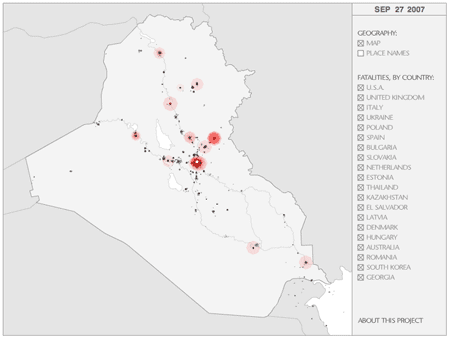
The only figure we can be sure of is that 4300 US and coalition soldiers have died in the war. The graphic below links to flash-based animation that maps these deaths over time (to October 2007). It is a moving experience. Remember, each dot represents one coalition soldier but, for each, up to another 250 people also died.
94 comments on “Five years of hell ”
- Comments are now closed
Links to post
- Comments are now closed
Recent Comments


- Another way to roll
 Hello! Here comes the Saturday edition of More Than A Feilding, catching you up on the past week’s editions.Share ...31 mins ago
 - Simon Clark: The climate lies you'll hear this year
 This video includes conclusions of the creator climate scientist Dr. Simon Clark. It is presented to our readers as an informed perspective. Please see video description for references (if any). This year you will be lied to! Simon Clark helps prebunk some misleading statements you'll hear about climate. The video includes ...5 hours ago
 - Cutting the Public Service
 It is all very well cutting the backrooms of public agencies but it may compromise the frontlines. One of the frustrations of the Productivity Commission’s 2017 review of universities is that while it observed that their non-academic staff were increasing faster than their academic staff, it did not bother to ...13 hours ago
 - Luxon’s demoted ministers might take comfort from the British politician who bounced back after th...
 Buzz from the Beehive Two speeches delivered by Foreign Affairs Minister Winston Peters at Anzac Day ceremonies in Turkey are the only new posts on the government’s official website since the PM announced his Cabinet shake-up. In one of the speeches, Peters stated the obvious: we live in a troubled ...16 hours ago
 - This is how I roll over
 1. Which of these would you not expect to read in The Waikato Invader?a. Luxon is here to do business, don’t you worry about thatb. Mr KPI expects results, and you better believe itc. This decisive man of action is getting me all hot and excitedd. Melissa Lee is how ...17 hours ago
 - The Waitangi Tribunal is not “a roving Commission”…
 …it has a restricted jurisdiction which must not be abused: it is not an inquisition NOTE – this article was published before the High Court ruled that Karen Chhour does not have to appear before the Waitangi Tribunal Gary Judd writes – The High Court ...19 hours ago
 - Is Oranga Tamariki guilty of neglect?Lindsay Mitchell writes – One of reasons Oranga Tamariki exists is to prevent child neglect. But could the organisation itself be guilty of the same? Oranga Tamariki’s statistics show a decrease in the number and age of children in care. “There are less children ...20 hours ago
- Three Strikes saw lower reoffendingDavid Farrar writes: Graeme Edgeler wrote in 2017: In the first five years after three strikes came into effect 5248 offenders received a ‘first strike’ (that is, a “stage-1 conviction” under the three strikes sentencing regime), and 68 offenders received a ‘second strike’. In the five years prior to ...20 hours ago
- Luxon’s ruthless show of strength is perfect for our angry eraBryce Edwards writes – Prime Minister Christopher Luxon has surprised everyone with his ruthlessness in sacking two of his ministers from their crucial portfolios. Removing ministers for poor performance after only five months in the job just doesn’t normally happen in politics. That’s refreshing and will be extremely ...20 hours ago
- 'Lacks attention to detail and is creating double-standards.'
 TL;DR: These are the six things that stood out to me in news and commentary on Aotearoa-NZ’s political economy in the two days to 6:06am on Thursday, April 25:Politics: PM Christopher Luxon has set up a dual standard for ministerial competence by demoting two National Cabinet ministers while leaving also-struggling ...1 day ago
 - One Night Only!Hi,Today I mainly want to share some of your thoughts about the recent piece I wrote about success and failure, and the forces that seemingly guide our lives. But first, a quick bit of housekeeping: I am doing a Webworm popup in Los Angeles on Saturday May 11 at 2pm. ...1 day ago
- What did Melissa Lee do?
 It is hard to see what Melissa Lee might have done to “save” the media. National went into the election with no public media policy and appears not to have developed one subsequently. Lee claimed that she had prepared a policy paper before the election but it had been decided ...1 day ago
 - Skeptical Science New Research for Week #17 2024Open access notables Ice acceleration and rotation in the Greenland Ice Sheet interior in recent decades, Løkkegaard et al., Communications Earth & Environment: In the past two decades, mass loss from the Greenland ice sheet has accelerated, partly due to the speedup of glaciers. However, uncertainty in speed derived from satellite products ...2 days ago
- Maori Party (with “disgust”) draws attention to Chhour’s race after the High Court rules on Wa...Buzz from the Beehive A statement from Children’s Minister Karen Chhour – yet to be posted on the Government’s official website – arrived in Point of Order’s email in-tray last night. It welcomes the High Court ruling on whether the Waitangi Tribunal can demand she appear before it. It does ...2 days ago
- Who’s Going Up The Media Mountain?
 Mr Bombastic: Ironically, the media the academic experts wanted is, in many ways, the media they got. In place of the tyrannical editors of yesteryear, advancing without fear or favour the interests of the ruling class; the New Zealand news media of today boasts a troop of enlightened journalists dedicated to ...2 days ago
 - “That's how I roll”
 It's hard times try to make a livingYou wake up every morning in the unforgivingOut there somewhere in the cityThere's people living lives without mercy or pityI feel good, yeah I'm feeling fineI feel better then I have for the longest timeI think these pills have been good for meI ...2 days ago
 - “Comity” versus the rule of law
 In 1974, the US Supreme Court issued its decision in United States v. Nixon, finding that the President was not a King, but was subject to the law and was required to turn over the evidence of his wrongdoing to the courts. It was a landmark decision for the rule ...2 days ago
 - Aotearoa: a live lab for failed Right-wing socio-economic zombie experiments once more…
 Every day now just seems to bring in more fresh meat for the grinder. In their relentlessly ideological drive to cut back on the “excessive bloat” (as they see it) of the previous Labour-led government, on the mountains of evidence accumulated in such a short period of time do not ...2 days ago
 - Water is at the heart of farmers’ struggle to survive in BeninThis is a re-post from Yale Climate Connections by Megan Valére Sosou Market gardening site of the Itchèléré de Itagui agricultural cooperative in Dassa-Zoumè (Image credit: Megan Valère Sossou) For the residents of Dassa-Zoumè, a city in the West African country of Benin, choosing between drinking water and having enough ...3 days ago
- At a time of media turmoil, Melissa had nothing to proclaim as Minister – and now she has been dem...Buzz from the Beehive
 Melissa Lee – as may be discerned from the screenshot above – has not been demoted for doing something seriously wrong as Minister of ... 3 days ago
 - These people are not our friends
 Morning in London Mother hugs beloved daughter outside the converted shoe factory in which she is living.Afternoon in London Travelling writer takes himself and his wrist down to A&E, just to be sure. Read more ...3 days ago
 - Some advice from our tertiary history for the University Advisory GroupMike Grimshaw writes – The recent announcement of the University Advisory Group, chaired by Sir Peter Gluckman, makes very clear where the Government’s focus and priorities lie. The remit of the Advisory Group is that Group members will consider challenges and opportunities for improvement in the university sector including: ...3 days ago
- Still no prudential regulation case around climate changeEric Crampton writes – The Reserve Bank of New Zealand desperately wants to find reasons to have workstreams in climate change. It makes little sense. They’ve run another stress test on the banks looking to see if they could find a prudential regulation case. They couldn’t. They ...3 days ago
- Bernard’s pick ‘n’ mix of the news links for Wednesday, April 24
 TL;DR: These six news links stood out to me in the last 24 hours or so onWednesday, April 23:Scoop: 'Released in error': Treasury paper hints at axing $6b flood resilience plan by NZ Herald-$$$ Thomas CoughlanScoop: EY launches new misconduct review amid Fonterra ban. Fonterra tells EY to remove some ...3 days ago
 - How National can neutralise serious allegations of corruption should the “Fast Track” Bill becom...Rob MacCullough writes – Pundits from the left and the right are arguing that National’s Fast Track Bill that is designed to speed up infrastructure decisions could end up becoming mired in a cesspool of corruption. Political commentator ...3 days ago
- Cleaning Up After Gabrielle.
 Looking at the headlines this morning it’s hard to feel anything other than pessimistic about the future of humanity.Note that I’m not speaking about the future of mankind, but the survival of our humanity. The values that we believe in seem to be ebbing away, by the day.Perhaps every generation ...3 days ago
 - Gordon Campbell on bird flu, AUKUS entry fees and Cindy LeeSwabbing mixed breed baby chicks to test for avian influenzaUh oh. Bird flu – often deadly to humans – is not only being transmitted from infected birds to dairy cows, but is now travelling between dairy cows. As of last Friday, Bloomberg News reports, there were 32 American dairy herds ...3 days ago
- Tolling Existing Roads
 One of the government’s transport policy and agreements with it’s coalition partners made it clear that they were looking at options like tolling and road pricing. This was reinforced in it’s draft Government Policy Statement released at the start of March which made a couple of references to it. Road pricing, ...3 days ago
 - At a glance – The difference between weather and climateOn February 14, 2023 we announced our Rebuttal Update Project. This included an ask for feedback about the added "At a glance" section in the updated basic rebuttal versions. This weekly blog post series highlights this new section of one of the updated basic rebuttal versions and serves as a ...4 days ago
- More criminal minersWhat is it with the mining industry? Its not enough for them to pillage the earth - they apparently can't even be bothered getting resource consent to do so: The proponent behind a major mine near the Clutha River had already been undertaking activity in the area without a ...4 days ago
- Photos from the road
 Photo # 1 I am a huge fan of Singapore’s approach to housing, as described here two years ago by copying and pasting from The ConversationWhat Singapore has that Australia does not is a public housing developer, the Housing Development Board, which puts new dwellings on public and reclaimed land, ...4 days ago
 - RMA reforms aim to ease stock-grazing rules and reduce farmers’ costs – but Taxpayers’ Union w...Buzz from the Beehive Reactions to news of the government’s readiness to make urgent changes to “the resource management system” through a Bill to amend the Resource Management Act (RMA) suggest a balanced approach is being taken. The Taxpayers’ Union says the proposed changes don’t go far enough. Greenpeace says ...4 days ago
- Luxon Strikes Out.
 I’m starting to wonder if Anna Burns-Francis might be the best political interviewer we’ve got. That might sound unlikely to you, it came as a bit of a surprise to me.Jack Tame can be excellent, but has some pretty average days. I like Rebecca Wright on Newshub, she asks good ...4 days ago
 - In many ways the media that the experts wanted, turned out to be the media they have gotChris Trotter writes – Willie Jackson is said to be planning a “media summit” to discuss “the state of the media and how to protect Fourth Estate Journalism”. Not only does the Editor of The Daily Blog, Martyn Bradbury, think this is a good idea, but he has also ...4 days ago
- The Waitangi Tribunal Summons; or the more things stay the sameGraeme Edgeler writes – This morning [April 21], the Wellington High Court is hearing a judicial review brought by Hon. Karen Chhour, the Minister for Children, against a decision of the Waitangi Tribunal. This is unusual, judicial reviews are much more likely to brought against ministers, rather than ...4 days ago
- Both Parliamentary watchdogs hammer Fast-track billBoth of Parliament’s watchdogs have now ripped into the Government’s Fast-track Approvals Bill. Photo: Lynn Grieveson / The KākāMy pick of the six newsey things to know from Aotearoa’s political economy and beyond on the morning of Tuesday, April 23 are:The Lead: The Auditor General, John Ryan, has joined the ...4 days ago
- India makes a big bet on electric busesThis is a re-post from Yale Climate Connections by Sarah Spengeman People wait to board an electric bus in Pune, India. (Image credit: courtesy of ITDP) Public transportation riders in Pune, India, love the city’s new electric buses so much they will actually skip an older diesel bus that ...4 days ago
- Bernard’s pick ‘n’ mix of the news links at 6:36am on Tuesday, April 23
 TL;DR: These six news links stood out in the last 24 hours to 6:36am on Tuesday, April 22:Scoop & Deep Dive: How Sir Peter Jackson got to have his billion-dollar exit cake and eat Hollywood too NZ Herald-$$$ Matt NippertFast Track Approval Bill: Watchdogs seek substantial curbs on ministers' powers ...4 days ago
 - What is really holding up infrastructureThe infrastructure industry yesterday issued a “hurry up” message to the Government, telling it to get cracking on developing a pipeline of infrastructure projects.The hiatus around the change of Government has seen some major projects cancelled and others delayed, and there is uncertainty about what will happen with the new ...4 days ago
- “Pure Unadulterated Charge”
 Hi,Over the weekend I revisited a podcast I really adore, Dead Eyes. It’s about a guy who got fired from Band of Brothers over two decades ago because Tom Hanks said he had “dead eyes”.If you don’t recall — 2001’s Band of Brothers was part of the emerging trend of ...4 days ago
 - Bernard's six-stack of substacks for Monday, April 22
 Tonight’s six-stack includes: writes via his substack that’s he’s sceptical about the IPSOS poll last week suggesting a slide into authoritarianism here, writing: Kiwis seem to want their cake and eat it too Tal Aster writes for about How Israel turned homeowners into YIMBYs. writes via his ...5 days ago
 - The media were given a little list and hastened to pick out Fast Track prospects – but the Treaty ...Buzz from the Beehive The 180 or so recipients of letters from the Government telling them how to submit infrastructure projects for “fast track” consideration includes some whose project applications previously have been rejected by the courts. News media were quick to feature these in their reports after RMA Reform Minister Chris ...5 days ago
- Just trying to stay upright
 It would not be a desirable way to start your holiday by breaking your back, your head, or your wrist, but on our first hour in Singapore I gave it a try.We were chatting, last week, before we started a meeting of Hazel’s Enviro Trust, about the things that can ...5 days ago
 - “Unprecedented”Today, former Port of Auckland CEO Tony Gibson went on trial on health and safety charges for the death of one of his workers. The Herald calls the trial "unprecedented". Firstly, it's only "unprecedented" because WorkSafe struck a corrupt and unlawful deal to drop charges against Peter Whittall over Pike ...5 days ago
- Bryce Edwards: Time for “Fast-Track Watch”
 Calling all journalists, academics, planners, lawyers, political activists, environmentalists, and other members of the public who believe that the relationships between vested interests and politicians need to be scrutinised. We need to work together to make sure that the new Fast-Track Approvals Bill – currently being pushed through by the ...5 days ago
 - Gordon Campbell on fast track powers, media woes and the Tiktok banFeel worried. Shane Jones and a couple of his Cabinet colleagues are about to be granted the power to override any and all objections to projects like dams, mines, roads etc even if: said projects will harm biodiversity, increase global warming and cause other environmental harms, and even if ...5 days ago
- The Government’s new fast-track invitation to corruption
 Bryce Edwards writes- The ability of the private sector to quickly establish major new projects making use of the urban and natural environment is to be supercharged by the new National-led Government. Yesterday it introduced to Parliament one of its most significant reforms, the Fast Track Approvals Bill. ...5 days ago
 - Maori push for parallel government structuresMichael Bassett writes – If you think there is a move afoot by the radical Maori fringe of New Zealand society to create a parallel system of government to the one that we elect at our triennial elections, you aren’t wrong. Over the last few days we have ...5 days ago
- An announcement about an announcementWithout a corresponding drop in interest rates, it’s doubtful any changes to the CCCFA will unleash a massive rush of home buyers. Photo: Lynn GrievesonTL;DR: The six things that stood out to me in Aotearoa’s political economy around housing, poverty and climate on Monday, April 22 included:The Government making a ...5 days ago
- All the Green Tech in China.
 Sunday was a lazy day. I started watching Jack Tame on Q&A, the interviews are usually good for something to write about. Saying the things that the politicians won’t, but are quite possibly thinking. Things that are true and need to be extracted from between the lines.As you might know ...5 days ago
 - Western Express SuccessIn our Weekly Roundup last week we covered news from Auckland Transport that the WX1 Western Express is going to get an upgrade next year with double decker electric buses. As part of the announcement, AT also said “Since we introduced the WX1 Western Express last November we have seen ...5 days ago
- Bernard’s pick ‘n’ mix of the news links at 7:16am on Monday, April 22
 TL;DR: These six news links stood out in the last 24 hours to 7:16am on Monday, April 22:Labour says Kiwis at greater risk from loan sharks as Govt plans to remove borrowing regulations NZ Herald Jenee TibshraenyHow did the cost of moving two schools blow out to more than $400m?A ...5 days ago
 - The Kaka’s diary for the week to April 29 and beyond
 TL;DR: The six key events to watch in Aotearoa-NZ’s political economy in the week to April 29 include:PM Christopher Luxon is scheduled to hold a post-Cabinet news conference at 4 pm today. Stats NZ releases its statutory report on Census 2023 tomorrow.Finance Minister Nicola Willis delivers a pre-Budget speech at ...5 days ago
 - 2024 SkS Weekly Climate Change & Global Warming News Roundup #16A listing of 29 news and opinion articles we found interesting and shared on social media during the past week: Sun, April 14, 2024 thru Sat, April 20, 2024. Story of the week Our story of the week hinges on these words from the abstract of a fresh academic ...5 days ago
- Bryce Edwards: The Government’s new fast-track invitation to corruptionThe ability of the private sector to quickly establish major new projects making use of the urban and natural environment is to be supercharged by the new National-led Government. Yesterday it introduced to Parliament one of its most significant reforms, the Fast Track Approvals Bill. The Government says this will ...6 days ago
- Thank you
 This is a column to say thank you. So many of have been in touch since Mum died to say so many kind and thoughtful things. You’re wonderful, all of you. You’ve asked how we’re doing, how Dad’s doing. A little more realisation each day, of the irretrievable finality of ...6 days ago
 - Determining the Engine Type in Your Car
 Identifying the engine type in your car is crucial for various reasons, including maintenance, repairs, and performance upgrades. Knowing the specific engine model allows you to access detailed technical information, locate compatible parts, and make informed decisions about modifications. This comprehensive guide will provide you with a step-by-step approach to ...7 days ago
 - How to Become a Race Car Driver: A Comprehensive GuideIntroduction: The allure of racing is undeniable. The thrill of speed, the roar of engines, and the exhilaration of competition all contribute to the allure of this adrenaline-driven sport. For those who yearn to experience the pinnacle of racing, becoming a race car driver is the ultimate dream. However, the ...7 days ago
- How Many Cars Are There in the World in 2023? An Exploration of Global Automotive StatisticsIntroduction Automobiles have become ubiquitous in modern society, serving as a primary mode of transportation and a symbol of economic growth and personal mobility. With countless vehicles traversing roads and highways worldwide, it begs the question: how many cars are there in the world? Determining the precise number is a ...7 days ago
- How Long Does It Take for Car Inspection?Maintaining a safe and reliable vehicle requires regular inspections. Whether it’s a routine maintenance checkup or a safety inspection, knowing how long the process will take can help you plan your day accordingly. This article delves into the factors that influence the duration of a car inspection and provides an ...7 days ago
- Who Makes Mazda Cars?Mazda Motor Corporation, commonly known as Mazda, is a Japanese multinational automaker headquartered in Fuchu, Aki District, Hiroshima Prefecture, Japan. The company was founded in 1920 as the Toyo Cork Kogyo Co., Ltd., and began producing vehicles in 1931. Mazda is primarily known for its production of passenger cars, but ...7 days ago
- How Often to Replace Your Car Battery A Comprehensive GuideYour car battery is an essential component that provides power to start your engine, operate your electrical systems, and store energy. Over time, batteries can weaken and lose their ability to hold a charge, which can lead to starting problems, power failures, and other issues. Replacing your battery before it ...7 days ago
- Can You Register a Car Without a License?In most states, you cannot register a car without a valid driver’s license. However, there are a few exceptions to this rule. Exceptions to the Rule If you are under 18 years old: In some states, you can register a car in your name even if you do not ...7 days ago
- Mazda: A Comprehensive Evaluation of Reliability, Value, and PerformanceMazda, a Japanese automotive manufacturer with a rich history of innovation and engineering excellence, has emerged as a formidable player in the global car market. Known for its reputation of producing high-quality, fuel-efficient, and driver-oriented vehicles, Mazda has consistently garnered praise from industry experts and consumers alike. In this article, ...7 days ago
- What Are Struts on a Car?Struts are an essential part of a car’s suspension system. They are responsible for supporting the weight of the car and damping the oscillations of the springs. Struts are typically made of steel or aluminum and are filled with hydraulic fluid. How Do Struts Work? Struts work by transferring the ...7 days ago
- What Does Car Registration Look Like: A Comprehensive GuideCar registration is a mandatory process that all vehicle owners must complete annually. This process involves registering your car with the Department of Motor Vehicles (DMV) and paying an associated fee. The registration process ensures that your vehicle is properly licensed and insured, and helps law enforcement and other authorities ...7 days ago
- How to Share Computer Audio on ZoomZoom is a video conferencing service that allows you to share your screen, webcam, and audio with other participants. In addition to sharing your own audio, you can also share the audio from your computer with other participants. This can be useful for playing music, sharing presentations with audio, or ...7 days ago
- How Long Does It Take to Build a Computer?Building your own computer can be a rewarding and cost-effective way to get a high-performance machine tailored to your specific needs. However, it also requires careful planning and execution, and one of the most important factors to consider is the time it will take. The exact time it takes to ...7 days ago
- How to Put Your Computer to SleepSleep mode is a power-saving state that allows your computer to quickly resume operation without having to boot up from scratch. This can be useful if you need to step away from your computer for a short period of time but don’t want to shut it down completely. There are ...7 days ago
- What is Computer-Assisted Translation (CAT)?Introduction Computer-Assisted Translation (CAT) has revolutionized the field of translation by harnessing the power of technology to assist human translators in their work. This innovative approach combines specialized software with human expertise to improve the efficiency, accuracy, and consistency of translations. In this comprehensive article, we will delve into the ...7 days ago
- iPad vs. Tablet Computers A Comprehensive Guide to DifferencesIn today’s digital age, mobile devices have become an indispensable part of our daily lives. Among the vast array of portable computing options available, iPads and tablet computers stand out as two prominent contenders. While both offer similar functionalities, there are subtle yet significant differences between these two devices. This ...7 days ago
- How Are Computers Made?A computer is an electronic device that can be programmed to carry out a set of instructions. The basic components of a computer are the processor, memory, storage, input devices, and output devices. The Processor The processor, also known as the central processing unit (CPU), is the brain of the ...7 days ago
- How to Add Voice Memos from iPhone to ComputerVoice Memos is a convenient app on your iPhone that allows you to quickly record and store audio snippets. These recordings can be useful for a variety of purposes, such as taking notes, capturing ideas, or recording interviews. While you can listen to your voice memos on your iPhone, you ...7 days ago
- Why My Laptop Screen Has Lines on It: A Comprehensive GuideLaptop screens are essential for interacting with our devices and accessing information. However, when lines appear on the screen, it can be frustrating and disrupt productivity. Understanding the underlying causes of these lines is crucial for finding effective solutions. Types of Screen Lines Horizontal lines: Also known as scan ...7 days ago
- How to Right-Click on a LaptopRight-clicking is a common and essential computer operation that allows users to access additional options and settings. While most desktop computers have dedicated right-click buttons on their mice, laptops often do not have these buttons due to space limitations. This article will provide a comprehensive guide on how to right-click ...7 days ago


- Gaza: Aotearoa Must Support Independent Investigation into Mass GravesTe Pāti Māori are demanding the New Zealand Government support an international independent investigation into mass graves that have been uncovered at two hospitals on the Gaza strip, following weeks of assault by Israeli troops. Among the 392 bodies that have been recovered, are children and elderly civilians. Many of ...17 hours ago
- Release: Working together on consistent support for veterans this Anzac Day
 Our two-tiered system for veterans’ support is out of step with our closest partners, and all parties in Parliament should work together to fix it, Labour veterans’ affairs spokesperson Greg O’Connor said. ...3 days ago
 - Release: Penny drops – but what about Seymour and Peters?Stripping two Ministers of their portfolios just six months into the job shows Christopher Luxon’s management style is lacking, Labour Leader Chris Hipkins said. ...3 days ago
- Another ‘Stolen Generation’ enabled by court ruling on Waitangi Tribunal summonsTonight’s court decision to overturn the summons of the Children’s Minister has enabled the Crown to continue making decisions about Māori without evidence, says Te Pāti Māori spokesperson for Children, Mariameno Kapa-Kingi. “The judicial system has this evening told the nation that this government can do whatever they want when ...3 days ago
- Release: Budget blunder shows Nicola Willis could cut recovery fundingIt appears Nicola Willis is about to pull the rug out from under the feet of local communities still dealing with the aftermath of last year’s severe weather, and local councils relying on funding to build back from these disasters. ...4 days ago
- Further environmental mismanagement on the cards
 The Government’s resource management reforms will add to the heavy and ever-growing burden this Government is loading on to our environment. ...4 days ago
 - Release: RMA changes will be a disaster for environmentThe Government is making short-sighted changes to the Resource Management Act (RMA) that will take away environmental protection in favour of short-term profits, Labour’s environment spokesperson Rachel Brooking said today. ...4 days ago
- Release: Labour supports urgent changes to emergency management systemLabour welcomes the release of the report into the North Island weather events and looks forward to working with the Government to ensure that New Zealand is as prepared as it can be for the next natural disaster. ...4 days ago
- Release: Labour calls for New Zealand to recognise PalestineThe Labour Party has called for the New Zealand Government to recognise Palestine, as a material step towards progressing the two-State solution needed to achieve a lasting peace in the region. ...5 days ago
- Release: Three strikes law political posturing of worst kindThe Government is bringing back a law that has little evidential backing just to look tough, Labour justice spokesperson Duncan Webb said. ...5 days ago
- Release: Government cuts unbelievably target child exploitation, violent extremism, ports and airpor...Some of our country’s most important work, stopping the sexual exploitation of children and violent extremism could go along with staff on the frontline at ports and airports. ...5 days ago
- Three strikes has failed before and will fail againResurrecting the archaic three-strikes legislation is an unwelcome return to a failed American-style approach to justice. ...5 days ago
- Release: Environmental protection vital, not ‘onerous’The Government’s Fast Track Approvals Bill will give projects such as new coal mines a ‘get out of jail free’ card to wreak havoc on the environment, Labour Leader Chris Hipkins said today. ...5 days ago
- Ferris – Three Strikes targets those ‘too brown to be white’The government's decision to reintroduce Three Strikes is a destructive and ineffective piece of law-making that will only exacerbate an inherently biased and racist criminal justice system, said Te Pāti Māori Justice Spokesperson, Tākuta Ferris, today. During the time Three Strikes was in place in Aotearoa, Māori and Pasifika received ...5 days ago
- Release: Govt cuts doctors and nurses in hiring freezeCuts to frontline hospital staff are not only a broken election promise, it shows the reckless tax cuts have well and truly hit the frontline of the health system, says Labour Health spokesperson Ayesha Verrall. ...1 week ago
- Fast-track submissions period must be extendedThe Green Party has joined the call for public submissions on the fast-track legislation to be extended after the Ombudsman forced the Government to release the list of organisations invited to apply just hours before submissions close. ...1 week ago
- Release: Progress on climate will be undone by GovtNew Zealand’s good work at reducing climate emissions for three years in a row will be undone by the National government’s lack of ambition and scrapping programmes that were making a difference, Labour Party climate spokesperson Megan Woods said today. ...1 week ago
- Release: Dark day for Kiwi kids as a third of Govt cuts affect themNews that 1000 jobs at the Ministry of Education and Oranga Tamariki could go is devastating for future generations of New Zealanders. ...1 week ago
- Release: Alarm as Government signals further blow to school lunchesMore essential jobs could be on the chopping block, this time Ministry of Education staff on the school lunches team are set to find out whether they're in line to lose their jobs. ...1 week ago
- Oranga Tamariki cuts commit tamariki to state abuseTe Pāti Māori is disgusted at the confirmation that hundreds are set to lose their jobs at Oranga Tamariki, and the disestablishment of the Treaty Response Unit. “This act of absolute carelessness and out of touch decision making is committing tamariki to state abuse.” Said Te Pāti Māori Oranga Tamariki ...1 week ago
- Release: Quick, submit – stop Govt’s dodgy approvals billThe Government is trying to bring in a law that will allow Ministers to cut corners and kill off native species, Labour environment spokesperson Rachel Brooking said. ...2 weeks ago
- Government throws coal on the climate crisis fireThe Government’s policy announced today to ease consenting for coal mining will have a lasting impact across generations. ...2 weeks ago
- Release: Public transport costs to double as National looks at unaffordable roading project insteadCancelling urgently needed new Cook Strait ferries and hiking the cost of public transport for many Kiwis so that National can announce the prospect of another tunnel for Wellington is not making good choices, Labour Transport Spokesperson Tangi Utikere said. ...2 weeks ago
- Release: Cost of living in Auckland still not a priorityA laundry list of additional costs for Tāmaki Makarau Auckland shows the Minister for the city is not delivering for the people who live there, says Labour Auckland Issues spokesperson Shanan Halbert. ...2 weeks ago
- Te Pāti Māori to visit Queensland to strengthen ties with Māori in AustraliaTe Pāti Māori co-leader Rawiri Waititi, and Mema Paremata mō Tāmaki-Makaurau, Takutai Tarsh Kemp, will travel to the Gold Coast to strengthen ties with Māori in Australia next week (15-21 April). The visit, in the lead-up to the 9th Australian National Kapa haka Festival, will be an opportunity for both ...2 weeks ago
- Greens look to fast-track submissions on harmful lawThe Green Party has today launched a step-by-step guide to help New Zealanders make their voice heard on the Government’s democracy dodging and anti-environment fast track legislation. ...2 weeks ago
- Release: Govt should stop making people’s lives harder and build more homesThe National Government’s proposed changes to the Residential Tenancies Act will mean tenants can be turfed from their homes by landlords with little notice, Labour housing spokesperson Kieran McAnulty said. ...2 weeks ago
- Release: Melissa Lee missing in action on mediaThe action Melissa Lee promised to protect democracy and the media sector is missing, Media and Communications spokesperson Willie Jackson said. ...2 weeks ago
- Landlord Government leaves little hope for rentersThe Government’s announcement on tenancy rules prove that it does not care about renters. ...2 weeks ago
- Opportunity to build a more sustainable economyGreen Party co-leader Marama Davidson is calling on all parties to support a common-sense change that’s great for the planet and great for consumers after her member’s bill was drawn from the ballot today. ...2 weeks ago
- Significant step forward in fixing cruel and unjust pastA significant milestone has been reached in the fight to strike an anti-Pasifika and unfair law from the country’s books after Teanau Tuiono’s members’ bill passed its first reading. ...2 weeks ago
- Missed opportunity but NZ will surely one day recognise the right to a sustainable environmentNew Zealand has today missed the opportunity to uphold the right to a clean, healthy, and sustainable environment, says James Shaw after his member’s bill was voted down in its first reading. ...2 weeks ago
- Release: Don’t cut our lunches – clear message sent to GovernmentTens of thousands of people are demanding the Government commits to fully funding free and healthy school lunches. ...2 weeks ago
- Release: Govt makes U-turn on Suicide Prevention OfficeLabour welcomes the Government’s U-turn on the closure of the Suicide Prevention Office, says Labour Mental Health spokesperson Ingrid Leary. ...3 weeks ago
- CCC issues warning over further climate delayToday’s advice from the Climate Change Commission paints a sobering reality of the challenge we face in combating climate change, especially in light of recent Government policy announcements. ...3 weeks ago
- Luxon targets lame and lousy example of leadershipIf talk is cheap, Chris Luxon’s “targets” are bankrupt. ...3 weeks ago
- Luxon targets are lousy example of leadershipIf talk is cheap, Chris Luxon’s “targets” are bankrupt. ...3 weeks ago
- Release: Commitment to disability communities missing from Govt prioritiesMinister for Disability Issues Penny Simmonds appears to have delayed a report back to Cabinet on the progress New Zealand is making against international obligations for disabled New Zealanders. ...3 weeks ago
- Diplomacy needed more than ever
 Foreign Minister Winston Peters’ engagements in Türkiye this week underlined the importance of diplomacy to meet growing global challenges. “Returning to the Gallipoli Peninsula to represent New Zealand at Anzac commemorations was a sombre reminder of the critical importance of diplomacy for de-escalating conflicts and easing tensions,” Mr Peters ...1 hour ago
 - Anzac Commemorative Address, Buttes New British Cemetery BelgiumAmbassador Millar, Burgemeester, Vandepitte, Excellencies, military representatives, distinguished guests, ladies and gentlemen – good morning and welcome to this sacred Anzac Day dawn service. It is an honour to be here on behalf of the Government and people of New Zealand at Buttes New British Cemetery, Polygon Wood – a deeply ...17 hours ago
- Anzac Commemorative Address – NZ National Service, Chunuk BairDistinguished guests - It is an honour to return once again to this site which, as the resting place for so many of our war-dead, has become a sacred place for generations of New Zealanders. Our presence here and at the other special spaces of Gallipoli is made ...1 day ago
- Anzac Commemorative Address – Dawn Service, Gallipoli, TürkiyeMai ia tawhiti pamamao, te moana nui a Kiwa, kua tae whakaiti mai matou, ki to koutou papa whenua. No koutou te tapuwae, no matou te tapuwae, kua honoa pumautia. Ko nga toa kua hinga nei, o te Waipounamu, o te Ika a Maui, he okioki tahi me o ...2 days ago
- PM announces changes to portfoliosPaul Goldsmith will take on responsibility for the Media and Communications portfolio, while Louise Upston will pick up the Disability Issues portfolio, Prime Minister Christopher Luxon announced today. “Our Government is relentlessly focused on getting New Zealand back on track. As issues change in prominence, I plan to adjust Ministerial ...3 days ago
- New catch limits for unique fishery areasRecreational catch limits will be reduced in areas of Fiordland and the Chatham Islands to help keep those fisheries healthy and sustainable, Oceans and Fisheries Minister Shane Jones says. The lower recreational daily catch limits for a range of finfish and shellfish species caught in the Fiordland Marine Area and ...3 days ago
- Minister welcomes hydrogen milestoneEnergy Minister Simeon Brown has welcomed an important milestone in New Zealand’s hydrogen future, with the opening of the country’s first network of hydrogen refuelling stations in Wiri. “I want to congratulate the team at Hiringa Energy and its partners K one W one (K1W1), Mitsui & Co New Zealand ...4 days ago
- Urgent changes to system through first RMA Amendment BillThe coalition Government is delivering on its commitment to improve resource management laws and give greater certainty to consent applicants, with a Bill to amend the Resource Management Act (RMA) expected to be introduced to Parliament next month. RMA Reform Minister Chris Bishop has today outlined the first RMA Amendment ...4 days ago
- Overseas decommissioning models consideredOverseas models for regulating the oil and gas sector, including their decommissioning regimes, are being carefully scrutinised as a potential template for New Zealand’s own sector, Resources Minister Shane Jones says. The Coalition Government is focused on rebuilding investor confidence in New Zealand’s energy sector as it looks to strengthen ...4 days ago
- Release of North Island Severe Weather Event InquiryEmergency Management and Recovery Minister Mark Mitchell has today released the Report of the Government Inquiry into the response to the North Island Severe Weather Events. “The report shows that New Zealand’s emergency management system is not fit-for-purpose and there are some significant gaps we need to address,” Mr Mitchell ...4 days ago
- Justice Minister to attend Human Rights CouncilJustice Minister Paul Goldsmith is today travelling to Europe where he’ll update the United Nations Human Rights Council on the Government’s work to restore law and order. “Attending the Universal Periodic Review in Geneva provides us with an opportunity to present New Zealand’s human rights progress, priorities, and challenges, while ...5 days ago
- Patterson reopens world’s largest wool scouring facilityAssociate Agriculture Minister, Mark Patterson, formally reopened the world’s largest wool processing facility today in Awatoto, Napier, following a $50 million rebuild and refurbishment project. “The reopening of this facility will significantly lift the economic opportunities available to New Zealand’s wool sector, which already accounts for 20 per cent of ...5 days ago
- Speech to the Southland Otago Regional Engineering Collective Summit, 18 April 2024Hon Andrew Bayly, Minister for Small Business and Manufacturing At the Southland Otago Regional Engineering Collective (SOREC) Summit, 18 April, Dunedin Ngā mihi nui, Ko Andrew Bayly aho, Ko Whanganui aho Good Afternoon and thank you for inviting me to open your summit today. I am delighted ...5 days ago
- Government to introduce revised Three Strikes lawThe Government is delivering on its commitment to bring back the Three Strikes legislation, Associate Justice Minister Nicole McKee announced today. “Our Government is committed to restoring law and order and enforcing appropriate consequences on criminals. We are making it clear that repeat serious violent or sexual offending is not ...5 days ago
- New diplomatic appointmentsForeign Minister Winston Peters has today announced four new diplomatic appointments for New Zealand’s overseas missions. “Our diplomats have a vital role in maintaining and protecting New Zealand’s interests around the world,” Mr Peters says. “I am pleased to announce the appointment of these senior diplomats from the ...5 days ago
- Humanitarian support for Ethiopia and SomaliaNew Zealand is contributing NZ$7 million to support communities affected by severe food insecurity and other urgent humanitarian needs in Ethiopia and Somalia, Foreign Minister Rt Hon Winston Peters announced today. “Over 21 million people are in need of humanitarian assistance across Ethiopia, with a further 6.9 million people ...5 days ago
- Arts Minister congratulates Mataaho CollectiveMinister for Arts, Culture and Heritage Paul Goldsmith is congratulating Mataaho Collective for winning the Golden Lion for best participant in the main exhibition at the Venice Biennale. "Congratulations to the Mataaho Collective for winning one of the world's most prestigious art prizes at the Venice Biennale. “It is good ...6 days ago
- Supporting better financial outcomes for KiwisThe Government is reforming financial services to improve access to home loans and other lending, and strengthen customer protections, Commerce and Consumer Affairs Minister Andrew Bayly and Housing Minister Chris Bishop announced today. “Our coalition Government is committed to rebuilding the economy and making life simpler by cutting red tape. We are ...6 days ago
- Trade relationship with China remains strong“China remains a strong commercial opportunity for Kiwi exporters as Chinese businesses and consumers continue to value our high-quality safe produce,” Trade and Agriculture Minister Todd McClay says. Mr McClay has returned to New Zealand following visits to Beijing, Harbin and Shanghai where he met ministers, governors and mayors and engaged in trade and agricultural events with the New ...6 days ago
- PM’s South East Asia mission does the businessPrime Minister Christopher Luxon has completed a successful trip to Singapore, Thailand and the Philippines, deepening relationships and capitalising on opportunities. Mr Luxon was accompanied by a business delegation and says the choice of countries represents the priority the New Zealand Government places on South East Asia, and our relationships in ...7 days ago
- $41m to support clean energy in South East AsiaNew Zealand is demonstrating its commitment to reducing global greenhouse emissions, and supporting clean energy transition in South East Asia, through a contribution of NZ$41 million (US$25 million) in climate finance to the Asian Development Bank (ADB)-led Energy Transition Mechanism (ETM). Prime Minister Christopher Luxon and Climate Change Minister Simon Watts announced ...1 week ago
- Minister releases Fast-track stakeholder listThe Government is today releasing a list of organisations who received letters about the Fast-track applications process, says RMA Reform Minister Chris Bishop. “Recently Ministers and agencies have received a series of OIA requests for a list of organisations to whom I wrote with information on applying to have a ...1 week ago
- Judicial appointments announcedAttorney-General Judith Collins today announced the appointment of Wellington Barrister David Jonathan Boldt as a Judge of the High Court, and the Honourable Justice Matthew Palmer as a Judge of the Court of Appeal. Justice Boldt graduated with an LLB from Victoria University of Wellington in 1990, and also holds ...1 week ago
- Education Minister heads to major teaching summit in SingaporeEducation Minister Erica Stanford will lead the New Zealand delegation at the 2024 International Summit on the Teaching Profession (ISTP) held in Singapore. The delegation includes representatives from the Post Primary Teachers’ Association (PPTA) Te Wehengarua and the New Zealand Educational Institute (NZEI) Te Riu Roa. The summit is co-hosted ...1 week ago
- Value of stopbank project proven during cycloneA stopbank upgrade project in Tairawhiti partly funded by the Government has increased flood resilience for around 7000ha of residential and horticultural land so far, Regional Development Minister Shane Jones says. Mr Jones today attended a dawn service in Gisborne to mark the end of the first stage of the ...1 week ago
- Anzac commemorations, Türkiye relationship focus of visitForeign Affairs Minister Winston Peters will represent the Government at Anzac Day commemorations on the Gallipoli Peninsula next week and engage with senior representatives of the Turkish government in Istanbul. “The Gallipoli campaign is a defining event in our history. It will be a privilege to share the occasion ...1 week ago
- Minister to Europe for OECD meeting, Anzac DayScience, Innovation and Technology and Defence Minister Judith Collins will next week attend the OECD Science and Technology Ministerial conference in Paris and Anzac Day commemorations in Belgium. “Science, innovation and technology have a major role to play in rebuilding our economy and achieving better health, environmental and social outcomes ...1 week ago
- Comprehensive Partnership the goal for NZ and the PhilippinesPrime Minister Christopher Luxon held a bilateral meeting today with the President of the Philippines, Ferdinand Marcos Jr. The Prime Minister was accompanied by MP Paulo Garcia, the first Filipino to be elected to a legislature outside the Philippines. During today’s meeting, Prime Minister Luxon and President Marcos Jr discussed opportunities to ...1 week ago
- Government commits $20m to Westport flood protectionThe Government has announced that $20 million in funding will be made available to Westport to fund much needed flood protection around the town. This measure will significantly improve the resilience of the community, says Local Government Minister Simeon Brown. “The Westport community has already been allocated almost $3 million ...1 week ago
- Taupō takes pole positionThe Government is proud to support the first ever Repco Supercars Championship event in Taupō as up to 70,000 motorsport fans attend the Taupō International Motorsport Park this weekend, says Economic Development Minister Melissa Lee. “Anticipation for the ITM Taupō Super400 is huge, with tickets and accommodation selling out weeks ...1 week ago
- Cost of living support for low-income homeownersLocal Government Minister Simeon Brown has announced an increase to the Rates Rebate Scheme, putting money back into the pockets of low-income homeowners. “The coalition Government is committed to bringing down the cost of living for New Zealanders. That includes targeted support for those Kiwis who are doing things tough, such ...1 week ago
- Government backing mussel spat projectThe Coalition Government is investing in a project to boost survival rates of New Zealand mussels and grow the industry, Oceans and Fisheries Minister Shane Jones has announced. “This project seeks to increase the resilience of our mussels and significantly boost the sector’s productivity,” Mr Jones says. “The project - ...1 week ago
- Government focused on getting people into workBenefit figures released today underscore the importance of the Government’s plan to rebuild the economy and have 50,000 fewer people on Jobseeker Support, Social Development and Employment Minister Louise Upston says. “Benefit numbers are still significantly higher than when National was last in government, when there was about 70,000 fewer ...1 week ago
- Clean energy key driver to reducing emissionsThe Government’s commitment to doubling New Zealand’s renewable energy capacity is backed by new data showing that clean energy has helped the country reach its lowest annual gross emissions since 1999, Climate Change Minister Simon Watts says. New Zealand’s latest Greenhouse Gas Inventory (1990-2022) published today, shows gross emissions fell ...1 week ago
- Earthquake-prone buildings review brought forwardThe Government is bringing the earthquake-prone building review forward, with work to start immediately, and extending the deadline for remediations by four years, Building and Construction Minister Chris Penk says. “Our Government is focused on rebuilding the economy. A key part of our plan is to cut red tape that ...1 week ago
- Thailand and NZ to agree to Strategic PartnershipPrime Minister Christopher Luxon and his Thai counterpart, Prime Minister Srettha Thavisin, have today agreed that New Zealand and the Kingdom of Thailand will upgrade the bilateral relationship to a Strategic Partnership by 2026. “New Zealand and Thailand have a lot to offer each other. We have a strong mutual desire to build ...1 week ago
- Government consults on extending coastal permits for portsRMA Reform Minister Chris Bishop and Transport Minister Simeon Brown have today announced the Coalition Government’s intention to extend port coastal permits for a further 20 years, providing port operators with certainty to continue their operations. “The introduction of the Resource Management Act in 1991 required ports to obtain coastal ...1 week ago
- Inflation coming down, but more work to doToday’s announcement that inflation is down to 4 per cent is encouraging news for Kiwis, but there is more work to be done - underlining the importance of the Government’s plan to get the economy back on track, acting Finance Minister Chris Bishop says. “Inflation is now at 4 per ...1 week ago
- School attendance restored as a priority in health adviceRefreshed health guidance released today will help parents and schools make informed decisions about whether their child needs to be in school, addressing one of the key issues affecting school attendance, says Associate Education Minister David Seymour. In recent years, consistently across all school terms, short-term illness or medical reasons ...1 week ago
- Unnecessary bureaucracy cut in oceans sectorOceans and Fisheries Minister Shane Jones is streamlining high-level oceans management while maintaining a focus on supporting the sector’s role in the export-led recovery of the economy. “I am working to realise the untapped potential of our fishing and aquaculture sector. To achieve that we need to be smarter with ...1 week ago
- Behind the counter: Wellington shopkeepers
 A new exhibition in Wellington showcases the faces behind your local goods and services. Back in 1977, when I was a fine arts student at the University of Canterbury, I took a series of photographs of Christchurch shopkeepers. The photos were for a calendar – a project for my end ...32 mins ago
 - Iranian Solidarity Group New Zealand Condemns Toomaj Salehi's Death Sentence And The New Aggres...
 Toomaj and his resistance to tyranny through his songs have become an icon for the youth of Iran, so his sentence has hit the nation hard. Toomaj Salehi is not the first artist to pay the price for standing with the people. ...1 hour ago
 - Short story: Calf Creek, by Anna Scaife
 My cousin Dylan and I spotted these big eels under the bridge that summer. We watched them lounging under the dark weed, facing into the flow of water, their mouths frozen open. Dylan and I couldn’t stop thinking about those eels. The night we went down to the creek, we ...2 hours ago
 - Newsroom welcomes the Secret DiaryNewsroom, home of satire. My long-running weekly satirical series The Secret Diary has moved to Newsroom and will appear every Saturday, with Victor Billot’s wildly popular satirical Odes continuing to appear every Sunday. Diaries, Odes – while serious political columnists toil at meaningful opinions and stroke their chins to an ...2 hours ago
- I saw ‘The Sign’, and it opened up my eyes: All the fuss around Bluey, explainedTara Ward unravels the many nuanced layers of a cartoon about talking dogs. This is an excerpt from our weekly pop culture newsletter Rec Room. Sign up here. It’s not often an episode of a children’s cartoon has adults sobbing into their sleeves, but that’s exactly what happened this week when ...2 hours ago
- Jessica Tater has ambition without bordersWorking as a doctor in developing countries to help communities achieve better health outcomes is nothing short of a life goal for Jessica Tater. The University of Otago medical student has her sights firmly set on joining the international humanitarian organisation Doctors Without Borders/Médecins Sans Frontières (MSF) when she qualifies ...3 hours ago
- The island where people’s stories are paramountThere’s an island in the far reaches of Auckland’s territory, sitting off the tip of the Coromandel Peninsula, 30 minutes by air from the city or four hours on the slow boat. Aotea Great Barrier is off-grid, it has a population of fewer than a thousand people … and most ...3 hours ago
- Australian author leads silence protest over ‘blood debt’ owed to Papuans
 Asia Pacific Report An Australian author and advocate, Jim Aubrey, today led a national symbolic one minute’s silence to mark the “blood debt” owed to Papuan allies during the Second World War indigenous resistance against the invading Japanese forces. “A promise to most people is a promise,” Aubrey said in ...3 hours ago
 - Israel delays Gaza Freedom Flotilla departure with bureaucratic ‘block’Asia Pacific Report The Freedom Flotilla is ready to sail to Gaza, reports Kia Ora Gaza. All the required paperwork has been submitted to the port authority, and the cargo has been loaded and prepared for the humanitarian trip to the besieged enclave. However, organisers received word of an “administrative ...4 hours ago
- Have New Zealanders really been ‘misled’ about AUKUS, or is involvement now a foregone conclusio...ANALYSIS: By Marco de Jong, Auckland University of Technology and Robert G. Patman, University of Otago When former prime minister Helen Clark spoke out against New Zealand potentially compromising its independent foreign policy by joining pillar two of the AUKUS security pact, Foreign Minister Winston Peters responded bluntly: On ...8 hours ago
- Palestine protesters challenge TVNZ over Israeli ambassador’s ‘propaganda’Pacific Media Watch Palestine solidarity protesters today demonstrated at the Auckland headquarters of Television New Zealand, accusing the country’s major TV network of broadcasting “propaganda” backing Israel’s genocidal war on Gaza. About 50 protesters targeted the main entrance to the TVNZ building near Sky Tower and also picketed a side ...9 hours ago
- Lynley Hood Opinion – Senator Fulbright must be spinning in his grave11 hours ago
- Fast-track bill could affect NZ's reputation – Transparency International
 The ministers responsible for green-lighting major projects need to be open about potential conflicts of interest, says Transparency International. ...12 hours ago
 - We’re all feeling the collective grief and trauma of violence against women – but this is the pr...Source: The Conversation (Au and NZ) – By Anastasia Powell, Professor, Family and Sexual Violence, RMIT University It has been a particularly distressing start to the year. There is little that can ease the current grief of individuals, families and communities who have needlessly lost a loved one to men’s ...13 hours ago
- Species living closely together in symbiosis is far older and way more common than you might thinkSource: The Conversation (Au and NZ) – By Gregory Moore, Senior Research Associate, School of Ecosystem and Forest Sciences, The University of Melbourne Lichen, the first described example of symbiosis. AdeJ Artventure/Shutterstock Once known only to those studying biology, the word symbiosis is now widely used. Symbiosis is the intimate ...13 hours ago
- What is childhood dementia? And how could new research help?Source: The Conversation (Au and NZ) – By Kim Hemsley, Head, Childhood Dementia Research Group, Flinders Health and Medical Research Institute, College of Medicine and Public Health, Flinders University Olena Ivanova/Shutterstock “Childhood” and “dementia” are two words we wish we didn’t have to use together. But sadly, around 1,400 ...14 hours ago
- Jobseekers get about $345 less than pensioners each fortnight. This gap is hurting, and is set to wi...Source: The Conversation (Au and NZ) – By Peter Whiteford, Professor, Crawford School of Public Policy, Australian National University The government’s Economic Inclusion Advisory Committee has just published its second report. It was set up by Treasurer Jim Chalmers and Minister for Social Services Amanda Rishworth in 2022 to provide: ...14 hours ago
- Does fighting inflation always lead to recession? What NZ data tellsHere is what 60 years of New Zealand data shows us. ...15 hours ago
- The government's 20 trips abroad in AprilThe government appears committed to overseas visits with 14 ministers and MPs in 18 countries this month. ...15 hours ago
- Government unveils fetal alcohol guidelines, plan for diagnosis trainingThe government is promising to step up the response to Fetal Alcohol Spectrum Disorder, promising to boost diagnoses and raise awareness. ...16 hours ago
- Labor facing heavy defeat in Queensland, but faring better in federal pollsSource: The Conversation (Au and NZ) – By Adrian Beaumont, Election Analyst (Psephologist) at The Conversation; and Honorary Associate, School of Mathematics and Statistics, The University of Melbourne The Queensland state election will be held in October. A YouGov poll for The Courier Mail, conducted April 9–17 from a sample ...16 hours ago
- Why the potential for another Donald Trump presidency is making Iran very nervousSource: The Conversation (Au and NZ) – By Amin Naeni, PhD candidate at Alfred Deakin Institute for Citizenship and Globalisation, Deakin University There’s been much talk in recent months about what a possible second Donald Trump presidency in the United States could mean for Europe, Russia’s war in Ukraine, the ...16 hours ago
- ‘The worst piece of law proposed since 1979’: Reactions to the Fast-track Approvals BillA brief round-up of submissions on the controversial proposed law. This is an excerpt from our weekly environmental newsletter Future Proof. Sign up here. Last week, submissions on the controversial Fast-track Approvals Bill closed just hours after the government released a list of stakeholder organisations who were sent letters advising how they could ...17 hours ago
- The Friday Poem: ‘Cereal giving’ by Robin PeaceA poem from Robin Peace’s new collection Detritus of Empire: feather / grass / rock. Cereal giving I see a woman’s hands, see her curious hands break a stalk as she walks through the tall prairie, the savannah, the steppe, wherever it was. See her idly bite the grass that ...18 hours ago
- The Unity Books bestseller chart for the week ending April 26The only published and available best-selling indie book chart in New Zealand is the top 10 sales list recorded every week at Unity Books’ stores in High St, Auckland, and Willis St, Wellington. AUCKLAND 1 Hemingway’s Goblet by Dermot Ross (Mary Egan Publishing, $38) A handsomely produced (debossed cover, lovely ...18 hours ago
- Te Rūnanga O Ngāti Whātua Welcomes Commissioner's Decision Regarding Awataha MaraeThe Commissioner's decision validates the longstanding efforts of the local community and ensures that Awataha Marae will be managed to serve the needs of the local community, particularly for hosting tangihanga. ...19 hours ago
- We reconstructed landscapes that greeted the first humans in Australia around 65,000 years agoSource: The Conversation (Au and NZ) – By Tristan Salles, Associate professor, University of Sydney Examples of Australian landscapes. Unsplash Seventy thousand years ago, the sea level was much lower than today. Australia, along with New Guinea and Tasmania, formed a connected landmass known as Sahul. Around this time – ...19 hours ago
- What do we lose when our old suburbs disappear?Source: The Conversation (Au and NZ) – By Felicity Castagna, Lecturer, Creative Writing, Western Sydney University Day Day Market, Parramatta Photo: Garry Trinh I live on the edge of Parramatta, Australia’s fastest-growing city, on the kind of old-fashioned suburban street that has 1950s fibros constructed in the post-war housing boom, ...19 hours ago
- Does fighting inflation always lead to recession? What 60 years of NZ data can tell usSource: The Conversation (Au and NZ) – By Michael Ryan, Teaching Fellow in Economics, University of Waikato GettyImages fatido/Getty Images There is an ongoing global debate over whether the high inflation seen in the aftermath of the COVID-19 pandemic can be lowered without a recession. New Zealand is not ...19 hours ago
- After spending $700,000 on pins for Covid-19 workers, department now cutting costsA government office that set aside millions for lapel pins for pandemic workers is now looking to cut back on spending. ...19 hours ago
- ‘A hell of a lot of fun’: Our reviews of Chris Isaak’s dazzling Auckland showThe ‘Wicked Game’ heartthrob is in his late 60s now. That didn’t stop him putting on a lively, goofy and very sparkly show. Apart from ‘Wicked Game’, which graces a sultry playlist of mine simply called 💋, my last sustained Chris Isaak listening session took place when I was about ...20 hours ago
- The Week in Politics: Days of drama and demotionsAnalysis - Two ministers were stripped of portfolios in a warning to Cabinet, drama broke out at the Waitangi Tribunal, and the gang patch ban bill ran into opposition. ...20 hours ago
- Hear me out: All I want is a TrueBliss T-shirtTara Ward makes an impassioned plea for some vital pop culture merch. In April 1999, I became obsessed with a new reality television show called Popstars. Every Tuesday night, five strangers transformed into music royalty before my very eyes as Joe, Keri, Carly, Erika and Megan were chosen to form ...21 hours ago
- Solemn ANZAC dawn service at PNG’s Isurava battle memorialPNG Post-Courier In the early hours of ANZAC Day, aerial photographs captured an impressive gathering of Australians and Papua New Guineans at Isurava in the Northern (Oro) Province. The solemn dawn service yesterday was held at a site steeped in history, where some of the fiercest battles of World War ...21 hours ago
- Political editors panel: A reshuffle and the fast trackListen - RNZ's Jo Moir and NZ Herald's Claire Trevett dissect the demotion of two ministers and the PM's response on Morning Report. ...22 hours ago
- After-hours clinics on verge of collapse in some regionsOverworked GPs have signalled they can no longer cover, while funding is falling short. ...22 hours ago
- Oranga Tamariki Axes Specialist Māori Roles, Weakens Commitment To Te Ao MāoriThe PSA is shocked that Oranga Tamariki has used the cost cutting drive to downgrade its commitment to Te Ao Māori and remove many specialist Māori roles. ...22 hours ago
- China’s money only goes so far – Kokoda shows why history binds PNG and Australia in a far deepe...Source: The Conversation (Au and NZ) – By Ian Kemish, Adjunct Professor, School of Historical and Philosophical Inquiry, The University of Queensland There can be no more powerful symbol of the relationship between Australia and Papua New Guinea than the prime ministers of these neighbouring countries walking together on the ...22 hours ago
- We spoke to young people about sexual consent. They understand the concept, but don’t always ask i...Source: The Conversation (Au and NZ) – By Andrea Waling, ARC DECRA Senior Research Fellow in Sex & Sexuality, La Trobe University BAZA Production/Shutterstock Sexual consent has been a major focus in Australia for the past few years. In early 2022 the federal government mandated consent education in ...22 hours ago
- Longer-lasting ozone holes over Antarctica expose seal pups and penguin chicks to much more UVSource: The Conversation (Au and NZ) – By Sharon Robinson, Distinguished Professor and Deputy Director of ARC Securing Antarctica’s Environmental Future (SAEF), University of Wollongong, University of Wollongong Andrew Netherwood Over the last 25 years, the ozone hole which forming over Antarctica each spring has started to shrink. ...22 hours ago
- Granting legal ‘personhood’ to nature is a growing movement – can it stem biodiversity loss?Source: The Conversation (Au and NZ) – By Viktoria Kahui, Senior Lecturer in Environmental Economics, University of Otago Getty Images/Amy Toensing Biodiversity is declining at rates unprecedented in human history. This suggests the ways we currently use to manage our natural environment are failing. One emerging concept focuses on ...22 hours ago
- Will checking character references really help you find the best candidate for a job?Source: The Conversation (Au and NZ) – By Timothy Colin Bednall, Associate Professor in Management, Swinburne University of Technology marvent/Shutterstock Finding the best person to fill a position can be tough, from drafting a job ad to producing a shortlist of top interview candidates. Employers typically consider information from ...22 hours ago
- A guide to Wellington’s best BYO restaurantsWondering where to host your next BYO? Whether its a small gathering or a massive party, we’ve got some recommendations. I was first introduced to the concept of BYOs at Dunedin’s India Gardens, a legendary but sadly defunct establishment, which purveyed enormous quantities of mango chicken to Aotearoa’s drunkest future ...23 hours ago
- New rock art discoveries in Eastern Sudan tell a tale of ancient cattle, the ‘green Sahara’ and ...Source: The Conversation (Au and NZ) – By Julien Cooper, Honorary Lecturer, Department of History and Archaeology, Macquarie University Julien Cooper The hyper-arid desert of Eastern Sudan, the Atbai Desert, seems like an unlikely place to find evidence of ancient cattle herders. But in this dry environment, my new ...23 hours ago
- Paul Goldsmith starts as new Media Minister replacing sacked Melissa LeeThe media industry is "under pressure", Paul Goldsmith says, but he plans to plot a path forward as he takes up the difficult role. ...24 hours ago
- Media industry sheds few tears for minister LeeThe sector says it’s hopeful her replacement Paul Goldsmith will be able to throw it a lifeline, after six months with a minister deemed missing in action, writes Catherine McGregor in this excerpt from The Bulletin, The Spinoff’s morning news round-up. To receive The Bulletin in full each weekday, sign ...1 day ago
- Is NZ bringing in 'Indonesian coal every month to keep the lights on'?Analysis: The Resource Minister said it, but is it true and why does it matter? ...1 day ago
- More spending cuts needed to stablise government finances – economistThe government can't just rely on axing public sector jobs and has to do more to cut spending, says the chief economist at a free market think tank. ...1 day ago
- The government's 22 trips abroad in AprilThe government appears committed to overseas visits with 14 miniters and MPs in 18 countries this month. ...1 day ago
- Loopholes will be exploited in new vape rules – expertsThere is no doubt vape manufacturers will find and exploit loopholes in new regulations, say marketing experts. ...1 day ago
- Aotearoa Party Merges With Rock The Vote NZ Party And John Alcock Elected As Party LeaderRock The Vote NZ, known for its advocacy for minor party unity and its role within the Freedoms NZ Coalition during the 2023 General Election, celebrates this merger as a strategic enhancement of its operational strength and outreach. ...1 day ago
- After spending $2m on pins for Covid-19 workers, department now cutting costsGovernment department that spent $2m on lapel pins to honour Covid-19 workers is now looking to make cuts. ...1 day ago
- An afternoon at the Repair Café, where everyday objects get a second lifeNearly everyone has experienced the frustration of something you use breaking and being difficult or expensive to fix. Proposed legislation could change that. It’s been raining on and off all Sunday afternoon but people are lining up outside a building in a corner of Gribblehirst Park in Sandringham, Auckland. In ...1 day ago
- Dreaming of my not-wedding dayWhat does a forever relationship look like when you don’t believe in marriage? And how do you celebrate it? This essay is part of our Sunday Essay series, made possible thanks to the support of Creative New Zealand. I’m going to do it, right now. I’m going to say ...1 day ago
- On the fringes of the Gallipoli battlefieldYou can’t have missed the Gallipoli story as the movies, documentaries, essays and books capture what it was like for New Zealand troops in their eight-month campaign on the Peninsula. But this Anzac Day the Auckland War Memorial Museum has published a book that sheds light on a little-known aspect of the ...1 day ago
- Govt repeats mistakes of Muldoon’s authoritarian excessesOpinion: It needs wiser leadership to learn from the past to have a balanced planning and resource management law The post Govt repeats mistakes of Muldoon’s authoritarian excesses appeared first on Newsroom. ...1 day ago
- Debt clifftop guardrail and ambulance removed at same timeIt will be soon be easier to get lending, but harder to get help for debt The post Debt clifftop guardrail and ambulance removed at same time appeared first on Newsroom. ...1 day ago
- Just Life exit from NZX puts listed company regulation under microscopeJust Life’s chief executive says the exchange’s regulatory burden outweighs any benefits to small business The post Just Life exit from NZX puts listed company regulation under microscope appeared first on Newsroom. ...1 day ago
- Prime Minister jumps the gun in ThailandThe Prime Minister has committed to resuming direct flights to Thailand. But it’s not a promise he will be able to deliver on anytime soon. The post Prime Minister jumps the gun in Thailand appeared first on Newsroom. ...1 day ago
- Daily crossword, Friday 26 AprilThe post Daily crossword, Friday 26 April appeared first on Newsroom. ...1 day ago
- The outlook for engineering specialists looks bleakOpinion: Delays getting to the starting line of new programmes of work are causing significant disruption across the sector The post The outlook for engineering specialists looks bleak appeared first on Newsroom. ...1 day ago
- Eliza wants more than a last tango in ParisIt’s not that long ago Eliza McCartney was seriously wondering if the Paris Olympics would be her pole vaulting swansong. After years of being hounded by injury after injury, the Rio Olympics bronze medallist was still confident she would compete at her second Olympics in Paris in July, unless something ...1 day ago
- This week’s bestselling books – April 26FICTION 1 Take Two by Danielle Hawkins (Allen & Unwin, $36.99) There’s commercial fiction, like this book, and then there’s quality fiction, quality writers, quality literature; the forthcoming Auckland Writers Festival is full of quality, and ReadingRoom has two tickets to give away to the following events: Paul Lynch (Dublin ...1 day ago
- Newsroom daily quiz, Friday 26 AprilLoading…(function(i,s,o,g,r,a,m){var ql=document.querySelectorAll('A[quiz],DIV[quiz],A[data-quiz],DIV[data-quiz]'); if(ql){if(ql.length){for(var k=0;k<ql.length;k++){ql[k].id='quiz-embed-'+k;ql[k].href="javascript:var i=document.getElementById('quiz-embed-"+k+"');try{qz.startQuiz(i)}catch(e){i.start=1;i.style.cursor='wait';i.style.opacity='0.5'};void(0);"}}};i['QP']=r;i[r]=i[r]||function(){(i[r].q=i[r].q||[]).push(arguments)},i[r].l=1*new Date();a=s.createElement(o),m=s.getElementsByTagName(o)[0];a.async=1;a.src=g;m.parentNode.insertBefore(a,m)})(window,document,'script','https://take.quiz-maker.com/3012/CDN/quiz-embed-v1.js','qp'); Got a good quiz question? Send Newsroom your questions. The post Newsroom daily quiz, Friday 26 April appeared first on Newsroom. ...1 day ago
- Grattan on Friday: Social media companies can’t be immune from the need for a social licenceSource: The Conversation (Au and NZ) – By Michelle Grattan, Professorial Fellow, University of Canberra In the free-for-all between the Australian government and Big Tech boss Elon Musk this week, the government had to be on a winner. Most people would have little sympathy with Musk’s vociferous opposition to ...1 day ago
- Nelson Mandela’s grandson joins Gaza flotilla, slams ‘genocide complicit’ leadersAsia Pacific Report Chief Mandla Mandela, a member of the National Assembly of South Africa and Nelson Mandela’s grandson, has joined the Freedom Flotilla in istanbul as the ships prepare to sail for Gaza, reports Kia Ora Gaza. Mandela is also the ambassador for the Global Campaign to Return to ...2 days ago
- 200 journalists ‘targeted’ over their environment reporting, warns RSFPacific Media Watch Journalists who report on environmental issues are encountering growing difficulties in many parts of the world, reports Reporters Without Borders. According to the tally kept by RSF, 200 journalists have been subjected to threats and physical violence, including murder, in the past 10 years because they were ...2 days ago
- Bryce Edwards Analysis – Luxon’s ruthless show of strength is perfect for our angry eraAnalysis by Dr Bryce Edwards, Democracy Project (https://democracyproject.nz) Political scientist, Dr Bryce Edwards. Prime Minister Christopher Luxon has surprised everyone with his ruthlessness in sacking two of his ministers from their crucial portfolios. Removing ministers for poor performance after only five months in the job just doesn’t normally happen in ...2 days ago
- David Seymour: Auckland Grammar School ANZAC Day AddressThis speech was delivered to Auckland Grammar students, family, Old Boys, and staff on ANZAC Day 2024 by David Seymour ’97, MP for Epsom. ...2 days ago
- David Seymour: Auckland Grammar School ANZAC Day AddressThis speech was delivered to Auckland Grammar students, family, Old Boys, and staff on ANZAC Day 2024 by David Seymour ’97, MP for Epsom. ...2 days ago
- Inflation is slowly falling while student debt is climbing: 6 graphs that explain the CPISource: The Conversation (Au and NZ) – By John Hawkins, Senior Lecturer, Canberra School of Politics, Economics and Society, University of Canberra BagzhanSadvakassov/Upsplash, CC BY-SA Australia’s inflation rate has fallen for the fifth successive quarter, and it’s now less than half of what it was back in late 2022. ...2 days ago
- Response To ANZAC Day ProtestsACT's Rural Communities and Veterans spokesman Mark Cameron responds to cancellations and protests of ANZAC Day commemorations in Wellington. He says, "These pitiful attempts to detract from ANZAC Day are not at all indicative of the feelings of mainstream ...2 days ago
- Claimants want Children's Minister to front up kanohi ki te kanohi (face to face)Waitangi Tribunal claimants will appeal a High Court decision to overturn a summons order from the Tribunal for Children's Minister Karen Chhour. ...2 days ago
- ‘It bucked our lads up wonderfully’: the lightning-quick battle that marked the birth of the US-...Source: The Conversation (Au and NZ) – By Meighen McCrae, Associate Professor of Strategic & Defence Studies, Australian National University American and Australian stretcher bearers working together near the front line during the Battle of Hamel in 1918. Australian War Memorial While the AUKUS alliance is new, the Australian-American partnership ...2 days ago
- GCSB refuses to release details of spy deal 'to protect interests'The spy agency is refusing to release a copy of its deal with a foreign agency to run a secret operation out of this country. ...2 days ago


ggrrrrrrr. Was a good until you mentioned Mrs Key.
Please leave spouses out of politics.
cheers
Andy
double ggggrrrrr. wrong thread.
oops sorry!
Yeah, Iraq would be a much better place today if the allies hadn’t invaded. Those bastard Yanks should’ve minded their own goddamn business and left Saddam and his bros to mind theirs. I mean, what’s a little rape, torture, murder and genocide between mates?
Jameson – So that’s what you’ve been drinking!
Just to show you that stereotyping ‘righties’ is not a good idea, the ‘war’ in Iraq is a bloody disgrace and totally unjustified.
There we go.
Captchsa Mrs Wartsila. Heh.
Yeah, Iraq would be a much better place today if the allies hadn’t invaded. Those bastard Yanks should’ve minded their own goddamn business and left Saddam and his bros to mind theirs. I mean, what’s a little rape, torture, murder and genocide between mates?
Do you have any idea at all what you’re talking about Jameson? Yes Saddam was a vicious little dictator that the world could have done without. But Iraq is substantially worse off since the Americans invaded for the oil. Since then:
– Over 1 million Iraqis killed
– 20% of the population displaced homeless or refugees
– most civilian infrastructure destroyed
– religious civil war started
– oil resources annexed by foreigners
– country poisoned for 100 years by depleted uranium
You can find any number of reports from Iraqis stating that life was much better under Saddam.
Jameson – let’s not forget that American supported and/or chose not to interfere with Saddam’s rule in Iraq for a long time, partly due to the fact that his “leadership” kept any conflict between the different ethnic and religous factions within Iraq shut down. He promoted stability” in the region which made it easier to get oil out. When America invaded, inadequate attention was given to how to manage potential sectarian conflict, and even Colin Powell at the time of the invasion was advising against getting into a ground war that would never be finished. He viewed Iraq as another Vietnam. History has proven him right.
There were SO many other ways the human rights issues in Iraq could have been addressed – but that wasn’t the core issue for America. No country has a sovereign right to invade another country to support dubious political and economic interests of its own.
Your depleted uranium comment is total bullshit. Please do some research.
Btw, I can barely read the captcha, you guys should really work on that for people with fucked eyes.
Jameson, you need to update your apologetics. Torture is ok now. Other than that, doubleplusgood duckspeak
infused: Your depleted uranium comment is total bullshit. Please do some research
You need to take your own advice infused.
http://www.truthout.org/cgi-bin/artman/exec/view.cgi/37/11023
http://www.truthout.org/docs_2006/021907G.shtml
http://www.informationclearinghouse.info/article12903.htm
http://www.globalresearch.ca/articles/FLO308B.html
http://www.newint.org/issue316/poisoned.htm (re DU in Gulf War 1)
And so on
http://www.informationclearinghouse.info/article4406.htm#FAHEY
and so on, and so on…
if your captcha is too hard too read reload it with the spin symbol. i’m a little dyslexic so i often reload
The allies had good reason and by the U.N.’s own rules, justifiable cause to invade Iraq and remove Saddam Hussein:
1) Saddam Hussein was actively on the hunt for WMD materials, and was deliberately ambiguous about whether or not he had WMDs. Given his record, the allies had no reason to assume he DIDN’T have them.
2) The weapons they DID find were chemical in nature – tonnes of Sarin and VX, with warheads that could carry them, that could have wiped out entire cities. You only have to ask the Kurds if he had the will to use them.
3) To those who hold stock in the authority of the U.N. I ask, after a decade of broken U.N. resolutions how many more should they have tolerated before THEY sanctioned an invasion? Saddam repeatedly broke international law, invaded a member-state, performed hideous atrocities on his own people, and committed genocide every act a legal justification for invasion and yet the U.N. did nothing more than send in inspectors to be lied to, intimidated and insulted.
4) It is beyond doubt now that Saddam DID harbour, finance and assist jihadist terrorists linked to Bin Laden in the Sudan, Afghanistan and through Western Asia. [1] After 9/11 Iraq was the only Middle-Eastern country that applauded the attacks, and when Saudi Arabia and Pakistan were expelling al-Qaeda sympathisers, they started welcoming them in most notably al-Zarqawi. Abu Abbas was traveling on a diplomatic passport issued by Iraq when he committed his acts of terrorism. Yassin, the man who’d mixed the chemicals to blow up the World Trade Centers the first time around ended up where? Baghdad. And then there’s Abu Nidal, the world’s most notorious terrorist of the time, who for years lived openly under the auspices of Saddam Hussein.
If you want to give this ex-totalitarian the benefit of the doubt, go right ahead. It neatly exposes your anti-American, pro-dictatorship sympathies.
[1] http://www.weeklystandard.com/Content/Public/Articles/000/000/011/945usqnx.asp
Keep up with events, Vic, this is NOT another Vietnam. The surge IS working and even the anti-war evangelist Obama has admitted as much. In a poll released last week, the number of Iraqis who’ve have stated they are now better off than before is on the rise, sitting on 45% and as concrete proof their people are returning home by the bushel. More than a quarter of the top al-Qaeda heads have been lopped off and soldiers can now walk the streets of Baghdad without Kevlar vests. The list of good news is long, but not a peep of it here.
War is ugly. The collateral damage in any war is appalling and as far as I can tell, the only ones who are truly concerned about this are our guys. You know how many billions have been spent by the allies developing weapons that DON’T kill civilians? A cursory glance at the “Futureweapons’ show on the doco channel will give you some idea.
The allies had EVERY right to invade, as I’ve stated, as a matter of pre-emptive self-defence. To call this a war for oil is not only ignorant, it’s downright dangerous. To overlook the Islamofascist’s call to arms is to bury your head in the sand of a primitive and envious people determined, as they repeatedly state, to bring down Western Civilization.
The only reason why Vietnam failed was because the politicians hamstrung the military. No war was ever won with a limited objective, and until the surge that’s exactly what the poor soldiers were battling against in Iraq. And while we’re on the subject of limitations, how many reports have you heard back from the front about the enemy’s rules of engagement? It’s quite the opposite: they deliberately use their own people as human shields.
And yet the only criticism here is levelled at the Americans you people disgust me.
1) Saddam Hussein was actively on the hunt for WMD materials,
Proof please? Are you referring to the “aluminium tubes”? The Nigerian “yellowcake”? Because both of those are wrong.
Given his record, the allies had no reason to assume he DIDN’T have them.
They had perfectly good reason to assume he had no WMD, based on the reports of the 100 UN inspectors team that had been searching Iraq for four months:
http://www.informationclearinghouse.info/article5878.htm
See also http://www.informationclearinghouse.info/article8839.htm
These reports were ignored, the decision go to war was made, and (according to records from the UK government) “the intelligence and facts were being fixed around the policy” http://www.informationclearinghouse.info/article9387.htm
2) The weapons they DID find were chemical in nature – tonnes of Sarin and VX, with warheads that could carry them, that could have wiped out entire cities. You only have to ask the Kurds if he had the will to use them.
As far as I am aware, only a few (less than 10?) old, non functional warheads were found. Sources please for your claim “tonnes of Sarin and VX, with warheads that could carry them, that could have wiped out entire cities.”
Hmmm – must go for now – more later perhaps…
1) (note the dates supersede the articles you’ve posted)
From the right:
THE TRUTH ABOUT THE IRAQI-NIGER “YELLOWCAKE” NEXUS.
By Christopher Hitchens – July 25, 2006
http://www.slate.com/id/2146475/
From the left:
The Washington Post – April 9, 2006
“In fact, his report supported the conclusion that Iraq had sought uranium.”
http://www.washingtonpost.com/wp-dyn/content/article/2006/04/08/AR2006040800895.html
2)
Iraq Documents Destruction of VX and Anthrax – 14-Mar-03
CNN reports, “Iraq on Friday will give the United Nations details about its claims to have destroyed 3.9 tons of VX nerve agent, diplomatic sources said. Iraq is still putting the final touches on the report that is to explain how it disposed of at least 2,245 gallons (8,500 liters) of anthrax.’
UNITED NATIONS, Oct 27: Possible degradation or decomposed product of a nerve gas found on Iraqi missile warheads by American, French and Swiss laboratories could have come from deadly VX or Sarin, United Nations weapons inspectors have reported.
http://www.indianexpress.com/res/web/pIe/ie/daily/19981028/30150404.html
Report: Hundreds of WMDs Found in Iraq – June 22, 2006
“Since 2003, coalition forces have recovered approximately 500 weapons munitions which contain degraded mustard or sarin nerve agent. Despite many efforts to locate and destroy Iraq’s pre-Gulf War chemical munitions, filled and unfilled pre-Gulf War chemical munitions are assessed to still exist.”
http://www.foxnews.com/story/0,2933,200499,00.html
Iraq’s Chemical Weapon Program
http://www.iraqwatch.org/profiles/chemical.html
Iraqi chemical weapon attacks
Haij Umran Mustard August 1983 fewer than 100 Iranian/Kurdish
Panjwin Mustard October-November 1983 3,001 Iranian/Kurdish
Majnoon Island Mustard February-March 1984 2,500 Iranians
al-Basrah Tabun March 1984 50-100 Iranians
Hawizah Marsh Mustard & Tabun March 1985 3,000 Iranians
al-Faw Mustard & Tabun February 1986 8,000 to 10,000 Iranians
Um ar-Rasas Mustard December 1986 1,000s Iranians
al-Basrah Mustard & Tabun April 1987 5,000 Iranians
Sumar/Mehran Mustard & nerve agent October 1987 3,000 Iranians
Halabjah Mustard & nerve agent March 1988 7,000s Kurdish/Iranian
al-Faw Mustard & nerve agent April 1988 1,000s Iranians
Fish Lake Mustard & nerve agent May 1988 100s or 1,000s Iranians
Majnoon Islands Mustard & nerve agent June 1988 100s or 1,000s Iranians
South-central border Mustard & nerve agent July 1988 100s or 1,000s Iranians
Karbala area Nerve agent & CS March 1991 Shi’a casualties not known
————————————-
Looking forward to the ‘refutation’ of points 3 & 4.
Rob:
“They had perfectly good reason to assume he had no WMD, based on the reports of the 100 UN inspectors team that had been searching Iraq for four months”
I agree with you 100 per cent.
But how about invading Kuwait, then? And how about the disgusting way women were/are treated in Iraq?
Would you care to accept either of those things from a government in NZ? If not, why not?
Iraq Survey Group Final Report
http://www.globalsecurity.org/wmd/library/report/2004/isg-final-report/isg-final-report_vol2_nuclear-03.htm
A few moments google-monkeying produced this interesting thread about Hitchen’s articles:
http://fray.slate.com/discuss/forums/thread/862933.aspx
Or are you going to quote one of these experts next?
http://www.huffingtonpost.com/tom-tomorrow/what-they-said_b_46907.html
Jameson, your first claim:
1) Saddam Hussein was actively on the hunt for WMD materials
Your support for this claim:
THE TRUTH ABOUT THE IRAQI-NIGER “YELLOWCAKE’ NEXUS.
By Christopher Hitchens – July 25, 2006
The context for all this is is Bush’s statement in his January 2003 State of the Union address that “the British government has learned that Saddam Hussein recently sought significant quantities of uranium from Africa”. As the WMD case in Iraq unravelled and this statement came under scrutiny, it became apparent that this claim could not be justified. In December 2003, then CIA director George Tenet conceded that the inclusion of the claim in the State of the Union address was a mistake.
The same conclusion was reached by a bipartisan review:
http://www.truthout.org/docs_03/093003F.shtml
Fast forward to 2006, Hitchens and Leeden (well known neocons) have both written excited little articles about new information that suggests that, purely by accident and unknown to Team Bush at the time, they may have been correct. The actual substance comes from the UK “Butler Review” published in 2004, which referred to a 1999 visit of Iraqi officials to Niger: “The British government had intelligence from several different sources indicating that this visit was for the purpose of acquiring uranium. Since uranium constitutes almost three-quarters of Niger’s exports, the intelligence was credible.’
So there we have it. Although Team Bush was lying at the time (ooops making claims that they couldn’t substantiate), information has emerged since (about one incident, not a systematic “actively on the hunt”) which gives them a partial “out”. And let’s not forget the main conclusions of the Butler Review: that key intelligence used to justify the war with Iraq has been shown to be unreliable. Overall it said that “more weight was placed on the intelligence than it could bear”, and that judgements had stretched available intelligence “to the outer limits”.
Now, your second claim:
2) The weapons they DID find were chemical in nature – tonnes of Sarin and VX, with warheads that could carry them, that could have wiped out entire cities. You only have to ask the Kurds if he had the will to use them.
The historical context is that at one time Iraq did have some chemical warfare agents, and did use them (1982 – 1991, you provided a list). After Gulf War 1 a lot of this stuff was destroyed by UN inspectors, and by the time of further UN inspections in 2003 Iraq claimed that all such munitions had been destroyed.
Now, I asked you for sources supporting your claim that they (Americans?) found post invasion: “tonnes of Sarin and VX, with warheads that could carry them”. Your evidence:
“Iraq on Friday will give the United Nations details about its claims to have destroyed 3.9 tons of VX nerve agent, diplomatic sources said. Iraq is still putting the final touches on the report that is to explain how it disposed of at least 2,245 gallons (8,500 liters) of anthrax.
Yes, Iraq disposed of this stuff long before the invasion.
Possible degradation or decomposed product of a nerve gas found on Iraqi missile warheads by American, French and Swiss laboratories could have come from deadly VX or Sarin
Or from detergent, the report found. But once again, tiny remnants of old degraded stuff, consistent with Iraq’s claims to have destroyed munitions.
Next evidence:
Report: Hundreds of WMDs Found in Iraq – June 22, 2006
“Since 2003, coalition forces have recovered approximately 500 weapons munitions which contain degraded mustard or sarin nerve agent. Despite many efforts to locate and destroy Iraq’s pre-Gulf War chemical munitions, filled and unfilled pre-Gulf War chemical munitions are assessed to still exist.’
War apologists (like Fox news) are desperate to find some WMDs in Iraq – something, anything to justify the invasion and the grandiose WMD claims that preceded it. Re this particular claim:
http://www.informationclearinghouse.info/article14396.htm
No significant WMDs have ever been found in Iraq, even according to the American’s own military inquiries – see the history described here: http://en.wikipedia.org/wiki/Iraq_Survey_Group
So Jameson, re your claim “The weapons they DID find were chemical in nature – tonnes of Sarin and VX, with warheads that could carry them” – evidence please? Or, I suggest, admit that you were wrong.
Looking forward to the ‘refutation’ of points 3 & 4.
All in due course, let’s finish with point 2 shall we?
Dean – sorry, I can’t make sense of your questions.
Rob:
“Dean – sorry, I can’t make sense of your questions.”
What a surprise.
Thanks for the Wiki link, rOb — very informative:
INTERIM PROGRESS REPORT
Interim Progress Report on October 3, 2003. The team has found evidence of “WMD-related program activities”
DAVID KAY RESIGNS
On January 23, 2004, the head of the ISG, David Kay, resigned his position, stating that he believed WMD stockpiles would not be found in Iraq
Kay told the SASC during his oral report the following, though: “Based on the intelligence that existed, I think it was reasonable to reach the conclusion that Iraq posed an imminent threat. Now that you know reality on the ground as opposed to what you estimated before, you may reach a different conclusion-—although I must say I actually think what we learned during the inspection made Iraq a more dangerous place, potentially, than, in fact, we thought it was even before the war.”
Kay also believed some components of the former Iraqi regime’s WMD program had been moved to Syria shortly before the 2003 invasion.
DUELFER REPORT
On September 30, 2004, the ISG released the Duelfer Report, its final report on Iraq’s WMD programs. Among its Key Findings:
Saddam wanted to recreate Iraq’s WMD capability, after sanctions were removed and Iraq’s economy stabilized. Saddam aspired to develop a nuclear capability—in an incremental fashion, irrespective of international pressure and the resulting economic risks—but he intended to focus on ballistic missile and tactical chemical warfare (CW) capabilities.
In March 2005 Duelfer added an addenda to the original report
acknowledging that “ISG was unable to rule out the possibility that WMD was evacuated to Syria before the war.”
Duelfer also concluded that Saddam planned to resume production of weapons of mass destruction once the United Nations lifted economic sanctions.
.
Kay: “I must say I actually think what we learned during the inspection made Iraq a more dangerous place, potentially, than, in fact, we thought it was even before the war.”
Hands up who think we dodged a bullet oh, that’s right you guys prefer to sit on them.
More from the inspectors:
SADDAM’S WMD HAVE BEEN FOUND
New evidence unveils chemical, biological, nuclear, ballistic arms
When former weapons inspector Kay reported to Congress in January that the United States had found “no stockpiles” of forbidden weapons in Iraq, his conclusions made front-page news. But when he detailed what the ISG had found in testimony before the House Permanent Select Committee on Intelligence last October, few took notice.
The Iraq Survey Group, ISG, whose intelligence analysts are managed by Charles Duelfer, a former State Department official and deputy chief of the U.N.-led arms-inspection teams, has found “hundreds of cases of activities that were prohibited” under U.N. Security Council resolutions, a senior administration official tells Insight.
“There is a long list of charges made by the U.S. that have been confirmed, but none of this seems to mean anything because the weapons that were unaccounted for by the United Nations remain unaccounted for.” — [ that includes the 3.9 tons of VX that Saddam admitted he had, rOb, which amounts to one large garage in an area the size of California ]
Both Duelfer and his predecessor, David Kay, reported to Congress that the evidence they had found on the ground in Iraq showed Saddam’s regime was in “material violation” of U.N. Security Council Resolution 1441, the last of 17 resolutions that promised “serious consequences” if Iraq did not make a complete disclosure of its weapons programs and dismantle them in a verifiable manner.
Both Duelfer and Kay found Iraq had “a clandestine network of laboratories and safe houses with equipment that was suitable to continuing its prohibited chemical- and biological-weapons [BW] programs,” the official said. “They found a prison laboratory where we suspect they tested biological weapons on human subjects.”
They found equipment for “uranium-enrichment centrifuges” whose only plausible use was as part of a clandestine nuclear-weapons program. In all these cases, “Iraqi scientists had been told before the war not to declare their activities to the U.N. inspectors,” the official said.
The full article will make your toes curl
http://www.worldnetdaily.com/news/article.asp?ARTICLE_ID=38213
Jameson, I appreciate that you’re doing the best you can with very little material. Stockpiles long destroyed, a few old artillery shells, drums of fertiliser and so on. Neocon supporters are desperately trying to make the best case they can for the fictional Iraq WMDs:
http://www.nytimes.com/2006/06/23/us/23believers.html
But not even Bush believes it:
http://www.washingtonpost.com/wp-dyn/articles/A44268-2004Jul12.html
(or http://news.bbc.co.uk/2/hi/americas/3888587.stm )
Not even Dick Cheney believes it:
http://www.msnbc.msn.com/id/14767199/
And Jameson, despite making the best of whatever scraps you can find, you are nowhere close to substantiating your original claim: The weapons they DID find were chemical in nature – tonnes of Sarin and VX, with warheads that could carry them, that could have wiped out entire cities. You only have to ask the Kurds if he had the will to use them.
Where are the tonnes of chemicals and the warheads that could carry them Jameson? Or were you, perhaps, mistaken? There’s no shame in admitting a mistake Jameson.
I have to bow to r0b’s homework here. Yet for all the details, hair-splitting and disinterring of old information that we can indulge in… one thing is obvious. Saddam Hussein’s military was NOT bristling with WMD’s ready and able for use.
Put yourselves in Iraqi military boots for one moment. Your nation is clearly under threat. Your job is to defend your country. It would your duty to investigate whatever means that MAY be available to you to fulfill your role. Therefore I would expect the Iraqi’s to have been investigating or at the least experimenting with whatever WMD technologies that they might be able to exploit given the intense scrutiny they were under.
But the fact is that the UN Inspections regime was most the very most part working. When the US led “coalition of the coerced” invaded was the time when these weapons, if they existed, should have been used. And once we had taken control of the country, despite extensive searches, almost no evidence that such weapons existed was found.
Of course it is not hard to devise an argument that the Iraqi’s would have had an intent to possess such weapons, but intent is not the same as possession, which in turn is not the same as using them.
(Nor is a history of using them much of an argument, otherwise why else do we tolerate the USA possessing nuclear weapons?)
The whole justification for the invasion of Iraq was based on the idea that the Iraq military was armed to the teeth with WMD’s, ready to use. This was a lie. It was known to be a lie by those who made the decision, it was known to be a lie to the media who acted as cheerleaders, and known to be a lie to millions who have not the guts to be honest with themselves and admit that the West lied it’s way into an illegal, immoral and fatally flawed invasion of a sovereign nation. Not to mention the several trillion dollars spent on it that might have been spent more productively. Oh and did I mention all the dead people?
But who gives a flying pigs ass about my moral posturing. The war has been a raging success. Iraq has been dismantled as a potential military threat to Israel, and the US military machine (and it’s attendant suppliers) is set to encamped there for decades into the future regardless of who occupies the White House. The US political machine is addicted to war and death. The fix is in…and what the hell are us rubes gonna be able to do about it anyhow?
I concede that my statement that they’d ‘found’ VX and Sarin is inaccurate. I should have written that they have found plenty of evidence of its existence. Saddam himself admitted that he had tonnes of the stuff, which to this day remains unaccounted for.
So let’s move beyond your one and only point shall we
What is not in doubt is that he was actively pursuing them.
According to the EVIDENCE YOU HAVE PRESENTED it’s not the neo-cons who are suggesting this, it was the head of the U.N. weapons inspection team, David Kay, who said, “Based on the intelligence that existed, I think it was reasonable to reach the conclusion that Iraq posed an imminent threat.’
Furthermore his successor, inspector Duelfer, concluded that “Saddam planned to resume production of weapons of mass destruction once the United Nations lifted economic sanctions.’
According to the EVIDENCE YOU HAVE PRESENTED, the chief inspector at the time and please read this carefully — “LEARNED DURING THE INSPECTION MADE IRAQ A MORE DANGEROUS PLACE, POTENTIALLY, THAN, IN FACT, WE THOUGHT IT WAS EVEN BEFORE THE WAR.’
That you have sidestepped every one of these key findings by your blessed U.N. inspectors suggests you’re the one with a thinnest of arguments.
If you want to maintain that Saddam filled his warheads with washing detergent, go right ahead.
Care to whitewash points 3 & 4 now, in your relentless pursuit to give Saddam Hussein the benefit of the doubt?
According to the EVIDENCE YOU HAVE PRESENTED, the chief inspector at the time and please read this carefully — “The team has found evidence of “WMD-related program activities” but no actual chemical, biological or nuclear weapons.”
Or how about:
“David Kay, resigned his position, stating that he believed WMD stockpiles would not be found in Iraq. “I don’t think they existed,” commented Kay. “What everyone was talking about is stockpiles produced after the end of the last Gulf War and I don’t think there was a large-scale production program in the nineties.” In a briefing to the Senate Armed Services Committee, Kay criticized the pre-war WMD intelligence and the agencies that produced it, saying “It turns out that we were all wrong, probably in my judgment, and that is most disturbing.””
So how are we to reconcile that with Kays’ later statement that you quote?
You can quibble over interpret various reports all you like… but the lack of any actual weapons…. weapons that we were assured before the war actually existed, were actually ready for immediate deployment… the complete lack of any evidence that they ever existed renders your argument null and void.
We didn’t go to war in Iraq because maybe one day Hussein might have WMD’s. We were unequivocally told that he HAD THEM and WAS READY TO USE THEM. Spot the difference?
Red: “But the fact is that the UN Inspections regime was most the very most part working.”
Which part exactly? The part where they found “hundreds of cases of activities that were prohibited” under U.N. Security Council resolutions — including the “material violation” of U.N. Security Council Resolution 1441, the last of 17 resolutions that promised “serious consequences” – and did NOTHING?
Red: “Therefore I would expect the Iraqi’s to have been investigating or at the least experimenting with whatever WMD technologies that they might be able to exploit…”
That’s precisely what he was doing. They found torture chambers where Saddam’s henchmen tested nerve agents on the innocent victims you lot would prefer to have left in the hands of your beloved dictator.
Red: “… the West lied it’s way into an illegal, immoral and fatally flawed invasion of a sovereign nation.”
a) According to the U.N. chief inspector “it was reasonable to reach the conclusion that Iraq posed an imminent threat.’
b) The resolutions broken by Saddam made the invasion legal under U.N. rules — except the toothless tiger’s “serious consequences” amounted to spanking Saddam with the wet bus ticket.
c) You think it was immoral to stop a genocidal maniac in his tracks?
Honestly, Red, your Saddam-fellating bullshit is making my stomach churn.
Red: “(Nor is a history of using them much of an argument, otherwise why else do we tolerate the USA possessing nuclear weapons?)”
This demands clarification:
Do you believe the US dropping the bomb on the Japs and Saddam dropping nerve gas on the Kurds is morally equivalent?
I’m not going to be drawn into parsing “moral equivalences” about who did what in which war. All war is hell, and ‘fair’ really doesn’t enter into it.
Besides if I recall right it was Winston Churchill who first dabbled in using poison gases in the Middle East:
http://www.globalresearch.ca/articles/CHU407A.html
You won’t be drawn into moral equivalences, but now you’re suggesting Churchill, Truman and Saddam are all as bad as one another?
What’s your point, Red?
And while you’re pondering that, perhaps you’d like to address the facts presented by the U.N. inspectors that you’ve neatly frog-leapt.
The UN inspectors presented facts alright. Like a complete absence of any actual usable weapons. Their reported opinions on what all this meant were inconsistent and contradictory.
My point is that yes Churchill, Truman and Hussein are all as bad as each other, inasmuch as war is an especial darkness of the human heart. There is no ‘good war’.
This is what war is. You take your family, all those you dearly love, and then while you are bound helpless, you are forced to watch each one tortured, raped and then slowly burned to death by the most debased, “stomach churning” means devisable. After that they burn down your house and home to cover up the evidence. And bayonet the family dog on the way out for fun. And you do it over and over until millions upon millions have been snuffed out.
Did I really have to spell that out?
i heard they did find a lot of oil and reconstruction contracts when the americans “liberated” iraq. funny thing is, there must be lots more where that came from, i just can’t understand why they aren’t so gung-ho about “liberating” china and north korea.
I concede that my statement that they’d ‘found’ VX and Sarin is inaccurate.
Bravo Jameson. Don’t worry, you’re in excellent company, lots of people have been wrong about Iraq having WMDs…
Simply stated, there is no doubt that Saddam Hussein now has weapons of mass destruction. Dick Cheney August 26, 2002
Wrong.
Intelligence gathered by this and other governments leaves no doubt that the Iraq regime continues to possess and conceal some of the most lethal weapons ever devised. George Bush March 18, 2003
Wrong.
Well, there is no question that we have evidence and information that Iraq has weapons of mass destruction, biological and chemical particularly… Ari Fleisher March 21, 2003
Wrong.
They can produce enough dry biological agent in a single month to kill thousands upon thousands of people. … Our conservative estimate is that Iraq today has a stockpile of between 100 and 500 tons of chemical-weapons agent. … My colleagues, every statement I make today is backed up by sources, solid sources. These are not assertions. What we’re giving you are facts and conclusions based on solid intelligence. Colin Powell, Presentation to the UN Security Council, February 2003
Wrong. Wrong. Wrong.
We’ve also discovered through intelligence that Iraq has a growing fleet of manned and unmanned aerial vehicles that could be used to disperse chemical or biological weapons across broad areas. Bush, October 2002
Wrong.
The Iraqi regime possesses biological and chemical weapons, is rebuilding the facilities to make more and, according to the British government, could launch a biological or chemical attack in as little as 45 minutes after the order is given. Bush, September 2002
Wrong.
This is not just an academic exercise or the United States being in a
fit of pique. We’re talking about real weapons. We’re talking about
anthrax. We’re talking about botulinum toxin. Colin Powell, February 2003
Wrong.
There is no doubt that the regime of Saddam Hussein possesses weapons of mass destruction. As this operation continues, those weapons will be identified, found, along with the people who have produced them and who guard them. Gen. Tommy Franks March 22, 2003
Wrong.
The regime is seeking a nuclear bomb, and with fissile material, could build one within a year. Bush, September 2002
Wrong.
… we know he has been absolutely devoted to trying to acquire nuclear weapons. And we believe he has, in fact, reconstituted nuclear weapons. Cheney, March 2003
Wrong.
And so on.
Interestingly enough Jameson, your argument is like a miniature version of the Bush government’s argument. When it becomes obvious that there were no WMDs, the fallback position is that there were “weapons programmes” and “capabilities” and intentions to acquire or build. Perhaps all those things are true (on a small, disorganised scale), but they are not the reason that team Bush gave for invading Iraq. The reasons given (as above) were about real WMDs, not imaginary ones.
So let’s move beyond your one and only point shall we
My one and only point? Well that remains to be seen. But for now, it’s a fairly important point, wouldn’t you agree? Leaving aside value judgements, leaving aside the question of whether it was deliberate deception or genuine mistake, I put to you the following:
The most significant reasons presented for America’s invasion of Iraq, namely that Iraq had and could deploy WMDs, were incorrect.
Do you agree Jameson?
J:
Short answer is yes. Both were dropped on civilians where there were no significant military targets. Both killed large numbers of civilians as terror weapons to quell an military opposition. Morally it is the equivalent of rounding up nearby civilians and shooting them for being responsible for the decisions of their leaders (or local resistance group). Similarly the bombing of Coventry, Dresden, and mass bombing of other cities where there were no significant military targets.
If you think differently, then perhaps you could explain your logic?
There was no significant evidence of WMD’s found in Iraq after the 2nd Gulf War. There is no doubt that Saddam would have probably built them if he’d had the capability, and he was trying to run the bluff that he had them. However, the evidence from both before the war, and afterwards, was that the blockade and embargo was very effective. First time that had really happened since the first world war.
In effect the coalition of the willing (and stupid) violated the primary UN principle of not invading a country from where there was no clear and immediate danger. The plans for the war showed that they were aware of that as they didn’t allocate sufficient forces to defeat what Saddam had in 1990, just enough for the forces in 2002.
The big screwup during the war was by that idiot Defense Secretary who over-rode his military and tried to run a cheap war. He didn’t send in sufficient occupying forces to at least make sure that his commander in chief’s screwup didn’t wind up as a morass.
Militarily the ‘surge’ is an admission of defeat. Effectively it signals that they have been unable to get the Iraqi military and security forces up to a point that they could quell the sectarian violence. The US etc had to pull in more troops.
The same problem occurred during Vietnam, with the same ‘surges’ and same internal security failures. The question is how does the US get troops out of Iraq?
BTW: from my ex-military viewpoint, you sound like one of those armchair warriors who are fond of getting other people killed. Believing in whatever theory happens to fit your blinders. Interesting you mention Churchill – I always associate him with Gallipoli as First Sea Lord – he had the same problem.
This is what war is. You take your family, all those you dearly love, and then while you are bound helpless, you are forced to watch each one tortured, raped and then slowly burned to death by the most debased, “stomach churning’ means devisable. After that they burn down your house and home to cover up the evidence. And bayonet the family dog on the way out for fun. And you do it over and over until millions upon millions have been snuffed out.
Did I really have to spell that out
You’d hope not Red, but I’m glad you did.
War is, literally, the worst thing that can happen, save destruction, to a society. It demands that people act barbarically. It destroys lives, futures and economies. It destroys the psyche of a huge number of it’s survivors, with rippling effects that last generations. We all know this, and it is why we lie to ourselves about it, and highlight the sacrafice and bravery, none of which would be necessary without the horror.
Sometimes it is necessary. For all it’s costs, sometimes, the alternative is destruction.
This war, in Iraq, was predicated on the lie that Saddam was a threat so severe that war was the only option. The lie needed to be told because if the American people knew the true state of Iraq’s WMD abilities, they would not have supported a war.
That is why they lied. That is why they did everything they could to discredit the inspection process. That is why they ran a second intelligence analysis out of the VP’s and the undersecretary of defence’s offices. That is why the analysis out of those politically appointed offices was more frightening and less robust than the initial stories from the CIA and State dept. The existence of those reports and their leakage to journalists such as Judith Millar of the NYT, put political pressure on State and CIA to come up with something acceptable to the White house.
All of this is documented in many places. And the point of it all was that the White House did not believe that the American people, even after the trauma of 911, would support the invasion of Iraq if they were told the truth.
A government that lies to it’s people in order to get them to support what they otherwise would not support; when that thing is the very worst thing save destruction that can happen to them; is not fit to govern.
Bush’s govt is not the first to do this and it won’t be the last no doubt. But that doesn’t change the facts.
PB:
And that I agree with. For instance Afghanistan is a classic case in point. It was literally a failed state after the Russians withdrew. Now that isn’t a particular reason for putting troops in. Ultimately that is a problem for the citizens of the society to build a stable political structure, and for the outside world to provide whatever assistance it can.
However the state was being used for launching attacks outside it’s borders. It was becoming a danger for societies everywhere. That is why the UN sanctioned its invasion (and why our troops are there). But at least that was planned from the start as requiring troops to be there for a considerable period, probably at least a decade. It wasn’t envisaged as being a ‘quick-fix’ like the Iraq.
Militarily the ‘surge’ is an admission of defeat.
Good point. It’s also failing on it’s own terms as set out when they started. The strategic purpose was to use the increased troops to stem the bloodflow enough to create political space for ‘reconciliation’. How they intended the second part to work is unknown of course but in any case the idea was that the Government would end up being closer to having a monopoly on the use of force.
Instead everyone is just entrenching their positions, which makes sense since everyone knows the surge can’t last for ever.
And Look!! You know those awakening council good-guys-now,
even-though-they-were-insurgents and still-hate-the-Iraqi-govt?
They gettin pissed off about something.
http://www.guardian.co.uk/world/2008/mar/21/iraq.alqaida
Bush’s govt is not the first to do this and it won’t be the last no doubt.
I’d rather hope it will be.
Thanks guys for the support. I admit my sense of passion about this makes it hard to express myself clearly. Pascal’s bookie makes a solid point that is worth underlining.
If the UN had reached a solid and unequivocal determination that Iraq should have been invaded, then I believe we would have been obliged by duty to participate.
The invention of WMD’s has forever changed the nature of war. Up until the end of WW2 the notion of the “justifiable war” still possessed some scraps of respectability. But since then almost all no significant war has achieved a constructive end, no matter how we attempted to justify it. The simple fact is that warfare, as conducted by the sovereign nation state, has become more or less obsolete as a political tool.
War has become the ultimate failure. It is now so unthinkably barbaric that is is truly the very last resort when all other options have irrefutably failed. Idealist I may be, but I do understand and accept the role of the military as this last resort.
But only in the context of the moral and legal imprimatur that a global body such as the UN can bestow upon such a grave step.
Thank you for spelling that out for me, Red. It’s not often that someone would so candidly and succinctly demonstrate their inability to distinguish between right and wrong.
Your description was not of ‘war’, but of the barbaric acts that necessitate war.
Fighting the good fight, or fighting the good war, does not mean participating in a ‘fun’ war; it means fighting a moral war. Fighting tyranny is a moral fight.
Hitler was a tyrant. Mussolini was a tyrant. Hirohito was a tyrant. They were guilty of those sorts of atrocities you so vividly described.
Conversely, Churchill was a good guy, Roosevelt was a good guy and Truman was a good guy. They were the heroic defenders of the free world,
Correspondingly, the Islamofascists are tyrants, Hussein was a tyrant, and the good guys are those who are heroically defending the free world against those who have pledged its enslavement and/or its annihilation, and going after those who support them.
But the real enemy is the appeaser. Chamberlain cost the lives of millions because he did not act in 1938 to snuff out (in the words of the U.N. Chief Inspector) “an imminent threat.’
There is, however, an even lower rung on the ladder to oblivion, reserved for the ugliest of characters: the passive bystander who watches on as a tyrant rapes, tortures and slowly burn to death the innocent; the limp-dick that is rendered immobile by his inability to determine the difference between good and evil, and right and wrong.
rOb… you just can’t help yourself can you. I concede the point and you “nah nah nah-nah nah” all over it. When you’re ready to move on…
But first I’d like to remind you that my concession does not mean there weren’t any WMD. The U.N. Inspectors have concluded that: a) there was plenty of evidence they had WMD; b)they can’t rule out that WMD weren’t moved into Syria; and c) they still haven’t accounted for the tons of VX Hussein admitted he had.
As far as I’m concerned the top U.N. Inspector vindicated Bush. According to David Kay it was potentially WORSE than the president thought:
“Based on the intelligence that existed, I think it was reasonable to reach the conclusion that Iraq posed an imminent threat. Now that you know reality on the ground as opposed to what you estimated before, you may reach a different conclusion-—although I must say I actually think what we learned during the inspection made Iraq a more dangerous place, potentially, than, in fact, we thought it was even before the war.’
I think that’s the third time I’ve transcribed this statement. Maybe one of you of you would like to comment. You can’t have it both ways: either the inspectors’ reports count or they don’t; you don’t get to cherry pick the convenient evidence like Mini-Me Michael Moores.
“Militarily the ‘surge’ is an admission of defeat.’
Good point?? Could someone please explain how this any sort of admission…
rOb you just can’t help yourself can you. I concede the point and you “nah nah nah-nah nah’ all over it. When you’re ready to move on
You misunderstand Jameson. I’m not “nah nah nah” at you. I’m pointing out that Team Bush made the same mistake. They said that there were WMDs when there weren’t. The point was to pose a question. The answer to the question is important before we can “move on”.
To repeat the question: Leaving aside value judgements, leaving aside the question of whether it was deliberate deception or genuine mistake, I put to you the following:
The most significant reasons presented for America’s invasion of Iraq, namely that Iraq had and could deploy WMDs, were incorrect.
Do you agree Jameson?
(Goodnight, it’s well past my bedtime. You’re an owl Jameson, are you in the NZ time zone?)
Oh all right, since you’re so fond of that quote, an attempted deconstruction:
Based on the intelligence that existed, I think it was reasonable to reach the conclusion that Iraq posed an imminent threat.
Before the war we thought there was an imminent threat.
Now that you know reality on the ground as opposed to what you estimated before, you may reach a different conclusion
Now that you (the committee) know how weak the actual situation was, you might reasonably conclude otherwise (no imminent threat).
although I must say I actually think what we learned during the inspection made Iraq a more dangerous place, potentially, than, in fact, we thought it was even before the war.
But I’ve got to throw my political masters a bone here – hell – “potentially” anything goes, right?
Really goodnight this time. The Vast Left Wing Conspiracy doesn’t pay me enough overtime for this…
Oh dear, not the tired old “appeaser” bogeyman again.
Actually it’s only a polite form of a much uglier and more primitive logic that goes along the lines, “Lets get them before they get us!”. It’s the kind of thing you are supposed to grow out of before you leave primary school.
Your fond reference to the “good wars” all date to a time before the invention of the nuclear bomb. Bu do you still imagine that it is possible to fight a “good war” with nuclear weapons and have anything that looks like a “good outcome”? Your comparisons are obsolete and irrelevant to our present situation. It’s akin to the teenaged boy thinking he can drive his 220kw boy racer Mitsi, like he did his skateboard. It’s just not the same thing anymore. The consequences of a fuckup are wholly more catastrophic.
Humanity has passed the point where this immature thing we have played at through out history called war, can be tolerated any longer. What is permitted to a child, may be forbidden to an adult.
So here is the answer to your “appeaser” accusation. When an adult commits a criminal act, we have a police and justice system that acts on our collective behalf to arrest and punish the wrong-doer according to a set of agreed upon laws. Inherent in our notions of justice is the idea of proportionate response. (ie we don’t execute people for parking meter offenses.)
Even more fundamental is the idea that we do not do convict someone for thinking about a crime, even if they have committed something similar in the past. If we have actual evidence of their intentions, plans and means to commit a crime, then we may act forestall that crime and charge them with something lessor like conspiracy,… but we cannot do not convict for murder until after there is a dead body. (It would be so much easier if somehow we could pre-emptively act to stop all crime before it happened, but then presumably you would be unhappy about the totalitarian police state you lived in.)
Therefore by direct parallel, when a nation, led by a tyrant, rises up an commits acts of aggression against others, then all the other nations must collectively consult, and formally act according to a system of law to deter, prevent and punish the aggressor. If in the last resort this means unleashing the hell of war, then so be it. This is how grown up civilisation works.
When Saddam Hussein invaded Kuwait, the UN collectively acted against him. And very effectively.
By contrast the GW Bush team knew that their real motives for invading Irag would not pass scrutiny at the UN. So they lied to the whole world, and went ahead with their home brewed vigilante justice. Which has turned out rather badly. And neither is the rest of the world going to lift a finger to help the USA wipe so much as a speck of the jumbo-sized omelette that now decorates Uncle Sam’s grizzled visage.
And you Jameson, need be wiping some of the spittle off yours.
Red: “War has become the ultimate failure. It is now so unthinkably barbaric that is is truly the very last resort when all other options have irrefutably failed.”
Yes, war is a last resort. But you don’t have a choice when your enemy declares war on you – as the Nazis, Japanese and Islamofascists have.
You keep mentioning these other options. What are they? Surely you don’t mean more weapons inspections and threats of “serious consequences’, and watching him give you the finger as he ignores another resolution… because that irrefutably failed.
………………………………..
This escaped my attention earlier: “They had perfectly good reason to assume he had no WMD, based on the reports of the 100 UN inspectors team that had been searching Iraq for four months.”
100 inspectors searching the whole of Iraq. If 100 Feds started now, how many months do you think it would take to turn every stone in the FRIENDLY & COOPERATIVE state of California?
And you guys think I’m the one who’s stretching a point…
One more thing: though my sympathies lay primarily and almost exclusively with the allied soldiers in WWII, the bombs dropped on Japan saved many millions of Japanese that would have been killed in a protracted invasion. The citizens who were spared this horror should get down on their knees and thank America for saving them. And, for that matter, so should you. But no-one ever thanks America.
rOb: Your deconstruction exposes your desperation to believe in a conspiracy. Once again… Based on the information Bush had BEFORE the war, the U.N. Inspector admits it was reasonable to assume he DID have WMD.
Only an idiot would ignore a maniac who declares his intentions to kill you.
Red: Have you heard about the crime they call “Conspiracy to Murder”? Much better to nab them before they kill, don’t you think?
rOb: Your deconstruction exposes your desperation to believe in a conspiracy.
Does it? What conspiracy do I think Kay was a part of? How do you interpret the second sentence of this quote that you’re so fond of?: Now that you know reality on the ground as opposed to what you estimated before, you may reach a different conclusion
Once again Based on the information Bush had BEFORE the war, the U.N. Inspector admits it was reasonable to assume he DID have WMD.
Kay was not a UN inspector, he was a US scientist. Yes – reasonable to assume that Iraq had WMD – not proved beyond all doubt, as the multiple quotes from the Bush administration (above) claimed.
Only an idiot would ignore a maniac who declares his intentions to kill you.
Ummm – what? When did Iraq announce intentions to Kill America? Is possible or even probable possession of dangerous weapons a licence for America to invade? How many other countries may be reasonably assumed to have WMDs? How many others actually have – say – nukes? Israel has. Pakistan has. North Korea (paid up member of “the axis of evil”) has actual nukes (not imaginary ones). Why weren’t they invaded Jameson? Seriously, this line of argument is beyond desperation for you.
But anyway Jameson, you are ostentatiously ignoring a question I have asked twice now (in following up your original “second point”). Why are you avoiding the question Jameson? Here it is again. Do you agree with the following claim?: The most significant reasons presented for America’s invasion of Iraq, namely that Iraq had and could deploy WMDs, were incorrect.
The citizens who were spared this horror should get down on their knees and thank America for saving them.
You view America’s motives for unleashing nuclear weapons on Japanese citizens, from the safe vantage point of and through the rather tinted lens of hindsight.
The US did not nuke Japan because of all the Japanese citizens they might save who would be otherwise lost in a protracted invasion. They did it because they had been fighting a barbaric war, with catastrophic loss of life for five years, and they had this weapon that would kill huge numbers of their enemy. They could do it, and so they did.. Equally the case with Churchill’s bombing campaign in Germany. There is no doubt that at some point it morphed from something militarily justified, to something uglier… something with a lot of vengeance mixed in. In the end even the British public could no longer stomach it.
As I said. This is what war is like. It’s not meant to be fair, to be sane and certainly not ‘good’.
“Only an idiot would ignore a maniac who declares his intentions to kill you. Red: Have you heard about the crime they call “Conspiracy to Murder’? Much better to nab them before they kill, don’t you think?
You re-write history. What makes you think we were ignoring Hussein? Are you not forgetting the very embargo and inspection regime under discussion here? Turns out it was working very well. No actual weapons remember?
‘Conspiracy to Murder’ is a lesser offense than Murder. Besides it requires evidence of intent, specific plans (eg times and places) and actual means. There is no doubt Hussein possessed a bad intent, but that alone was insufficient to prosecute him.
Lets see if YOU can tell right from wrong here.
When Iraq invaded Kuwait the case was made to the UN to act. It did, the action was short, bloody and effective. As much as war is a deplorable thing, the world community for the very large part supported this action. There were no large scale peace protests in major cities around the world involving millions of people.
By contrast the GW Bush neocon administration had a predetermined intent to invade both Afghanistan and Iraq. Their reasons and justifications for doing so have been proven both venal and false. The UN would not give unequivocal authority to an invasion, and the people of the world protested in huge numbers on the eve of it. And yet they went ahead with their plans regardless.
Spot the difference?
If I murder a known and convicted pedophile a lot of people might be sympathetic, but accept that I have committed a crime no matter what justifications I come up with. It’s called vigilantism and its wrong.
Imagine however that the pedophile was under close and safe supervision, yet regardless I had made up a false rumour he was still fiddling kiddies, and I had used that lie to justify killing the man. Moreover after killing him I had proceeded to steal a large sum of cash stashed on his rather valuable property, and then I went on to occupy it for my own gain… then not only have I still committed a crime, I don’t imagine most people would have much sympathy for me either.
Red
I think it’s reasonably well documented that the American’s bombed Nagasaki and Hiroshima because they’d run the figures that an invasion of Japan would be hideously expensive in terms of American serviceman lost (I believe it was estimated at over 1 million American casualties) this was their primary motive – you are correct that it was not directly on account of the loss of Japanese life that the decision was made. That being said there is no doubt that the Nuclear bomb hastened the end of the war in the Pacific and over all spared many more lives than it took.
I for one am glad the bomb was discovered by the USA and not the AXIS regimes who had no moral compass. Let’s hope however that it never has to be used again.
That being said there is no doubt that the Nuclear bomb hastened the end of the war in the Pacific and over all spared many more lives than it took.
Although this reasoning has a very strong plausibility to it, I often feel that we use it as a sort of ‘convenient truth’, to rationalise after the event something that was perhaps fundamentally unjustifiable.
This rationalisation for using the nukes discounts the very strong possibility that Japan was on the verge of surrender regardless. If not within days, quite likely within months. The war was unquestionably militarily lost. Even if the US had done nothing more than placed a blockade on the Japanese ports, bombed their remaining air capacity to rubble and then patiently starved out the now isolated remnant hostile forces still in the Pacific… a resource starved Japanese govt, with little capacity to re-build, would have been compelled by reality to surrender at some point.
I’m not trying to re-write history, all I am merely pointing out is that the US was not necessarily faced with a stark binary choice of “a bloody invasion of Japan with millions of casualties versus dropping a bloody big bomb on them”. There were other reasonable alternatives that may have played out.
But war is not reasonable. And I do not think that reason was the sole rider grasping the reigns of Truman’s mind. Which is why I do not like trying to morally parse questions about ‘who did what and why in which war’ from the safe armchair of hindsight.
I’m not ignoring your question rOb; I’ve already answered it. One of the main reasons for the invasion was that it was — according to Chief Weapons Inspector David Kay — reasonable to assume Saddam had WMD. When combined with the facts he was the only world leader to praise al Qaeda’s mass murder of American citizens, and was known to have aided and abetted terrorists, it completely justified the invasion.
Saddam’s maniacal intentions were clear and present. He tried to assassinate Bush Snr, clandestinely pursued WMD, attacked U.S. forces enforcing the U.N.-sanctioned no-fly zone, and applauded 9/11. He wasn’t a friendly, rOb.
Being in possession of nukes is not an automatic threat. I think we can rest assured that France, England, India, Israel and the US will not attack the free world. Pakistan is safe for the moment. China is trying to put on a friendly face. North Korea should be taken out as soon as possible and I’m sure their time will come.
As far as conspiracies go, I assume you’re one of the War for Oil brigade.
I’m not ignoring your question rOb; I’ve already answered it.
No you haven’t. And you know you haven’t.
Red, I never said they dropped the bomb to save Japanese lives; their only concern was the lives of their own and rightly so. Do you have a problem with that motive?
The U.N. sanctions WEREN’T working. He thumbed his nose at them for 10 years, violated the terms of the Gulf War ceasefire (incidentally, a justification for invasion in itself), and was in material violation of U.N. Security Council Resolution 1441, the last of 17 resolutions that promised “serious consequences’. And what was the U.N.’s serious response? Give him another chance.
I’ll say it slowly just for you, Red:
I believe the most significant reasonS for invading Iraq were the reasonable assumption that… Saddam had WMD and that he supported terrorism which was a combination that made his existence anathema to a free world AND while there were no significant amount of weapons found there is plenty of evidence presented by the U.N inspectors that he had them.
Red
Whatever the truth it would not have been pleasant being in Trueman’s shoes
if interested this piece offers some insights
http://www.weeklystandard.com/Utilities/printer_preview.asp?idArticle=5894
By the way, Red, your touchy-feely plan for dealing with tyrannical nations is naive and far less compassionate. A blockade of Japan would have slowly starved millions of Japanese to death. Being vaporised by an atom bomb is far more merciful.
More grist for the Japanese surrender mill.
http://www.universityofcalifornia.edu/news/article/7184
were the reasonable assumption that Saddam had WMD
Turned out to be wrong. Therefore it was an unreasonable assumption.
that he supported terrorism
Wrong also. Hussein and al-Quaeda were mortal enemies. Any evidence that they were in any manner linked is tenuous indeed.
You have fallen for the propaganda which had demonised Hussein for it’s own purposes. He was in fact your typical Middle Eastern strongman. In a part of the world with a scant tradition or regard for the conventions of democracy, ‘touchy feely’ democrats typically do not last very long. For all his very numerous and deplorable faults, at least Hussein’s Baath Party was able to govern Iraq. The people were fed, housed and well educated. The electricity was on, the water flowed and the sewerage was treated. They had more doctors than most other nations, and their economy worked. People could go about their business without constant terror and fear of sectarian violence. He was actually quite popular with a lot of Iraqi’s, especially with those content not to challenge the status quo.
Is this an apology for the man? Scarcely, but it is a reality that amnesia does not change. But the truth is that the US lied about their reasons for invading Iraq tells us that their real motives were not honorable ones. The real reasons why Iraq was invaded are a confluence of a number factors:
1. The political need to be seen to be “doing something” about 9/11, and to exploit the political capital automatically granted by the American people to any “war president.”
2. The influence of the pro-Israel lobby keen to see Iraq dismantled as a potential threat to Israel.
3. The influence of a fundamentalist Christian lobby committed to the idea of a ‘clash of civilisations’ heralding an ‘end of days’ catastrophe.
4. An armaments industry deeply entwined into the US corridors of power that was bound to see a new war as a major profit opportunity.
5. The final part of the jigsaw, being the need for the US to protect it’s interests in the oil business. By taking down Hussein (and his new Euro denominated oil bourse), invading Iraq and Afghanistan the US was able to project it’s power into the region and thus hope to restore it’s otherwise slipping grip on a vital industry. (The actual oil extracted from Iraq is not relevant to this argument… in reality it’s a drop in the bucket compared to the trillions of dollars the war has really cost.)
Thanks for the link hs, an interesting read. Certainly it was an exceedingly complex and fast moving set of events that Truman was enmeshed in. Not one of us should envy the position Truman was in, and I for one do not wish to judge him.
At the same time as Pasacl’s bookie reminds us the Soviet factor appears to have been the dominant card. The dates alone suggest this very strongly:
1. Truman delays Potsdam meeting with the Soviets until he is informed that the atomic bomb was successfully tested. The atomic bomb exploded in Alamogordo, New Mexico, on July 16th, and the Postdam meeting began on July 17th, 1945.
2. At Postdam, Truman gets the Soviets to agree to enter the war a week later than they had originally promised, moving the date from August 8th to August 15th, 1945.
3. After Soviets agree to enter the war against Japan on August 15th, Truman then orders that the Atomic bombs be dropped on August 6th and 9th, 1945.
4. If Truman thought that the war would be over as soon as the Soviets entered the war against Japan, why did he drop the atomic bombs on Japan before the Soviets could enter the war on August 15th, 1945?
5. Recognizing that the United States had misled them, after the American atomic bombing of Hiroshima on August 6th, the Russians entered the war against Japan on August 9th. After the atomic bombing of Nagasaki and the Russian entry into the war on August 9th, the Japanese surrendered on August 10th and the U.S. accepted their surrender on August 15th–the day the Russians were scheduled to enter the war against Japan.
6. In order to keep the Russians out of any peace settlement with Japan and prevent any Russian claims on Asia, the United States accepted the Japanese offer of conditional surrender on August 10th.The Japanese surrender wasn’t an unconditional surrender, which President Truman had demanded of the Japanese since May 1945.
7. Had the United States allowed the Japanese to keep their emperor the Japanese would have surrendered much earlier, as early as June 1945 when the Japanese offered a conditional surrender through Russian and Italian intermediaries.
http://www.colorado.edu/AmStudies/lewis/2010/atomic.htm#Real
Red: “Turned out to be wrong. Therefore it was an unreasonable assumption.”
Pointless arguing with an imbecile who thinks you can turn back time and make a reasonable assumption unreasonable when new evidence is presented AFTER the event.
Red: “The [Iraqis] were fed, housed and well educated. The electricity was on, the water flowed and the sewerage was treated. They had more doctors than most other nations, and their economy worked. People could go about their business without constant terror and fear of sectarian violence. [Saddam] was actually quite popular with a lot of Iraqi’s…”
I can’t stomach another minute of this. I’m done here — you Saddamites make my skin crawl. If you had your way Hussein would still be in power, the U.N. would still be pissing around, women would still be going to the raping rooms, dissenters would still be going to the torture chambers, and the invasion to stop a genocidal maniac would still have to come.
The joke is, you call yourselves idealists and think you’re all about love and giving. It’s your kind of thinking that allows evil to thrive in this world.
Pointless arguing with an imbecile who thinks you can turn back time and make a reasonable assumption unreasonable when new evidence is presented AFTER the event.
For the purposes of keeping this debate simple, I’ve held back from pointing out the rather obvious. That if dozens of amateur blog sites running on spare change categorically KNEW before the invasion, that Iraq had no WMD’s, then it is absolutely certain that the State Dept, the CIA and all the other spook gardens with their funding of billions, knew the truth also.
But if you cannot even be honest enough with yourself to acknowledge that the pre-war intelligence about Iraq’s WMD’s was proven in the event to be wrong, there is little point in attempting to take the debate to the next logical step.
women would still be going to the raping rooms
Well one of my closer acquaintances was just one of those women. She’s quite well known in Wellington. But here is something you will have trouble understanding.
For all her desire to see Hussein fall, she did not support the illegal invasion of Iraq that so transparently mis-appropriated Hussein’s crimes as a flimsy pretext to destroy a home country she still loves.
Go figure.
PS If your skin is still crawling, take a cold shower.
I was out of town for a day and have returned to find the original title of this post might just as well apply to the comments thread that follows it. I tried to post the following response a little earlier today and just noticed that it didn’t go through, so I’ve posted it now even later.
I’m not going to bother trying to return an argument relating specifically to my original comment which is many yards of polemic further up the page. I just wanted to share a story. I have a friend who has worked for an NGO in the Green Zone in Baghdad on and off over the last couple of years. She decided that she wanted to make a documentary about the lives of ordinary Iraqi people under the occupation, to share the reality of what they deal with all the time. In order to do this she would have needed to give cameras only to children because any adult seen outside with a camera is likely to be shot. She would have needed to remove all the children from Baghdad to train them in camera handling because for the children to go through all the internal checkpoints in Baghdad to get to the safety of the Greenzone would likely have resulted in some of them getting shot. If she herself had ventured beyond the Greenzone this would likely have resulted in her getting shot, or worse. The children are unlikely, in the event that the project gets off the ground, to ever be able to video anything beyond the back yard or, in some cases the back rooms of their home because to leave at all would most likely result in them getting shot. Many children have ingrained hatred towards Muslims from other sects because they have been told that family members have been killed by them. My friend wanted some of the children of Baghdad to mix with each other and learn that other people with other beliefs aren’t dangerous and evil, to curb the terrible effects of the sectarian violence in Iraq, and to show us on the outside what it’s really like. And despite the terrible danger, she had support from parents who were willing to put their families, their children, at incredible risk in order to express the truth of what America’s occupation really means for Iraqis on the ground.
No matter what America says it has done and why, the reality is that they have bought for the rest of the world a violent hotspot that will take generations to heal. It seems likely to me that many many more lives and resources have and will be spent on Iraq and all of the future conflict to come from the occupation, than would have been spent inside it if nothing had been done. I don’t have an answer about a better alternative, and I won’t stretch my limited historical war-nerdery by trying to prove that violent occupation has never solved anything. However looking at the examples of Israel and Ireland, engendering sectarian conflict is not a productive way to proceed. And as Redlogix points out two comments above, Israel is implicated in the current situation. Will the stupidness never end?
I’m not ignoring your question rOb; I’ve already answered it.
Ahh – no. You’ve tried to turn it into a different question, and tried to answer that. The invasion of Iraq was not sold the the UN and the American people on the basis that “Iraq may have WMDs”. It was sold on the basis that “Iraq has WMDs and could use them”. See all those quotes from Team Bush above – do I need to repeat them?
So, we know that the case for invasion was “Iraq has WMDs and could use them”. We know that there were no WMDs (even you have finally agreed to that Jameson). What then prevents you from reaching the only possible conclusion?: The most significant reasons presented for America’s invasion of Iraq, namely that Iraq had and could deploy WMDs, were incorrect. Do you agree Jameson?
As far as conspiracies go, I assume you’re one of the War for Oil brigade.
Tell you what Jameson, you answer my question, and I promise you an unambiguous one word answer to yours.
J:
From the discussion above, I don’t think that it is possible to class virtually any of the participants as being idealists – apart from yourself of course.
It is pretty self-evident that they all know more about the ;ong-term and short-term issues than you do. I might not agree with them, but I have to respect them.
Just one more point:-
Yeah – that has to be the funniest false claim around. The islamic fundamentalists hated Saddam more than almost anyone else.
BTW: People, interesting links.
hs:
Especially as he had a very good idea of the consequences after his service in WW1. While he wasn’t really in one of the hard fought lines, as an artillery officer he would have had a good idea of the potential damage.
I wouldn’t have liked to be in his shoes either
“Well one of my closer acquaintances was just one of those women. She’s quite well known in Wellington. But here is something you will have trouble understanding.
For all her desire to see Hussein fall, she did not support the illegal invasion of Iraq that so transparently mis-appropriated Hussein’s crimes as a flimsy pretext to destroy a home country she still loves.”
You’re either a liar, or your’re accurately representing her. If the latter is true, then I wish you were the former. That’s an utterly sick way to live, and I sincerely hope she gets help soon. I mean, why else would she have moved the the west?
Rob:
“So, we know that the case for invasion was “Iraq has WMDs and could use them’. We know that there were no WMDs (even you have finally agreed to that Jameson). What then prevents you from reaching the only possible conclusion?: The most significant reasons presented for America’s invasion of Iraq, namely that Iraq had and could deploy WMDs, were incorrect. Do you agree Jameson?”
Seeing as how you continue to avoid the question, would it matter to you that the UN itself, BEFORE THE INVASION, concluded that Iraq was probably in possession of WMD?
Please note the tense. It is important, and you seem either unwilling or unable to acknowledge it.
“But if you cannot even be honest enough with yourself to acknowledge that the pre-war intelligence about Iraq’s WMD’s was proven in the event to be wrong, there is little point in attempting to take the debate to the next logical step.”
And never mind the atrocities that happened right? After all, someone you know from there agrees with you! Let’s all turn a blind eye to humans being treated worse than cattle are in some countries and take the moral high ground. It’s so much more appealing than being, you know, realistic.
You’re either a liar, or your’re [in]accurately (sic) representing her.
Your choice. You are free to take my word at face value or not. But it is worth pausing a moment to consider WHY you find it so hard to believe what has happened here. Yes my friend went through a very bad time, (her sister as well)… but there is more to life than hurt, hatred and vengeance. Have you ever had to forgive something this bad? Do you think you could? And what would give you the strength and inspiration to do so. What power could transform the human heart so?
Because however bad you think it was, it was worse.
Now take that calculus and understand that what happened to her and her family was in her eyes, a lesser thing than what has happened to her country at the hands of the Americans.
Allow me to reassure you that your concerns for her misplaced. She lives a fine and very productive life here in the West.
If you still have trouble understanding, read what Vic has posted above. I urge you to consider what he has said carefully. He is speaking truth.
Seeing as how you continue to avoid the question, would it matter to you that the UN itself, BEFORE THE INVASION, concluded that Iraq was probably in possession of WMD?
Dean takes up the struggle eh. OK then. Tell me Dean, what is your source for the above claim? I do hope it isn’t Jameson. He was confused about a few issues of fact, and I didn’t have the energy to call him on every one.
So – what had the UN concluded? Because I’m feeling lazy tonight, the following quotes are all from the Wikipedia summary: http://en.wikipedia.org/wiki/Iraq_and_weapons_of_mass_destruction
Re nukes:
Re chemical / biological, not so clear:
However it was known that surviving materials from 1991 were harmless:
What the UN team was sure of was that invasion was not necessary to getting the full picture – that they were within months of (peacefully!) resolving all remaining issues:
So the UN weapons inspection team did not conclude that “Iraq was probably in possession of WMD”. But – even if they had, that doesn’t change anything about the question I was asking Jameson, and I will now ask you: The most significant reasons presented for America’s invasion of Iraq, namely that Iraq had and could deploy WMDs, were incorrect. Do you agree Dean?
“Dean takes up the struggle eh. OK then. Tell me Dean, what is your source for the above claim? I do hope it isn’t Jameson. He was confused about a few issues of fact, and I didn’t have the energy to call him on every one.”
No, it’s from the UN.
“The most significant reasons presented for America’s invasion of Iraq, namely that Iraq had and could deploy WMDs, were incorrect. Do you agree Dean?”
In retrospect, absolutely.
Isn’t it nice, being able to comment in retrospect? Chamberlain is absolved, too. In fact, anybody who was wrong about anything must be as well.
While we’re on the topic though, and seeing as how you like to play dumb about it, why do you think it was ok that Iraq treated women the way it did? Why don’t you think that was reason enough to invade? And most importantly – and I bet you don’t answer this one without any kind of conviction – would you support any New Zealand government in similr treatment of women? Exactly the same way you talked in circles about Labour and the Chinese over Tibet, I imagine.
why do you think it was ok that Iraq treated women the way it did?
Where the hell did you get that notion from?
Why don’t you think that was reason enough to invade?
No it was not.
Very few problems in this world are solved by the use of military force. Many are made much worse.
Your reasoning reminds me of that famous line from the Vietnam war; “We had to bomb the village in order to save it”.
“The most significant reasons presented for America’s invasion of Iraq, namely that Iraq had and could deploy WMDs, were incorrect. Do you agree Dean?’
In retrospect, absolutely.
Well done Dean! See Jameson? It’s not so hard! Now, there are some really interesting lines of questioning that follow on from that realisation, but you know what, I can’t be bothered.
why do you think it was ok that Iraq treated women the way it did?
You really don’t have a clue, do you Dean. In general women in Saddam’s Iraq were among the most liberated in the Middle East (see quote below). However, the regime did also use systematic rape and abuse in a way which was of course abhorrent. Why would I think that was OK?
But Dean, do you think it’s OK that since the invasion things have got a lot worse for women? A 2007 account:
http://www.guardian.co.uk/world/2007/dec/13/gender.iraq
Do you think that’s OK Dean? Or should we invade again to liberate the women?
“You really don’t have a clue, do you Dean. In general women in Saddam’s Iraq were among the most liberated in the Middle East”
Yeah, and that person who got treated really badly compared to other people when in this country we’d treat the same person really well must feel really aggrieved.
Your double standards in relation to women obviously know no bounds.
Moral equivalancies, Rob, that’s all this is to you.
And you still failed to answer the question. I’ll repeat it for you: would you support any New Zealand government in simialr treatment of women? If you can answer this without trying to say Iraq was, in secular Islam terms, a relative heaven, then I’ll be very surprised. Given that you seem to want to keep on dodging it.
“Do you think that’s OK Dean? Or should we invade again to liberate the women?”
It’s OK that Saddam and his neighbours treated (and continue to treat) the majority of women badly, because some didn’t get treated so badly. I’d like to see you trundle this out to women you know, because I’m sure they’d find your double standard just charming.
Why do you continue to defend people who treat women the way Saddam did, Rob? There’s another one you won’t answer.
“You really don’t have a clue, do you Dean.”
And how about Tibet, Rob?
I don’t see you doing a lot of wailing and gnashing of the teeth on that particular subject.
How about you tell us exactly why it’s ok that Labour don’t want to uphold their beliefs concerning human rights with China and Tibet?
Take your time. I imagine you’ll need to.
Yeah, and that person who got treated really badly compared to other people when in this country we’d treat the same person really well must feel really aggrieved.
What?
Your double standards in relation to women obviously know no bounds.
Ummm – what?
Moral equivalancies, Rob, that’s all this is to you.
Sorry – what? Seriously Dean, I don’t follow your train of thought at all. It’s all right though, don’t try and explain, I’m happy to remain confused.
And you still failed to answer the question. I’ll repeat it for you: would you support any New Zealand government in simialr treatment of women?
Dean, I haven’t got around to answering this, because I can’t believe that the question is as stupid as it sounds. Are you asking me if I would support an NZ government in using systematic rape and violence against women? Seriously? How is anyone ever going to answer that question with anything but “no” Dean. Seriously – what are you on?
It’s OK that Saddam and his neighbours treated (and continue to treat) the majority of women badly, because some didn’t get treated so badly.
Saddam’s dead Dean – didn’t you get the memo? He’s not continuing to treat anyone as anything. If you’re trying to argue that the treatment of women in Islamic cultures is unacceptable then for goodness sake just say so.
Why do you continue to defend people who treat women the way Saddam did, Rob? There’s another one you won’t answer.
I’ve done no such thing at any time Dean – do you have me confused with someone else?
Dean, the American invasion of Iraq has made things much worse for the women who live there. That is a huge tragedy. Yet another of the unintended consequences of this stupid war.
I don’t see you doing a lot of wailing and gnashing of the teeth on that particular subject.
It’s not the subject of the thread Dean. I think the actions of the Chinese government re Tibet are abhorrent, and I wish that the Labour led government had spoken out more strongly against them.
How about you tell us exactly why it’s ok that Labour don’t want to uphold their beliefs concerning human rights with China and Tibet?
Nah, I’ve answered a lot of questions already Dean. How about you answer this one first. How about you tell us exactly why it’s ok that National don’t want to uphold their beliefs concerning human rights with China and Tibet?
Dean,
I’m tempting to think you are drinking, you’re not making much sense.
Correct me if I am wrong but the question you appear to be asking is:
would you support any New Zealand government in simialr treatment of women?
Answer: No.
What is your point? At no point in this long thread have r0b, ancientgeek, Pascals bookie, or myself expressed any hint of explicit support for Saddam Hussein. Absolutely we have repeatedly expressed contempt and disdain for his crimes.
But it is important to note that these oppressions were directed at a relatively small minority of people whom the regime perceived as a threat. (And of course if a New Zealand govt did the same thing it would be condemned equally.) Moreover Iraq as you correctly point out is not alone in treating dissendents and internal opponents very badly. Imagine though if we had to invade everyone of them to put things to rights. (Just one invading one relatively small country has turned out poorly….)
But for the majority, life in Iraq was far more secular and developed than most Westerners realise and the consequences of this unwise military adventure has visited a far greater misery and oppression upon all of Iraqi.
Worse still the invasion has ripped the country apart along sectarian lines, and created the perfect conditions for an explosive resurgence of virulent anti-western Islamic fundamentalism.
And destroyed the prestige, morale and reputation of the USA in the process. And you seem to believe this was all such a good idea?
Jeeze? Do you want chips with that?
Dean are you saying that if a country has any policy that a person would not want to be the policy in their own country, then that person cannot object to war with that country?
The reason I ask is because it’s difficult to determine what your argument actually is. Maybe that is because that horse you are on is so damn high, or maybe it’s because you havn’t thought an argument out and are just happy slaying strawmen using the corpses of Iraqi women as your cudgels. Whatever.
But if your argument really is that if someone objects to the war in Iraq then they must want Saddam era laws here, then you’re an idiot in more ways than I care to think about.
No one is defending how Saddam treated women. Honestly. If I say that under Jim Crow in 50’s Mississippi, African Americans were not treated as badly as they were in the Confederacy, I’m not defending Jim Crow. I’m just stating a fact.
Let’s say that in a hypothetical 1950’s there was still slavery in Texas and Georgia but Jim Crow in Mississippi. Let’s say someone invaded Mississippi but didn’t invade Texas. Let’s say further that this invader is an ally of Texas and Georgia (the slave states) and calls them friends and ‘moderate southerners’.
If I say that this war is based on lies, immoral, a strategic disaster and I won’t support it, I’m not in any way defending Jim Crow. I could have a million objections to Jim Crow, and a couple of really good reasons to object to the war. The two things are unrelated.
If some halfwit comes along and says that I must be a racist Jim Crow fan for not supporting the war, I am well within my rights to respond by pointing out that there are allies of the invader that practice slavery, so that’s not what the war is about.
If this halfwit then says that I’m practicing moral relativism and am a closet racist for not supporting the war, even though there are slavers on the halfwit’s side of the argument, and even though opposing the war is not the same as defending Jim Crow, why the fuck should I pay the halfwit any mind?
Rob:
“Nah, I’ve answered a lot of questions already Dean. How about you answer this one first. How about you tell us exactly why it’s ok that National don’t want to uphold their beliefs concerning human rights with China and Tibet?”
Yep, spot on. National are as bad as Labour in this respect. It’s abolutely disgusting. Unfortunately for you, you’ve admitted to being a paid member of the Labour party before now (is that still the case?), whereas I have never been a member, paid or otherwise, of any political party.
So, let’s recap.
“Dean, I haven’t got around to answering this, because I can’t believe that the question is as stupid as it sounds. Are you asking me if I would support an NZ government in using systematic rape and violence against women? Seriously? How is anyone ever going to answer that question with anything but “no’ Dean. Seriously – what are you on?”
Yet you’re quite happy in restrospect for Saddam’s regieme to have treated women the way it did, all to avoid armed conflict.
Why the double standard, Rob? If it’s not OK here, as you’ve just admitted, why is it Ok for women to be treated this way anywhere on the face of the planet?
“Saddam’s dead Dean – didn’t you get the memo? He’s not continuing to treat anyone as anything. If you’re trying to argue that the treatment of women in Islamic cultures is unacceptable then for goodness sake just say so.”
You missed the part where I said “and his neighbours” – you know, like Iran. But if you want to keep picking out the parts that suit you, that’s fine.
If you’re trying to argue that the treatment of women in Islamic cultures is OK because as long as it’s not in your own back yard, for goodness sake just say so.
“Dean, the American invasion of Iraq has made things much worse for the women who live there. That is a huge tragedy. Yet another of the unintended consequences of this stupid war.”
All of them? The majority of them?
How about the ones that got to vote this time around? Yes, Rob, they got to vote.
How about that? Of course, it’s ok that all of them didn’t get to vote previously because some of them were better off than others.
Double standards, Rob. Or don’t all women deserve to live in a democracy?
“I’m tempting to think you are drinking, you’re not making much sense.”
I’m tempted to think you’ve got the biggest sense of appeasement, but I won’t accuse you of it until I know the facts about you as a person. It would serve you well to pay other people the same courtesy – unless you wish to appear to be someone that wants to play the man and not the ball.
“But it is important to note that these oppressions were directed at a relatively small minority of people whom the regime perceived as a threat.”
Tell that to the Kurds.
“Jeeze? Do you want chips with that?”
I’d prefer you addressed exactly why you think it was a good idea to leave someone like Saddam in charge, notwithstanding the human rights abuses, instead of removing him. Because all you’ve done so far is wring your hands and declare that all war is bad no matter what.
“Maybe that is because that horse you are on is so damn high, or maybe it’s because you havn’t thought an argument out and are just happy slaying strawmen using the corpses of Iraqi women as your cudgels.”
Then you follow it up with 50 year old examples of the US.
More double standards.
“Let’s say that in a hypothetical 1950’s there was still slavery in Texas and Georgia but Jim Crow in Mississippi. Let’s say someone invaded Mississippi but didn’t invade Texas. Let’s say further that this invader is an ally of Texas and Georgia (the slave states) and calls them friends and ‘moderate southerners’.”
You conveniently forgot the part where Mississippi had rape rooms (ever so eloquently defended previously, and I notice not a single one of you has commented on that because that would be way too uncomfortable for your moral compass), routinely sought genocide and attempted to develop nerve agents against your precious UN’s sanctions.
Really, guys. You’re just debating semantics here from your comfy armchairs, where in reality, if any one of you had to spend a single day living in a regieme the likes of Hussein perpetrated you’d be more exited than a Greenpeace member at a fish market.
I’m actually not a supporter of the Iraq conflict, but the reasons you guys are using to argue against it are the same old tired claptrap.
Yet you’re quite happy in restrospect for Saddam’s regieme to have treated women the way it did
Please stop lying about my beliefs Dean.
Why the double standard, Rob? If it’s not OK here, as you’ve just admitted, why is it Ok for women to be treated this way anywhere on the face of the planet?
It isn’t OK Dean. It isn’t OK that in countries all over the world women are mistreated, that children starve to death, that minorities are persecuted, that people lie and hate and kill. None of it’s OK Dean. None of it is OK.
But to pick one particular instance out of all in the world that is not OK, to ignore everything else and to say, yup, that one particular case justifies an invasion that has killed over a million people and destroyed a country – that is deeply and profoundly stupid.
For the money America has spent on this war – how much suffering could they have alleviated in this world?
I think I’m going to go do something fun, like, bang in nails with my forehead. Goodnight Dean.
Parting Shot:
Good news for Iraqis: Bad news for whinging Saddamites
……………………………………………………..
Sun, Feb. 24, 2008
Despite proof of progress in Iraq, Dems obstruct
CHARLES KRAUTHAMMER
“No one can spend some 10 days visiting the battlefields in Iraq without seeing major progress in every area. …If the U.S. provides sustained support to the Iraqi government — in security, governance, and development — there is now a very real chance that Iraq will emerge as a secure and stable state.”
— Anthony Cordesman, “The Situation in Iraq: A Briefing from the Battlefield,”
Feb. 13, 2008
This from a man who was a severe critic of the postwar occupation of Iraq and who, as author Peter Wehner points out, is no wide-eyed optimist. In fact, in May 2006 Cordesman had written that “no one can argue that the prospects for stability in Iraq are good.” Now, however, there is simply no denying the remarkable improvements in Iraq since the surge began a year ago.
Unless you’re a Democrat. As Joe Lieberman, I-Conn., put it, “Democrats have remained emotionally invested in a narrative of defeat and retreat in Iraq.” Their Senate leader, Harry Reid, declares the war already lost. Their presidential candidates (eight of them at the time) unanimously oppose the surge. Then the evidence begins trickling in.
We get news of the Anbar Awakening, which has now spread to other Sunni areas and Baghdad. The sectarian civil strife that the Democrats insisted was the reason for us to leave dwindles to the point of near disappearance. Much of Baghdad is returning to normal. There are 90,000 neighborhood volunteers — ordinary citizens who act as auxiliary police and vital informants on terror activity — starkly symbolizing the insurgency’s loss of popular support. Captured letters of al-Qaida leaders reveal despair as they are driven — mostly by Iraqi Sunnis, their own Arab co-religionists — to flight and into hiding.
Suddenly, three steps
After agonizing years of searching for the right strategy and the right general, we are winning. How do Democrats react? From Nancy Pelosi to Barack Obama the talking point is the same: Sure, there is military progress. We could have predicted that. (They in fact had predicted the opposite, but no matter.) But it’s all pointless unless you get national reconciliation.”National” is a way to ignore what is taking place at the local and provincial level, such as Shiite cleric Ammar al-Hakim, scion of the family that dominates the largest Shiite party in Iraq, traveling last October to Anbar in an unprecedented gesture of reconciliation with the Sunni sheiks.
Doesn’t count, you see. Democrats demand nothing less than federal-level reconciliation, and it has to be expressed in actual legislation.
The objection was not only highly legalistic but politically convenient: Very few (including me) thought this would be possible under the Maliki government. Then last week, indeed on the day Cordesman published his report, it happened. Mirabile dictu, the Iraqi parliament approved three very significant pieces of legislation.
First, a provincial powers law that turned Iraq into arguably the most federal state in the entire Arab world. The provinces get not only power but elections by Oct. 1. U.S. Ambassador Ryan Crocker has long been calling this the most crucial step to political stability. It will allow, for example, the pro-American Anbar sheiks to become the legitimate rulers of their province, exercise regional autonomy and forge official relations with the Shiite-dominated central government.
Second, parliament passed a partial amnesty for prisoners, 80 percent of whom are Sunni. Finally, it approved a $48 billion national budget that allocates government revenues — about 85 percent of which are from oil — to the provinces. Kurdistan, for example, gets one-sixth.
Democrats denying victory?
What will the Democrats say now? They will complain that there is still no oil distribution law. True. But oil revenues are being distributed to the provinces in the national budget.
The fact that parliament could not agree on a permanent formula for the future simply means it will be allocating oil revenues year-by-year as part of the budget process. Is that a reason to abandon Iraq to al-Qaida and Iran?
Despite all the progress military and political, the Democrats remain unwavering in their commitment to withdrawal on an artificial timetable that inherently jeopardizes our “very real chance that Iraq will emerge as a secure and stable state.”
Why? Imagine the transformative effects in the region and indeed in the entire Muslim world, of achieving a secure and stable Iraq, friendly to the U.S. and victorious over al-Qaida. Are the Democrats so intent on denying George Bush retroactive vindication for a war they insist is his that they would deny their own country a now achievable victory?
……………………………………………………..
The Post
Five years later, Iraq is a better place than it was under Saddam Hussein
March 20, 2008, 11:44 AM by Marni Soupcoff
Editorial
It is taken for granted by many Canadians that the Iraq war has been a failure. But many of those who believe this seem to have stopped their mental clocks in 2006 at the height of the insurgency, when dozens of deaths by ambush and roadside bombs were a daily occurrence. Over the last year, during the “surge” that brought more U.S. troops to Iraq, remarkable gains have taken place. On this, the fifth anniversary of the 2003 invasion, it’s only right that we enumerate the lessons learned.
To be sure, American civilian war planners made many mistakes following the initial, successful invasion. Chief among these was the decision to overrule senior generals’ estimates that at least 400,000 troops would be needed to maintain the peace in the months immediately following the liberation. When General Eric Shinseki, then the Army chief of staff, proposed sending nearly half a million soldiers, his political masters — notably defence secretary Donald Rumsfeld and deputy secretary Paul Wolfowitz — denounced his estimate as “wildly off the mark.” Instead, the decision was made to limit the deployment to fewer than 200,000, in the belief that superior equipment and technology could replace boots on the ground.
Without sufficient troops, the coalition could not secure Iraq’s borders. Jihadis flowed in from Syria, Iran and Saudi Arabia; bombs and missiles followed. Jihadis also beat coalition forces to major weapons caches. There were too few coalition forces to patrol the streets, collect intelligence about terror plots, protect Iraq’s civilian population and permit the resumption of normal daily life.
Attacks on essential infrastructure, such as pipelines and power plants, could not be stopped, so oil could not flow and the lights could not be kept on. That meant Iraq’s government had less oil-generated income than expected and businesses — small and large — could not operate fully since their owners could not be guaranteed a reliable power supply.
The U.S. purging of Baathists — the members of Saddam Hussein’s old ruling party — went too far. Reliable bureaucrats, army commanders and soldiers who knew the country were shunted to the sidelines, even though they were not Saddam loyalists. Many took up arms against the occupying army.
Young men without work were attracted to charismatic Shiite and Sunni militia leaders who offered them pay to fight the Americans. And neighbourhood leaders who could not trust coalition forces to secure their streets gravitated toward the militiamen, too.
Still, since the surge began a year ago, Iraq has changed. The overall picture that emerges is of a country that is gradually growing safer and happier. A poll done last week for American, British, German and Japanese television networks indicates 55% of Iraqis believe life is “going well,” compared to just 39% last August. Most now think the 2003 invasion was a good thing, and while they are not always happy with U.S. troops, 80% are happy the Americans are there battling al-Qaeda in Iraq.
The Awakening Councils — the anti-al-Qaeda alliances between tribal leaders, American commanders and the Iraq army — have cut off al-Qaeda’s supplies, safe houses and sources of recruits. Meanwhile, the Sons of Iraq neighbourhood patrols that pay citizens $450 a month to guard the streets around their homes and businesses have cut crime and minor acts of terror.
Oil is flowing at the rate of over two million barrels per day and the electricity is on for a nationwide average of 13 hours a day, versus just nine at the height of the insurgency.
Most important of all, deaths have dropped dramatically. Although Americans will likely suffer their 4,000th combat death this month or next, their fatal casualties have fallen from nearly 140 a month last summer to fewer than 20 a month now. Iraqi civilian deaths are down as well, from nearly 4,000 a month to under 500.
Sunnis — the dominant sect under Saddam — still feel victimized, and Kurds still seek their own nation carved out of Iraq, both of which are huge problems. However, in January, the Iraqi Parliament passed landmark legislation dealing with radicals from all elements who find their way into the military or civil service. This should permit the reintroduction of thousands of Sunnis into Iraq’s administration and mainstream culture — they had suffered a blanket ban under previous such laws — and facilitate the expulsion of radical Shiites friendly to Iran and militia leaders such as Moqtada al-Sadr.
That this might have come about much sooner, say, in 2004, if the U.S. had executed the occupation better is the tragedy of Iraq. Still, Iraq is a better place now than it was under Saddam, and its future is brighter. The world has also been spared the menace of a genocidal dictator playing the world community for fools, and acting as a champion of militant Arabism and a patron to Islamist suicide bombers.
……………………………………………………..
America. Making the world a better place. 🙂
Most important of all, deaths have dropped dramatically. Although Americans will likely suffer their 4,000th combat death this month or next, their fatal casualties have fallen from nearly 140 a month last summer to fewer than 20 a month now. Iraqi civilian deaths are down as well, from nearly 4,000 a month to under 500.
Last year, U.S. military deaths peaked as U.S. troops added troops to regain control of Baghdad and surrounding areas. The death toll per month has seesawed since, but nonetheless 2007 has ended as the deadliest year for American troops at 901 deaths. That was 51 more deaths than 2004, the second deadliest year for U.S. soldiers.
Numbers speak a language all of their own… don’t they?
Rhetorically speaking I wouldn’t have said that just because things are getting better now means that the original invasion can be considered either an appropriate course of action or a success. I’ve never thought that America should leave before cleaning up the mess they’ve made. But the fact that they’re still cleaning it up doesn’t mean they didn’t make it, or that the excuses used to go in in the first place actually stack up. And the assertion that Iraq is about to become a stable democracy if only America continues to hang in there is obviously an expedient thing for any Republican commentator to make. I hope it’s true, but I’m not holding my breath. The reality on the ground is far more complex culturally, religiously, politically, than any tidy op-ed piece from a comfy armchair in America can hope to address.
Ahh Jameson – a “parting shot” – some puff pieces from armchair neocons. Pathetic.
As AG pointed out far above, the “surge” is an admission of failure. Failure to establish a workable Iraqi society or army. And is it working? Never mind armchair neocons, never mind even asking Democrats, what do the folk in Baghdad have to say?:
http://www.informationclearinghouse.info/article19405.htm
There is also interesting stuff going on behind the “surge” that you won’t find in the puff pieces:
http://www.informationclearinghouse.info/article19384.htm
Even if the “surge” really does work, even if, eventually, in a decade, peace does come to Iraq, has America been “making the world a better place”?
http://www.informationclearinghouse.info/article19596.htm
And the final Irony, Jameson, is that those who are big fans of America are those that should be the most outraged at this stupid war. This war has gutted America militarily, financially, and morally. The damage is huge. And for what? If you love America you should hate the war that is dragging America inexorably down.
I always find this guy interesting on Iraq, he gets a lot right, some wrong, but certainly knows who is who.
http://abuaardvark.typepad.com/
Or if you prefer journalists to academics, Nir Rosen seems to have lot’s of good contacts in country:
http://www.rollingstone.com/politics/story/18722376/the_myth_of_the_surge/print
Ancient G, if you are still around I’d appreciate your thoughts on the following, if you have any you’d like to share.:
http://www.foreignpolicy.com/story/cms.php?story_id=4198
Parts of it shocked me.
As an example of what shocked:
38 percent of officers thought the draft should be reinstated to to help the military meet its recruiting and retention needs. Crikey thought me, that’s high considering these are all volunteers.
I’m around – just a lot less active during the working week..
Excellent link. I’ll muse over it today. But some prelim thoughts.
The post-cold war thinking in the US military in the 90’s (from my understanding) favoured being able to be involved in two regional level conflicts at the same time, as well as their general readiness and commitments. They redeployed on that basis
Problem is that they are involved in two at present – but they haven’t been quick like Grenada or Panama. So it is causing a stretch.
We’re having exactly the same problems here in a more miniature level. Just at present I think we have deployments in East Timor, Solomons, Afghanistan, etc… Current army deployments. This is reduced compared to the last few years as you can see from the list here, in particular as the commitment in Timor reduces.
But it is the same issue.
It is the old adage. To control an area you have to be able to control on the ground. There has been quite a focus in the US on improving tech over the last 20 years. That allows them to win campaigns, but as they’ve found in Iraq, not to win a war.
I wouldn’t like to be an intelligence chief in the states at present. The officer corp in the US is really starting to gun for them. From what I have heard, the military has been doing quite a lot of reworking of their own intelligence.
That has got to be a worrying trend. I wonder what the senior non-com rates are. If they are similar then the US has a real problem.
I think that the most interesting point that shows up in that survey, is that the officers show more intelligence than their C-in-C and defense sec.
That is probably related to this section.
You have to remember that they are at the point where they haven’t had to substantially eat into their resource commitments elsewhere. That is what happened in Vietnam where equipment, munitions, and troops were stripped from critical areas like the NATO and Korean deployments.
But if they get pulled into another conflict or there is continued escalation in Iraq, that will happen. The officers would prefer to get the recruitment for that started now rather than have to try and do it under time constraints. The military in the US is directly under political control rather than being semi-detached as they are here or in the UK. They have a lot less control over their own deployments.
Thanks man.
I guess one worry about the high number of officers leaving would be that the pool of options shrinks with regard to promotions.
Even if there is an even distribution of talent amoungst those that leave, I guess there will be many moving on up that might otherwise have been stuck at Captain or what-have-you.
Happy Birthday War