 National disses minimum wage
Written By:
- Date published:
2:01 pm, December 20th, 2007 - 128 comments
Categories: same old national, workers' rights -
Tags: same old national, workers' rights
National’s comments on the minimum wage show a party that has no answers on how to close the wage gap with Australia.
Just a day after the Government announced plans to increase the minimum wage to $12 next year – an increase of more than 70% since 1999 – John Key’s industrial relations spokesperson Kate Wilkinson has made it clear increases to the minimum wage will not be a priority under National:
National Party labour and industrial relations spokeswoman Kate Wilkinson said National did not oppose the minimum wage but preferred tax cuts.
“Our policy will be on a broader scale and looking at the bigger picture rather than just relying on this artificial solution of having an arbitrary level of what some people think is a fair wage and some people think is not.”
So there you have it: National sees a fair wage not as a right but as an “artificial” restraint on the free market of labour. Their plan is to remove instruments the Government can use to lift pay and instead use the tax system to subsidise employers who pay low wages.
This is the same old line we heard in the 90s, and it led to a real decrease in wages for the New Zealanders who could least afford it:
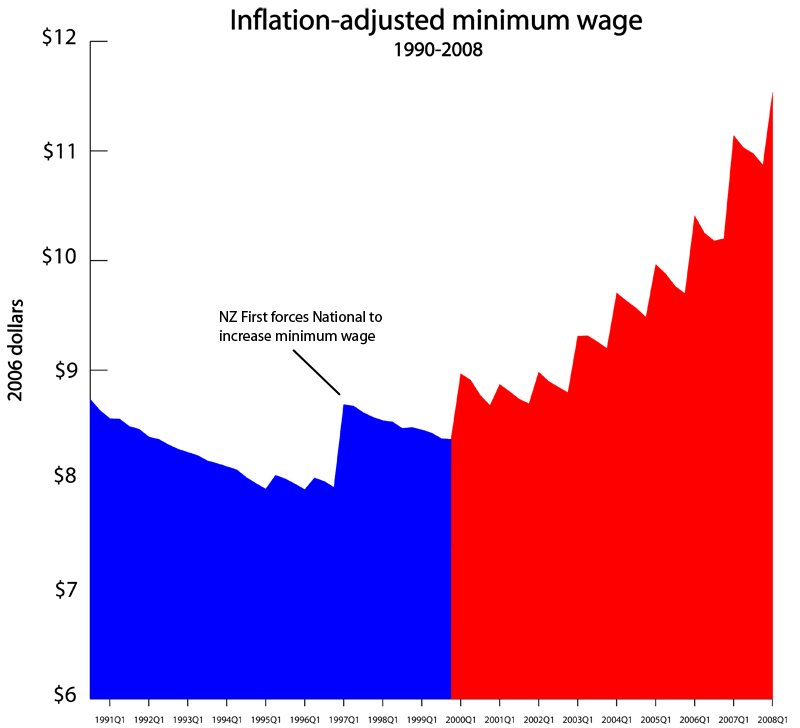
National are right when they say wages are far too low in New Zealand, but they don’t have any answers on how to fix it – just the same market-driven ideology that put us here in the first place.
[Hat tip to Kiwiblogblog for the graph data]
128 comments on “National disses minimum wage ”
- Comments are now closed
Links to post
- Comments are now closed
Recent Comments


- Simon Clark: The climate lies you'll hear this year
 This video includes conclusions of the creator climate scientist Dr. Simon Clark. It is presented to our readers as an informed perspective. Please see video description for references (if any). This year you will be lied to! Simon Clark helps prebunk some misleading statements you'll hear about climate. The video includes ...10 mins ago
 - Cutting the Public Service
 It is all very well cutting the backrooms of public agencies but it may compromise the frontlines. One of the frustrations of the Productivity Commission’s 2017 review of universities is that while it observed that their non-academic staff were increasing faster than their academic staff, it did not bother to ...8 hours ago
 - Luxon’s demoted ministers might take comfort from the British politician who bounced back after th...
 Buzz from the Beehive Two speeches delivered by Foreign Affairs Minister Winston Peters at Anzac Day ceremonies in Turkey are the only new posts on the government’s official website since the PM announced his Cabinet shake-up. In one of the speeches, Peters stated the obvious: we live in a troubled ...12 hours ago
 - This is how I roll over
 1. Which of these would you not expect to read in The Waikato Invader?a. Luxon is here to do business, don’t you worry about thatb. Mr KPI expects results, and you better believe itc. This decisive man of action is getting me all hot and excitedd. Melissa Lee is how ...12 hours ago
 - The Waitangi Tribunal is not “a roving Commission”…
 …it has a restricted jurisdiction which must not be abused: it is not an inquisition NOTE – this article was published before the High Court ruled that Karen Chhour does not have to appear before the Waitangi Tribunal Gary Judd writes – The High Court ...14 hours ago
 - Is Oranga Tamariki guilty of neglect?Lindsay Mitchell writes – One of reasons Oranga Tamariki exists is to prevent child neglect. But could the organisation itself be guilty of the same? Oranga Tamariki’s statistics show a decrease in the number and age of children in care. “There are less children ...15 hours ago
- Three Strikes saw lower reoffendingDavid Farrar writes: Graeme Edgeler wrote in 2017: In the first five years after three strikes came into effect 5248 offenders received a ‘first strike’ (that is, a “stage-1 conviction” under the three strikes sentencing regime), and 68 offenders received a ‘second strike’. In the five years prior to ...15 hours ago
- Luxon’s ruthless show of strength is perfect for our angry eraBryce Edwards writes – Prime Minister Christopher Luxon has surprised everyone with his ruthlessness in sacking two of his ministers from their crucial portfolios. Removing ministers for poor performance after only five months in the job just doesn’t normally happen in politics. That’s refreshing and will be extremely ...15 hours ago
- 'Lacks attention to detail and is creating double-standards.'
 TL;DR: These are the six things that stood out to me in news and commentary on Aotearoa-NZ’s political economy in the two days to 6:06am on Thursday, April 25:Politics: PM Christopher Luxon has set up a dual standard for ministerial competence by demoting two National Cabinet ministers while leaving also-struggling ...20 hours ago
 - One Night Only!Hi,Today I mainly want to share some of your thoughts about the recent piece I wrote about success and failure, and the forces that seemingly guide our lives. But first, a quick bit of housekeeping: I am doing a Webworm popup in Los Angeles on Saturday May 11 at 2pm. ...21 hours ago
- What did Melissa Lee do?
 It is hard to see what Melissa Lee might have done to “save” the media. National went into the election with no public media policy and appears not to have developed one subsequently. Lee claimed that she had prepared a policy paper before the election but it had been decided ...22 hours ago
 - Skeptical Science New Research for Week #17 2024Open access notables Ice acceleration and rotation in the Greenland Ice Sheet interior in recent decades, Løkkegaard et al., Communications Earth & Environment: In the past two decades, mass loss from the Greenland ice sheet has accelerated, partly due to the speedup of glaciers. However, uncertainty in speed derived from satellite products ...1 day ago
- Maori Party (with “disgust”) draws attention to Chhour’s race after the High Court rules on Wa...Buzz from the Beehive A statement from Children’s Minister Karen Chhour – yet to be posted on the Government’s official website – arrived in Point of Order’s email in-tray last night. It welcomes the High Court ruling on whether the Waitangi Tribunal can demand she appear before it. It does ...1 day ago
- Who’s Going Up The Media Mountain?
 Mr Bombastic: Ironically, the media the academic experts wanted is, in many ways, the media they got. In place of the tyrannical editors of yesteryear, advancing without fear or favour the interests of the ruling class; the New Zealand news media of today boasts a troop of enlightened journalists dedicated to ...2 days ago
 - “That's how I roll”
 It's hard times try to make a livingYou wake up every morning in the unforgivingOut there somewhere in the cityThere's people living lives without mercy or pityI feel good, yeah I'm feeling fineI feel better then I have for the longest timeI think these pills have been good for meI ...2 days ago
 - “Comity” versus the rule of law
 In 1974, the US Supreme Court issued its decision in United States v. Nixon, finding that the President was not a King, but was subject to the law and was required to turn over the evidence of his wrongdoing to the courts. It was a landmark decision for the rule ...2 days ago
 - Aotearoa: a live lab for failed Right-wing socio-economic zombie experiments once more…
 Every day now just seems to bring in more fresh meat for the grinder. In their relentlessly ideological drive to cut back on the “excessive bloat” (as they see it) of the previous Labour-led government, on the mountains of evidence accumulated in such a short period of time do not ...2 days ago
 - Water is at the heart of farmers’ struggle to survive in BeninThis is a re-post from Yale Climate Connections by Megan Valére Sosou Market gardening site of the Itchèléré de Itagui agricultural cooperative in Dassa-Zoumè (Image credit: Megan Valère Sossou) For the residents of Dassa-Zoumè, a city in the West African country of Benin, choosing between drinking water and having enough ...2 days ago
- At a time of media turmoil, Melissa had nothing to proclaim as Minister – and now she has been dem...Buzz from the Beehive
 Melissa Lee – as may be discerned from the screenshot above – has not been demoted for doing something seriously wrong as Minister of ... 2 days ago
 - These people are not our friends
 Morning in London Mother hugs beloved daughter outside the converted shoe factory in which she is living.Afternoon in London Travelling writer takes himself and his wrist down to A&E, just to be sure. Read more ...2 days ago
 - Some advice from our tertiary history for the University Advisory GroupMike Grimshaw writes – The recent announcement of the University Advisory Group, chaired by Sir Peter Gluckman, makes very clear where the Government’s focus and priorities lie. The remit of the Advisory Group is that Group members will consider challenges and opportunities for improvement in the university sector including: ...3 days ago
- Still no prudential regulation case around climate changeEric Crampton writes – The Reserve Bank of New Zealand desperately wants to find reasons to have workstreams in climate change. It makes little sense. They’ve run another stress test on the banks looking to see if they could find a prudential regulation case. They couldn’t. They ...3 days ago
- Bernard’s pick ‘n’ mix of the news links for Wednesday, April 24
 TL;DR: These six news links stood out to me in the last 24 hours or so onWednesday, April 23:Scoop: 'Released in error': Treasury paper hints at axing $6b flood resilience plan by NZ Herald-$$$ Thomas CoughlanScoop: EY launches new misconduct review amid Fonterra ban. Fonterra tells EY to remove some ...3 days ago
 - How National can neutralise serious allegations of corruption should the “Fast Track” Bill becom...Rob MacCullough writes – Pundits from the left and the right are arguing that National’s Fast Track Bill that is designed to speed up infrastructure decisions could end up becoming mired in a cesspool of corruption. Political commentator ...3 days ago
- Cleaning Up After Gabrielle.
 Looking at the headlines this morning it’s hard to feel anything other than pessimistic about the future of humanity.Note that I’m not speaking about the future of mankind, but the survival of our humanity. The values that we believe in seem to be ebbing away, by the day.Perhaps every generation ...3 days ago
 - Gordon Campbell on bird flu, AUKUS entry fees and Cindy LeeSwabbing mixed breed baby chicks to test for avian influenzaUh oh. Bird flu – often deadly to humans – is not only being transmitted from infected birds to dairy cows, but is now travelling between dairy cows. As of last Friday, Bloomberg News reports, there were 32 American dairy herds ...3 days ago
- Tolling Existing Roads
 One of the government’s transport policy and agreements with it’s coalition partners made it clear that they were looking at options like tolling and road pricing. This was reinforced in it’s draft Government Policy Statement released at the start of March which made a couple of references to it. Road pricing, ...3 days ago
 - At a glance – The difference between weather and climateOn February 14, 2023 we announced our Rebuttal Update Project. This included an ask for feedback about the added "At a glance" section in the updated basic rebuttal versions. This weekly blog post series highlights this new section of one of the updated basic rebuttal versions and serves as a ...3 days ago
- More criminal minersWhat is it with the mining industry? Its not enough for them to pillage the earth - they apparently can't even be bothered getting resource consent to do so: The proponent behind a major mine near the Clutha River had already been undertaking activity in the area without a ...3 days ago
- Photos from the road
 Photo # 1 I am a huge fan of Singapore’s approach to housing, as described here two years ago by copying and pasting from The ConversationWhat Singapore has that Australia does not is a public housing developer, the Housing Development Board, which puts new dwellings on public and reclaimed land, ...3 days ago
 - RMA reforms aim to ease stock-grazing rules and reduce farmers’ costs – but Taxpayers’ Union w...Buzz from the Beehive Reactions to news of the government’s readiness to make urgent changes to “the resource management system” through a Bill to amend the Resource Management Act (RMA) suggest a balanced approach is being taken. The Taxpayers’ Union says the proposed changes don’t go far enough. Greenpeace says ...3 days ago
- Luxon Strikes Out.
 I’m starting to wonder if Anna Burns-Francis might be the best political interviewer we’ve got. That might sound unlikely to you, it came as a bit of a surprise to me.Jack Tame can be excellent, but has some pretty average days. I like Rebecca Wright on Newshub, she asks good ...4 days ago
 - In many ways the media that the experts wanted, turned out to be the media they have gotChris Trotter writes – Willie Jackson is said to be planning a “media summit” to discuss “the state of the media and how to protect Fourth Estate Journalism”. Not only does the Editor of The Daily Blog, Martyn Bradbury, think this is a good idea, but he has also ...4 days ago
- The Waitangi Tribunal Summons; or the more things stay the sameGraeme Edgeler writes – This morning [April 21], the Wellington High Court is hearing a judicial review brought by Hon. Karen Chhour, the Minister for Children, against a decision of the Waitangi Tribunal. This is unusual, judicial reviews are much more likely to brought against ministers, rather than ...4 days ago
- Both Parliamentary watchdogs hammer Fast-track billBoth of Parliament’s watchdogs have now ripped into the Government’s Fast-track Approvals Bill. Photo: Lynn Grieveson / The KākāMy pick of the six newsey things to know from Aotearoa’s political economy and beyond on the morning of Tuesday, April 23 are:The Lead: The Auditor General, John Ryan, has joined the ...4 days ago
- India makes a big bet on electric busesThis is a re-post from Yale Climate Connections by Sarah Spengeman People wait to board an electric bus in Pune, India. (Image credit: courtesy of ITDP) Public transportation riders in Pune, India, love the city’s new electric buses so much they will actually skip an older diesel bus that ...4 days ago
- Bernard’s pick ‘n’ mix of the news links at 6:36am on Tuesday, April 23
 TL;DR: These six news links stood out in the last 24 hours to 6:36am on Tuesday, April 22:Scoop & Deep Dive: How Sir Peter Jackson got to have his billion-dollar exit cake and eat Hollywood too NZ Herald-$$$ Matt NippertFast Track Approval Bill: Watchdogs seek substantial curbs on ministers' powers ...4 days ago
 - What is really holding up infrastructureThe infrastructure industry yesterday issued a “hurry up” message to the Government, telling it to get cracking on developing a pipeline of infrastructure projects.The hiatus around the change of Government has seen some major projects cancelled and others delayed, and there is uncertainty about what will happen with the new ...4 days ago
- “Pure Unadulterated Charge”
 Hi,Over the weekend I revisited a podcast I really adore, Dead Eyes. It’s about a guy who got fired from Band of Brothers over two decades ago because Tom Hanks said he had “dead eyes”.If you don’t recall — 2001’s Band of Brothers was part of the emerging trend of ...4 days ago
 - Bernard's six-stack of substacks for Monday, April 22
 Tonight’s six-stack includes: writes via his substack that’s he’s sceptical about the IPSOS poll last week suggesting a slide into authoritarianism here, writing: Kiwis seem to want their cake and eat it too Tal Aster writes for about How Israel turned homeowners into YIMBYs. writes via his ...4 days ago
 - The media were given a little list and hastened to pick out Fast Track prospects – but the Treaty ...Buzz from the Beehive The 180 or so recipients of letters from the Government telling them how to submit infrastructure projects for “fast track” consideration includes some whose project applications previously have been rejected by the courts. News media were quick to feature these in their reports after RMA Reform Minister Chris ...4 days ago
- Just trying to stay upright
 It would not be a desirable way to start your holiday by breaking your back, your head, or your wrist, but on our first hour in Singapore I gave it a try.We were chatting, last week, before we started a meeting of Hazel’s Enviro Trust, about the things that can ...4 days ago
 - “Unprecedented”Today, former Port of Auckland CEO Tony Gibson went on trial on health and safety charges for the death of one of his workers. The Herald calls the trial "unprecedented". Firstly, it's only "unprecedented" because WorkSafe struck a corrupt and unlawful deal to drop charges against Peter Whittall over Pike ...4 days ago
- Bryce Edwards: Time for “Fast-Track Watch”
 Calling all journalists, academics, planners, lawyers, political activists, environmentalists, and other members of the public who believe that the relationships between vested interests and politicians need to be scrutinised. We need to work together to make sure that the new Fast-Track Approvals Bill – currently being pushed through by the ...5 days ago
 - Gordon Campbell on fast track powers, media woes and the Tiktok banFeel worried. Shane Jones and a couple of his Cabinet colleagues are about to be granted the power to override any and all objections to projects like dams, mines, roads etc even if: said projects will harm biodiversity, increase global warming and cause other environmental harms, and even if ...5 days ago
- The Government’s new fast-track invitation to corruption
 Bryce Edwards writes- The ability of the private sector to quickly establish major new projects making use of the urban and natural environment is to be supercharged by the new National-led Government. Yesterday it introduced to Parliament one of its most significant reforms, the Fast Track Approvals Bill. ...5 days ago
 - Maori push for parallel government structuresMichael Bassett writes – If you think there is a move afoot by the radical Maori fringe of New Zealand society to create a parallel system of government to the one that we elect at our triennial elections, you aren’t wrong. Over the last few days we have ...5 days ago
- An announcement about an announcementWithout a corresponding drop in interest rates, it’s doubtful any changes to the CCCFA will unleash a massive rush of home buyers. Photo: Lynn GrievesonTL;DR: The six things that stood out to me in Aotearoa’s political economy around housing, poverty and climate on Monday, April 22 included:The Government making a ...5 days ago
- All the Green Tech in China.
 Sunday was a lazy day. I started watching Jack Tame on Q&A, the interviews are usually good for something to write about. Saying the things that the politicians won’t, but are quite possibly thinking. Things that are true and need to be extracted from between the lines.As you might know ...5 days ago
 - Western Express SuccessIn our Weekly Roundup last week we covered news from Auckland Transport that the WX1 Western Express is going to get an upgrade next year with double decker electric buses. As part of the announcement, AT also said “Since we introduced the WX1 Western Express last November we have seen ...5 days ago
- Bernard’s pick ‘n’ mix of the news links at 7:16am on Monday, April 22
 TL;DR: These six news links stood out in the last 24 hours to 7:16am on Monday, April 22:Labour says Kiwis at greater risk from loan sharks as Govt plans to remove borrowing regulations NZ Herald Jenee TibshraenyHow did the cost of moving two schools blow out to more than $400m?A ...5 days ago
 - The Kaka’s diary for the week to April 29 and beyond
 TL;DR: The six key events to watch in Aotearoa-NZ’s political economy in the week to April 29 include:PM Christopher Luxon is scheduled to hold a post-Cabinet news conference at 4 pm today. Stats NZ releases its statutory report on Census 2023 tomorrow.Finance Minister Nicola Willis delivers a pre-Budget speech at ...5 days ago
 - 2024 SkS Weekly Climate Change & Global Warming News Roundup #16A listing of 29 news and opinion articles we found interesting and shared on social media during the past week: Sun, April 14, 2024 thru Sat, April 20, 2024. Story of the week Our story of the week hinges on these words from the abstract of a fresh academic ...5 days ago
- Bryce Edwards: The Government’s new fast-track invitation to corruptionThe ability of the private sector to quickly establish major new projects making use of the urban and natural environment is to be supercharged by the new National-led Government. Yesterday it introduced to Parliament one of its most significant reforms, the Fast Track Approvals Bill. The Government says this will ...5 days ago
- Thank you
 This is a column to say thank you. So many of have been in touch since Mum died to say so many kind and thoughtful things. You’re wonderful, all of you. You’ve asked how we’re doing, how Dad’s doing. A little more realisation each day, of the irretrievable finality of ...6 days ago
 - Determining the Engine Type in Your Car
 Identifying the engine type in your car is crucial for various reasons, including maintenance, repairs, and performance upgrades. Knowing the specific engine model allows you to access detailed technical information, locate compatible parts, and make informed decisions about modifications. This comprehensive guide will provide you with a step-by-step approach to ...6 days ago
 - How to Become a Race Car Driver: A Comprehensive GuideIntroduction: The allure of racing is undeniable. The thrill of speed, the roar of engines, and the exhilaration of competition all contribute to the allure of this adrenaline-driven sport. For those who yearn to experience the pinnacle of racing, becoming a race car driver is the ultimate dream. However, the ...6 days ago
- How Many Cars Are There in the World in 2023? An Exploration of Global Automotive StatisticsIntroduction Automobiles have become ubiquitous in modern society, serving as a primary mode of transportation and a symbol of economic growth and personal mobility. With countless vehicles traversing roads and highways worldwide, it begs the question: how many cars are there in the world? Determining the precise number is a ...6 days ago
- How Long Does It Take for Car Inspection?Maintaining a safe and reliable vehicle requires regular inspections. Whether it’s a routine maintenance checkup or a safety inspection, knowing how long the process will take can help you plan your day accordingly. This article delves into the factors that influence the duration of a car inspection and provides an ...6 days ago
- Who Makes Mazda Cars?Mazda Motor Corporation, commonly known as Mazda, is a Japanese multinational automaker headquartered in Fuchu, Aki District, Hiroshima Prefecture, Japan. The company was founded in 1920 as the Toyo Cork Kogyo Co., Ltd., and began producing vehicles in 1931. Mazda is primarily known for its production of passenger cars, but ...6 days ago
- How Often to Replace Your Car Battery A Comprehensive GuideYour car battery is an essential component that provides power to start your engine, operate your electrical systems, and store energy. Over time, batteries can weaken and lose their ability to hold a charge, which can lead to starting problems, power failures, and other issues. Replacing your battery before it ...6 days ago
- Can You Register a Car Without a License?In most states, you cannot register a car without a valid driver’s license. However, there are a few exceptions to this rule. Exceptions to the Rule If you are under 18 years old: In some states, you can register a car in your name even if you do not ...6 days ago
- Mazda: A Comprehensive Evaluation of Reliability, Value, and PerformanceMazda, a Japanese automotive manufacturer with a rich history of innovation and engineering excellence, has emerged as a formidable player in the global car market. Known for its reputation of producing high-quality, fuel-efficient, and driver-oriented vehicles, Mazda has consistently garnered praise from industry experts and consumers alike. In this article, ...6 days ago
- What Are Struts on a Car?Struts are an essential part of a car’s suspension system. They are responsible for supporting the weight of the car and damping the oscillations of the springs. Struts are typically made of steel or aluminum and are filled with hydraulic fluid. How Do Struts Work? Struts work by transferring the ...6 days ago
- What Does Car Registration Look Like: A Comprehensive GuideCar registration is a mandatory process that all vehicle owners must complete annually. This process involves registering your car with the Department of Motor Vehicles (DMV) and paying an associated fee. The registration process ensures that your vehicle is properly licensed and insured, and helps law enforcement and other authorities ...6 days ago
- How to Share Computer Audio on ZoomZoom is a video conferencing service that allows you to share your screen, webcam, and audio with other participants. In addition to sharing your own audio, you can also share the audio from your computer with other participants. This can be useful for playing music, sharing presentations with audio, or ...6 days ago
- How Long Does It Take to Build a Computer?Building your own computer can be a rewarding and cost-effective way to get a high-performance machine tailored to your specific needs. However, it also requires careful planning and execution, and one of the most important factors to consider is the time it will take. The exact time it takes to ...6 days ago
- How to Put Your Computer to SleepSleep mode is a power-saving state that allows your computer to quickly resume operation without having to boot up from scratch. This can be useful if you need to step away from your computer for a short period of time but don’t want to shut it down completely. There are ...6 days ago
- What is Computer-Assisted Translation (CAT)?Introduction Computer-Assisted Translation (CAT) has revolutionized the field of translation by harnessing the power of technology to assist human translators in their work. This innovative approach combines specialized software with human expertise to improve the efficiency, accuracy, and consistency of translations. In this comprehensive article, we will delve into the ...6 days ago
- iPad vs. Tablet Computers A Comprehensive Guide to DifferencesIn today’s digital age, mobile devices have become an indispensable part of our daily lives. Among the vast array of portable computing options available, iPads and tablet computers stand out as two prominent contenders. While both offer similar functionalities, there are subtle yet significant differences between these two devices. This ...6 days ago
- How Are Computers Made?A computer is an electronic device that can be programmed to carry out a set of instructions. The basic components of a computer are the processor, memory, storage, input devices, and output devices. The Processor The processor, also known as the central processing unit (CPU), is the brain of the ...6 days ago
- How to Add Voice Memos from iPhone to ComputerVoice Memos is a convenient app on your iPhone that allows you to quickly record and store audio snippets. These recordings can be useful for a variety of purposes, such as taking notes, capturing ideas, or recording interviews. While you can listen to your voice memos on your iPhone, you ...6 days ago
- Why My Laptop Screen Has Lines on It: A Comprehensive GuideLaptop screens are essential for interacting with our devices and accessing information. However, when lines appear on the screen, it can be frustrating and disrupt productivity. Understanding the underlying causes of these lines is crucial for finding effective solutions. Types of Screen Lines Horizontal lines: Also known as scan ...6 days ago
- How to Right-Click on a LaptopRight-clicking is a common and essential computer operation that allows users to access additional options and settings. While most desktop computers have dedicated right-click buttons on their mice, laptops often do not have these buttons due to space limitations. This article will provide a comprehensive guide on how to right-click ...6 days ago
- Where is the Power Button on an ASUS Laptop?Powering up and shutting down your ASUS laptop is an essential task for any laptop user. Locating the power button can sometimes be a hassle, especially if you’re new to ASUS laptops. This article will provide a comprehensive guide on where to find the power button on different ASUS laptop ...6 days ago


- Gaza: Aotearoa Must Support Independent Investigation into Mass GravesTe Pāti Māori are demanding the New Zealand Government support an international independent investigation into mass graves that have been uncovered at two hospitals on the Gaza strip, following weeks of assault by Israeli troops. Among the 392 bodies that have been recovered, are children and elderly civilians. Many of ...12 hours ago
- Release: Working together on consistent support for veterans this Anzac Day
 Our two-tiered system for veterans’ support is out of step with our closest partners, and all parties in Parliament should work together to fix it, Labour veterans’ affairs spokesperson Greg O’Connor said. ...2 days ago
 - Release: Penny drops – but what about Seymour and Peters?Stripping two Ministers of their portfolios just six months into the job shows Christopher Luxon’s management style is lacking, Labour Leader Chris Hipkins said. ...2 days ago
- Another ‘Stolen Generation’ enabled by court ruling on Waitangi Tribunal summonsTonight’s court decision to overturn the summons of the Children’s Minister has enabled the Crown to continue making decisions about Māori without evidence, says Te Pāti Māori spokesperson for Children, Mariameno Kapa-Kingi. “The judicial system has this evening told the nation that this government can do whatever they want when ...3 days ago
- Release: Budget blunder shows Nicola Willis could cut recovery fundingIt appears Nicola Willis is about to pull the rug out from under the feet of local communities still dealing with the aftermath of last year’s severe weather, and local councils relying on funding to build back from these disasters. ...3 days ago
- Further environmental mismanagement on the cards
 The Government’s resource management reforms will add to the heavy and ever-growing burden this Government is loading on to our environment. ...4 days ago
 - Release: RMA changes will be a disaster for environmentThe Government is making short-sighted changes to the Resource Management Act (RMA) that will take away environmental protection in favour of short-term profits, Labour’s environment spokesperson Rachel Brooking said today. ...4 days ago
- Release: Labour supports urgent changes to emergency management systemLabour welcomes the release of the report into the North Island weather events and looks forward to working with the Government to ensure that New Zealand is as prepared as it can be for the next natural disaster. ...4 days ago
- Release: Labour calls for New Zealand to recognise PalestineThe Labour Party has called for the New Zealand Government to recognise Palestine, as a material step towards progressing the two-State solution needed to achieve a lasting peace in the region. ...4 days ago
- Release: Three strikes law political posturing of worst kindThe Government is bringing back a law that has little evidential backing just to look tough, Labour justice spokesperson Duncan Webb said. ...4 days ago
- Release: Government cuts unbelievably target child exploitation, violent extremism, ports and airpor...Some of our country’s most important work, stopping the sexual exploitation of children and violent extremism could go along with staff on the frontline at ports and airports. ...4 days ago
- Three strikes has failed before and will fail againResurrecting the archaic three-strikes legislation is an unwelcome return to a failed American-style approach to justice. ...5 days ago
- Release: Environmental protection vital, not ‘onerous’The Government’s Fast Track Approvals Bill will give projects such as new coal mines a ‘get out of jail free’ card to wreak havoc on the environment, Labour Leader Chris Hipkins said today. ...5 days ago
- Ferris – Three Strikes targets those ‘too brown to be white’The government's decision to reintroduce Three Strikes is a destructive and ineffective piece of law-making that will only exacerbate an inherently biased and racist criminal justice system, said Te Pāti Māori Justice Spokesperson, Tākuta Ferris, today. During the time Three Strikes was in place in Aotearoa, Māori and Pasifika received ...5 days ago
- Release: Govt cuts doctors and nurses in hiring freezeCuts to frontline hospital staff are not only a broken election promise, it shows the reckless tax cuts have well and truly hit the frontline of the health system, says Labour Health spokesperson Ayesha Verrall. ...1 week ago
- Fast-track submissions period must be extendedThe Green Party has joined the call for public submissions on the fast-track legislation to be extended after the Ombudsman forced the Government to release the list of organisations invited to apply just hours before submissions close. ...1 week ago
- Release: Progress on climate will be undone by GovtNew Zealand’s good work at reducing climate emissions for three years in a row will be undone by the National government’s lack of ambition and scrapping programmes that were making a difference, Labour Party climate spokesperson Megan Woods said today. ...1 week ago
- Release: Dark day for Kiwi kids as a third of Govt cuts affect themNews that 1000 jobs at the Ministry of Education and Oranga Tamariki could go is devastating for future generations of New Zealanders. ...1 week ago
- Release: Alarm as Government signals further blow to school lunchesMore essential jobs could be on the chopping block, this time Ministry of Education staff on the school lunches team are set to find out whether they're in line to lose their jobs. ...1 week ago
- Oranga Tamariki cuts commit tamariki to state abuseTe Pāti Māori is disgusted at the confirmation that hundreds are set to lose their jobs at Oranga Tamariki, and the disestablishment of the Treaty Response Unit. “This act of absolute carelessness and out of touch decision making is committing tamariki to state abuse.” Said Te Pāti Māori Oranga Tamariki ...1 week ago
- Release: Quick, submit – stop Govt’s dodgy approvals billThe Government is trying to bring in a law that will allow Ministers to cut corners and kill off native species, Labour environment spokesperson Rachel Brooking said. ...2 weeks ago
- Government throws coal on the climate crisis fireThe Government’s policy announced today to ease consenting for coal mining will have a lasting impact across generations. ...2 weeks ago
- Release: Public transport costs to double as National looks at unaffordable roading project insteadCancelling urgently needed new Cook Strait ferries and hiking the cost of public transport for many Kiwis so that National can announce the prospect of another tunnel for Wellington is not making good choices, Labour Transport Spokesperson Tangi Utikere said. ...2 weeks ago
- Release: Cost of living in Auckland still not a priorityA laundry list of additional costs for Tāmaki Makarau Auckland shows the Minister for the city is not delivering for the people who live there, says Labour Auckland Issues spokesperson Shanan Halbert. ...2 weeks ago
- Te Pāti Māori to visit Queensland to strengthen ties with Māori in AustraliaTe Pāti Māori co-leader Rawiri Waititi, and Mema Paremata mō Tāmaki-Makaurau, Takutai Tarsh Kemp, will travel to the Gold Coast to strengthen ties with Māori in Australia next week (15-21 April). The visit, in the lead-up to the 9th Australian National Kapa haka Festival, will be an opportunity for both ...2 weeks ago
- Greens look to fast-track submissions on harmful lawThe Green Party has today launched a step-by-step guide to help New Zealanders make their voice heard on the Government’s democracy dodging and anti-environment fast track legislation. ...2 weeks ago
- Release: Govt should stop making people’s lives harder and build more homesThe National Government’s proposed changes to the Residential Tenancies Act will mean tenants can be turfed from their homes by landlords with little notice, Labour housing spokesperson Kieran McAnulty said. ...2 weeks ago
- Release: Melissa Lee missing in action on mediaThe action Melissa Lee promised to protect democracy and the media sector is missing, Media and Communications spokesperson Willie Jackson said. ...2 weeks ago
- Landlord Government leaves little hope for rentersThe Government’s announcement on tenancy rules prove that it does not care about renters. ...2 weeks ago
- Opportunity to build a more sustainable economyGreen Party co-leader Marama Davidson is calling on all parties to support a common-sense change that’s great for the planet and great for consumers after her member’s bill was drawn from the ballot today. ...2 weeks ago
- Significant step forward in fixing cruel and unjust pastA significant milestone has been reached in the fight to strike an anti-Pasifika and unfair law from the country’s books after Teanau Tuiono’s members’ bill passed its first reading. ...2 weeks ago
- Missed opportunity but NZ will surely one day recognise the right to a sustainable environmentNew Zealand has today missed the opportunity to uphold the right to a clean, healthy, and sustainable environment, says James Shaw after his member’s bill was voted down in its first reading. ...2 weeks ago
- Release: Don’t cut our lunches – clear message sent to GovernmentTens of thousands of people are demanding the Government commits to fully funding free and healthy school lunches. ...2 weeks ago
- Release: Govt makes U-turn on Suicide Prevention OfficeLabour welcomes the Government’s U-turn on the closure of the Suicide Prevention Office, says Labour Mental Health spokesperson Ingrid Leary. ...2 weeks ago
- CCC issues warning over further climate delayToday’s advice from the Climate Change Commission paints a sobering reality of the challenge we face in combating climate change, especially in light of recent Government policy announcements. ...3 weeks ago
- Luxon targets lame and lousy example of leadershipIf talk is cheap, Chris Luxon’s “targets” are bankrupt. ...3 weeks ago
- Luxon targets are lousy example of leadershipIf talk is cheap, Chris Luxon’s “targets” are bankrupt. ...3 weeks ago
- Release: Commitment to disability communities missing from Govt prioritiesMinister for Disability Issues Penny Simmonds appears to have delayed a report back to Cabinet on the progress New Zealand is making against international obligations for disabled New Zealanders. ...3 weeks ago
- Anzac Commemorative Address, Buttes New British Cemetery Belgium
 Ambassador Millar, Burgemeester, Vandepitte, Excellencies, military representatives, distinguished guests, ladies and gentlemen – good morning and welcome to this sacred Anzac Day dawn service. It is an honour to be here on behalf of the Government and people of New Zealand at Buttes New British Cemetery, Polygon Wood – a deeply ...12 hours ago
 - Anzac Commemorative Address – NZ National Service, Chunuk BairDistinguished guests - It is an honour to return once again to this site which, as the resting place for so many of our war-dead, has become a sacred place for generations of New Zealanders. Our presence here and at the other special spaces of Gallipoli is made ...1 day ago
- Anzac Commemorative Address – Dawn Service, Gallipoli, TürkiyeMai ia tawhiti pamamao, te moana nui a Kiwa, kua tae whakaiti mai matou, ki to koutou papa whenua. No koutou te tapuwae, no matou te tapuwae, kua honoa pumautia. Ko nga toa kua hinga nei, o te Waipounamu, o te Ika a Maui, he okioki tahi me o ...2 days ago
- PM announces changes to portfoliosPaul Goldsmith will take on responsibility for the Media and Communications portfolio, while Louise Upston will pick up the Disability Issues portfolio, Prime Minister Christopher Luxon announced today. “Our Government is relentlessly focused on getting New Zealand back on track. As issues change in prominence, I plan to adjust Ministerial ...3 days ago
- New catch limits for unique fishery areasRecreational catch limits will be reduced in areas of Fiordland and the Chatham Islands to help keep those fisheries healthy and sustainable, Oceans and Fisheries Minister Shane Jones says. The lower recreational daily catch limits for a range of finfish and shellfish species caught in the Fiordland Marine Area and ...3 days ago
- Minister welcomes hydrogen milestoneEnergy Minister Simeon Brown has welcomed an important milestone in New Zealand’s hydrogen future, with the opening of the country’s first network of hydrogen refuelling stations in Wiri. “I want to congratulate the team at Hiringa Energy and its partners K one W one (K1W1), Mitsui & Co New Zealand ...3 days ago
- Urgent changes to system through first RMA Amendment BillThe coalition Government is delivering on its commitment to improve resource management laws and give greater certainty to consent applicants, with a Bill to amend the Resource Management Act (RMA) expected to be introduced to Parliament next month. RMA Reform Minister Chris Bishop has today outlined the first RMA Amendment ...4 days ago
- Overseas decommissioning models consideredOverseas models for regulating the oil and gas sector, including their decommissioning regimes, are being carefully scrutinised as a potential template for New Zealand’s own sector, Resources Minister Shane Jones says. The Coalition Government is focused on rebuilding investor confidence in New Zealand’s energy sector as it looks to strengthen ...4 days ago
- Release of North Island Severe Weather Event InquiryEmergency Management and Recovery Minister Mark Mitchell has today released the Report of the Government Inquiry into the response to the North Island Severe Weather Events. “The report shows that New Zealand’s emergency management system is not fit-for-purpose and there are some significant gaps we need to address,” Mr Mitchell ...4 days ago
- Justice Minister to attend Human Rights CouncilJustice Minister Paul Goldsmith is today travelling to Europe where he’ll update the United Nations Human Rights Council on the Government’s work to restore law and order. “Attending the Universal Periodic Review in Geneva provides us with an opportunity to present New Zealand’s human rights progress, priorities, and challenges, while ...4 days ago
- Patterson reopens world’s largest wool scouring facilityAssociate Agriculture Minister, Mark Patterson, formally reopened the world’s largest wool processing facility today in Awatoto, Napier, following a $50 million rebuild and refurbishment project. “The reopening of this facility will significantly lift the economic opportunities available to New Zealand’s wool sector, which already accounts for 20 per cent of ...4 days ago
- Speech to the Southland Otago Regional Engineering Collective Summit, 18 April 2024Hon Andrew Bayly, Minister for Small Business and Manufacturing At the Southland Otago Regional Engineering Collective (SOREC) Summit, 18 April, Dunedin Ngā mihi nui, Ko Andrew Bayly aho, Ko Whanganui aho Good Afternoon and thank you for inviting me to open your summit today. I am delighted ...5 days ago
- Government to introduce revised Three Strikes lawThe Government is delivering on its commitment to bring back the Three Strikes legislation, Associate Justice Minister Nicole McKee announced today. “Our Government is committed to restoring law and order and enforcing appropriate consequences on criminals. We are making it clear that repeat serious violent or sexual offending is not ...5 days ago
- New diplomatic appointmentsForeign Minister Winston Peters has today announced four new diplomatic appointments for New Zealand’s overseas missions. “Our diplomats have a vital role in maintaining and protecting New Zealand’s interests around the world,” Mr Peters says. “I am pleased to announce the appointment of these senior diplomats from the ...5 days ago
- Humanitarian support for Ethiopia and SomaliaNew Zealand is contributing NZ$7 million to support communities affected by severe food insecurity and other urgent humanitarian needs in Ethiopia and Somalia, Foreign Minister Rt Hon Winston Peters announced today. “Over 21 million people are in need of humanitarian assistance across Ethiopia, with a further 6.9 million people ...5 days ago
- Arts Minister congratulates Mataaho CollectiveMinister for Arts, Culture and Heritage Paul Goldsmith is congratulating Mataaho Collective for winning the Golden Lion for best participant in the main exhibition at the Venice Biennale. "Congratulations to the Mataaho Collective for winning one of the world's most prestigious art prizes at the Venice Biennale. “It is good ...6 days ago
- Supporting better financial outcomes for KiwisThe Government is reforming financial services to improve access to home loans and other lending, and strengthen customer protections, Commerce and Consumer Affairs Minister Andrew Bayly and Housing Minister Chris Bishop announced today. “Our coalition Government is committed to rebuilding the economy and making life simpler by cutting red tape. We are ...6 days ago
- Trade relationship with China remains strong“China remains a strong commercial opportunity for Kiwi exporters as Chinese businesses and consumers continue to value our high-quality safe produce,” Trade and Agriculture Minister Todd McClay says. Mr McClay has returned to New Zealand following visits to Beijing, Harbin and Shanghai where he met ministers, governors and mayors and engaged in trade and agricultural events with the New ...6 days ago
- PM’s South East Asia mission does the businessPrime Minister Christopher Luxon has completed a successful trip to Singapore, Thailand and the Philippines, deepening relationships and capitalising on opportunities. Mr Luxon was accompanied by a business delegation and says the choice of countries represents the priority the New Zealand Government places on South East Asia, and our relationships in ...7 days ago
- $41m to support clean energy in South East AsiaNew Zealand is demonstrating its commitment to reducing global greenhouse emissions, and supporting clean energy transition in South East Asia, through a contribution of NZ$41 million (US$25 million) in climate finance to the Asian Development Bank (ADB)-led Energy Transition Mechanism (ETM). Prime Minister Christopher Luxon and Climate Change Minister Simon Watts announced ...1 week ago
- Minister releases Fast-track stakeholder listThe Government is today releasing a list of organisations who received letters about the Fast-track applications process, says RMA Reform Minister Chris Bishop. “Recently Ministers and agencies have received a series of OIA requests for a list of organisations to whom I wrote with information on applying to have a ...1 week ago
- Judicial appointments announcedAttorney-General Judith Collins today announced the appointment of Wellington Barrister David Jonathan Boldt as a Judge of the High Court, and the Honourable Justice Matthew Palmer as a Judge of the Court of Appeal. Justice Boldt graduated with an LLB from Victoria University of Wellington in 1990, and also holds ...1 week ago
- Education Minister heads to major teaching summit in SingaporeEducation Minister Erica Stanford will lead the New Zealand delegation at the 2024 International Summit on the Teaching Profession (ISTP) held in Singapore. The delegation includes representatives from the Post Primary Teachers’ Association (PPTA) Te Wehengarua and the New Zealand Educational Institute (NZEI) Te Riu Roa. The summit is co-hosted ...1 week ago
- Value of stopbank project proven during cycloneA stopbank upgrade project in Tairawhiti partly funded by the Government has increased flood resilience for around 7000ha of residential and horticultural land so far, Regional Development Minister Shane Jones says. Mr Jones today attended a dawn service in Gisborne to mark the end of the first stage of the ...1 week ago
- Anzac commemorations, Türkiye relationship focus of visitForeign Affairs Minister Winston Peters will represent the Government at Anzac Day commemorations on the Gallipoli Peninsula next week and engage with senior representatives of the Turkish government in Istanbul. “The Gallipoli campaign is a defining event in our history. It will be a privilege to share the occasion ...1 week ago
- Minister to Europe for OECD meeting, Anzac DayScience, Innovation and Technology and Defence Minister Judith Collins will next week attend the OECD Science and Technology Ministerial conference in Paris and Anzac Day commemorations in Belgium. “Science, innovation and technology have a major role to play in rebuilding our economy and achieving better health, environmental and social outcomes ...1 week ago
- Comprehensive Partnership the goal for NZ and the PhilippinesPrime Minister Christopher Luxon held a bilateral meeting today with the President of the Philippines, Ferdinand Marcos Jr. The Prime Minister was accompanied by MP Paulo Garcia, the first Filipino to be elected to a legislature outside the Philippines. During today’s meeting, Prime Minister Luxon and President Marcos Jr discussed opportunities to ...1 week ago
- Government commits $20m to Westport flood protectionThe Government has announced that $20 million in funding will be made available to Westport to fund much needed flood protection around the town. This measure will significantly improve the resilience of the community, says Local Government Minister Simeon Brown. “The Westport community has already been allocated almost $3 million ...1 week ago
- Taupō takes pole positionThe Government is proud to support the first ever Repco Supercars Championship event in Taupō as up to 70,000 motorsport fans attend the Taupō International Motorsport Park this weekend, says Economic Development Minister Melissa Lee. “Anticipation for the ITM Taupō Super400 is huge, with tickets and accommodation selling out weeks ...1 week ago
- Cost of living support for low-income homeownersLocal Government Minister Simeon Brown has announced an increase to the Rates Rebate Scheme, putting money back into the pockets of low-income homeowners. “The coalition Government is committed to bringing down the cost of living for New Zealanders. That includes targeted support for those Kiwis who are doing things tough, such ...1 week ago
- Government backing mussel spat projectThe Coalition Government is investing in a project to boost survival rates of New Zealand mussels and grow the industry, Oceans and Fisheries Minister Shane Jones has announced. “This project seeks to increase the resilience of our mussels and significantly boost the sector’s productivity,” Mr Jones says. “The project - ...1 week ago
- Government focused on getting people into workBenefit figures released today underscore the importance of the Government’s plan to rebuild the economy and have 50,000 fewer people on Jobseeker Support, Social Development and Employment Minister Louise Upston says. “Benefit numbers are still significantly higher than when National was last in government, when there was about 70,000 fewer ...1 week ago
- Clean energy key driver to reducing emissionsThe Government’s commitment to doubling New Zealand’s renewable energy capacity is backed by new data showing that clean energy has helped the country reach its lowest annual gross emissions since 1999, Climate Change Minister Simon Watts says. New Zealand’s latest Greenhouse Gas Inventory (1990-2022) published today, shows gross emissions fell ...1 week ago
- Earthquake-prone buildings review brought forwardThe Government is bringing the earthquake-prone building review forward, with work to start immediately, and extending the deadline for remediations by four years, Building and Construction Minister Chris Penk says. “Our Government is focused on rebuilding the economy. A key part of our plan is to cut red tape that ...1 week ago
- Thailand and NZ to agree to Strategic PartnershipPrime Minister Christopher Luxon and his Thai counterpart, Prime Minister Srettha Thavisin, have today agreed that New Zealand and the Kingdom of Thailand will upgrade the bilateral relationship to a Strategic Partnership by 2026. “New Zealand and Thailand have a lot to offer each other. We have a strong mutual desire to build ...1 week ago
- Government consults on extending coastal permits for portsRMA Reform Minister Chris Bishop and Transport Minister Simeon Brown have today announced the Coalition Government’s intention to extend port coastal permits for a further 20 years, providing port operators with certainty to continue their operations. “The introduction of the Resource Management Act in 1991 required ports to obtain coastal ...1 week ago
- Inflation coming down, but more work to doToday’s announcement that inflation is down to 4 per cent is encouraging news for Kiwis, but there is more work to be done - underlining the importance of the Government’s plan to get the economy back on track, acting Finance Minister Chris Bishop says. “Inflation is now at 4 per ...1 week ago
- School attendance restored as a priority in health adviceRefreshed health guidance released today will help parents and schools make informed decisions about whether their child needs to be in school, addressing one of the key issues affecting school attendance, says Associate Education Minister David Seymour. In recent years, consistently across all school terms, short-term illness or medical reasons ...1 week ago
- Unnecessary bureaucracy cut in oceans sectorOceans and Fisheries Minister Shane Jones is streamlining high-level oceans management while maintaining a focus on supporting the sector’s role in the export-led recovery of the economy. “I am working to realise the untapped potential of our fishing and aquaculture sector. To achieve that we need to be smarter with ...1 week ago
- Opinion: It’s time for an arts and creative sector strategyI was initially resistant to the idea often suggested to me that the Government should deliver an arts strategy. The whole point of the arts and creativity is that people should do whatever the hell they want, unbound by the dictates of politicians in Wellington. Peter Jackson, Kiri Te Kanawa, Eleanor ...1 week ago
- Have New Zealanders really been ‘misled’ about AUKUS, or is involvement now a foregone conclusio...
 ANALYSIS: By Marco de Jong, Auckland University of Technology and Robert G. Patman, University of Otago When former prime minister Helen Clark spoke out against New Zealand potentially compromising its independent foreign policy by joining pillar two of the AUKUS security pact, Foreign Minister Winston Peters responded bluntly: On ...3 hours ago
 - Palestine protesters challenge TVNZ over Israeli ambassador’s ‘propaganda’Pacific Media Watch Palestine solidarity protesters today demonstrated at the Auckland headquarters of Television New Zealand, accusing the country’s major TV network of broadcasting “propaganda” backing Israel’s genocidal war on Gaza. About 50 protesters targeted the main entrance to the TVNZ building near Sky Tower and also picketed a side ...4 hours ago
- Lynley Hood Opinion – Senator Fulbright must be spinning in his grave6 hours ago
- Fast-track bill could affect NZ's reputation – Transparency International
 The ministers responsible for green-lighting major projects need to be open about potential conflicts of interest, says Transparency International. ...7 hours ago
 - We’re all feeling the collective grief and trauma of violence against women – but this is the pr...Source: The Conversation (Au and NZ) – By Anastasia Powell, Professor, Family and Sexual Violence, RMIT University It has been a particularly distressing start to the year. There is little that can ease the current grief of individuals, families and communities who have needlessly lost a loved one to men’s ...8 hours ago
- Species living closely together in symbiosis is far older and way more common than you might thinkSource: The Conversation (Au and NZ) – By Gregory Moore, Senior Research Associate, School of Ecosystem and Forest Sciences, The University of Melbourne Lichen, the first described example of symbiosis. AdeJ Artventure/Shutterstock Once known only to those studying biology, the word symbiosis is now widely used. Symbiosis is the intimate ...8 hours ago
- What is childhood dementia? And how could new research help?Source: The Conversation (Au and NZ) – By Kim Hemsley, Head, Childhood Dementia Research Group, Flinders Health and Medical Research Institute, College of Medicine and Public Health, Flinders University Olena Ivanova/Shutterstock “Childhood” and “dementia” are two words we wish we didn’t have to use together. But sadly, around 1,400 ...9 hours ago
- Jobseekers get about $345 less than pensioners each fortnight. This gap is hurting, and is set to wi...Source: The Conversation (Au and NZ) – By Peter Whiteford, Professor, Crawford School of Public Policy, Australian National University The government’s Economic Inclusion Advisory Committee has just published its second report. It was set up by Treasurer Jim Chalmers and Minister for Social Services Amanda Rishworth in 2022 to provide: ...9 hours ago
- Does fighting inflation always lead to recession? What NZ data tellsHere is what 60 years of New Zealand data shows us. ...10 hours ago
- The government's 20 trips abroad in AprilThe government appears committed to overseas visits with 14 ministers and MPs in 18 countries this month. ...11 hours ago
- Government unveils fetal alcohol guidelines, plan for diagnosis trainingThe government is promising to step up the response to Fetal Alcohol Spectrum Disorder, promising to boost diagnoses and raise awareness. ...11 hours ago
- Labor facing heavy defeat in Queensland, but faring better in federal pollsSource: The Conversation (Au and NZ) – By Adrian Beaumont, Election Analyst (Psephologist) at The Conversation; and Honorary Associate, School of Mathematics and Statistics, The University of Melbourne The Queensland state election will be held in October. A YouGov poll for The Courier Mail, conducted April 9–17 from a sample ...11 hours ago
- Why the potential for another Donald Trump presidency is making Iran very nervousSource: The Conversation (Au and NZ) – By Amin Naeni, PhD candidate at Alfred Deakin Institute for Citizenship and Globalisation, Deakin University There’s been much talk in recent months about what a possible second Donald Trump presidency in the United States could mean for Europe, Russia’s war in Ukraine, the ...11 hours ago
- ‘The worst piece of law proposed since 1979’: Reactions to the Fast-track Approvals Bill
 A brief round-up of submissions on the controversial proposed law. This is an excerpt from our weekly environmental newsletter Future Proof. Sign up here. Last week, submissions on the controversial Fast-track Approvals Bill closed just hours after the government released a list of stakeholder organisations who were sent letters advising how they could ...12 hours ago
 - The Friday Poem: ‘Cereal giving’ by Robin PeaceA poem from Robin Peace’s new collection Detritus of Empire: feather / grass / rock. Cereal giving I see a woman’s hands, see her curious hands break a stalk as she walks through the tall prairie, the savannah, the steppe, wherever it was. See her idly bite the grass that ...13 hours ago
- The Unity Books bestseller chart for the week ending April 26The only published and available best-selling indie book chart in New Zealand is the top 10 sales list recorded every week at Unity Books’ stores in High St, Auckland, and Willis St, Wellington. AUCKLAND 1 Hemingway’s Goblet by Dermot Ross (Mary Egan Publishing, $38) A handsomely produced (debossed cover, lovely ...13 hours ago
- Te Rūnanga O Ngāti Whātua Welcomes Commissioner's Decision Regarding Awataha Marae
 The Commissioner's decision validates the longstanding efforts of the local community and ensures that Awataha Marae will be managed to serve the needs of the local community, particularly for hosting tangihanga. ...14 hours ago
 - We reconstructed landscapes that greeted the first humans in Australia around 65,000 years agoSource: The Conversation (Au and NZ) – By Tristan Salles, Associate professor, University of Sydney Examples of Australian landscapes. Unsplash Seventy thousand years ago, the sea level was much lower than today. Australia, along with New Guinea and Tasmania, formed a connected landmass known as Sahul. Around this time – ...14 hours ago
- What do we lose when our old suburbs disappear?Source: The Conversation (Au and NZ) – By Felicity Castagna, Lecturer, Creative Writing, Western Sydney University Day Day Market, Parramatta Photo: Garry Trinh I live on the edge of Parramatta, Australia’s fastest-growing city, on the kind of old-fashioned suburban street that has 1950s fibros constructed in the post-war housing boom, ...14 hours ago
- Does fighting inflation always lead to recession? What 60 years of NZ data can tell usSource: The Conversation (Au and NZ) – By Michael Ryan, Teaching Fellow in Economics, University of Waikato GettyImages fatido/Getty Images There is an ongoing global debate over whether the high inflation seen in the aftermath of the COVID-19 pandemic can be lowered without a recession. New Zealand is not ...14 hours ago
- After spending $700,000 on pins for Covid-19 workers, department now cutting costsA government office that set aside millions for lapel pins for pandemic workers is now looking to cut back on spending. ...15 hours ago
- ‘A hell of a lot of fun’: Our reviews of Chris Isaak’s dazzling Auckland showThe ‘Wicked Game’ heartthrob is in his late 60s now. That didn’t stop him putting on a lively, goofy and very sparkly show. Apart from ‘Wicked Game’, which graces a sultry playlist of mine simply called 💋, my last sustained Chris Isaak listening session took place when I was about ...15 hours ago
- The Week in Politics: Days of drama and demotionsAnalysis - Two ministers were stripped of portfolios in a warning to Cabinet, drama broke out at the Waitangi Tribunal, and the gang patch ban bill ran into opposition. ...15 hours ago
- Hear me out: All I want is a TrueBliss T-shirtTara Ward makes an impassioned plea for some vital pop culture merch. In April 1999, I became obsessed with a new reality television show called Popstars. Every Tuesday night, five strangers transformed into music royalty before my very eyes as Joe, Keri, Carly, Erika and Megan were chosen to form ...16 hours ago
- Solemn ANZAC dawn service at PNG’s Isurava battle memorialPNG Post-Courier In the early hours of ANZAC Day, aerial photographs captured an impressive gathering of Australians and Papua New Guineans at Isurava in the Northern (Oro) Province. The solemn dawn service yesterday was held at a site steeped in history, where some of the fiercest battles of World War ...16 hours ago
- Political editors panel: A reshuffle and the fast trackListen - RNZ's Jo Moir and NZ Herald's Claire Trevett dissect the demotion of two ministers and the PM's response on Morning Report. ...17 hours ago
- After-hours clinics on verge of collapse in some regionsOverworked GPs have signalled they can no longer cover, while funding is falling short. ...17 hours ago
- Oranga Tamariki Axes Specialist Māori Roles, Weakens Commitment To Te Ao MāoriThe PSA is shocked that Oranga Tamariki has used the cost cutting drive to downgrade its commitment to Te Ao Māori and remove many specialist Māori roles. ...17 hours ago
- China’s money only goes so far – Kokoda shows why history binds PNG and Australia in a far deepe...Source: The Conversation (Au and NZ) – By Ian Kemish, Adjunct Professor, School of Historical and Philosophical Inquiry, The University of Queensland There can be no more powerful symbol of the relationship between Australia and Papua New Guinea than the prime ministers of these neighbouring countries walking together on the ...18 hours ago
- We spoke to young people about sexual consent. They understand the concept, but don’t always ask i...Source: The Conversation (Au and NZ) – By Andrea Waling, ARC DECRA Senior Research Fellow in Sex & Sexuality, La Trobe University BAZA Production/Shutterstock Sexual consent has been a major focus in Australia for the past few years. In early 2022 the federal government mandated consent education in ...18 hours ago
- Longer-lasting ozone holes over Antarctica expose seal pups and penguin chicks to much more UVSource: The Conversation (Au and NZ) – By Sharon Robinson, Distinguished Professor and Deputy Director of ARC Securing Antarctica’s Environmental Future (SAEF), University of Wollongong, University of Wollongong Andrew Netherwood Over the last 25 years, the ozone hole which forming over Antarctica each spring has started to shrink. ...18 hours ago
- Granting legal ‘personhood’ to nature is a growing movement – can it stem biodiversity loss?Source: The Conversation (Au and NZ) – By Viktoria Kahui, Senior Lecturer in Environmental Economics, University of Otago Getty Images/Amy Toensing Biodiversity is declining at rates unprecedented in human history. This suggests the ways we currently use to manage our natural environment are failing. One emerging concept focuses on ...18 hours ago
- Will checking character references really help you find the best candidate for a job?Source: The Conversation (Au and NZ) – By Timothy Colin Bednall, Associate Professor in Management, Swinburne University of Technology marvent/Shutterstock Finding the best person to fill a position can be tough, from drafting a job ad to producing a shortlist of top interview candidates. Employers typically consider information from ...18 hours ago
- A guide to Wellington’s best BYO restaurantsWondering where to host your next BYO? Whether its a small gathering or a massive party, we’ve got some recommendations. I was first introduced to the concept of BYOs at Dunedin’s India Gardens, a legendary but sadly defunct establishment, which purveyed enormous quantities of mango chicken to Aotearoa’s drunkest future ...18 hours ago
- New rock art discoveries in Eastern Sudan tell a tale of ancient cattle, the ‘green Sahara’ and ...Source: The Conversation (Au and NZ) – By Julien Cooper, Honorary Lecturer, Department of History and Archaeology, Macquarie University Julien Cooper The hyper-arid desert of Eastern Sudan, the Atbai Desert, seems like an unlikely place to find evidence of ancient cattle herders. But in this dry environment, my new ...18 hours ago
- Paul Goldsmith starts as new Media Minister replacing sacked Melissa LeeThe media industry is "under pressure", Paul Goldsmith says, but he plans to plot a path forward as he takes up the difficult role. ...19 hours ago
- Media industry sheds few tears for minister LeeThe sector says it’s hopeful her replacement Paul Goldsmith will be able to throw it a lifeline, after six months with a minister deemed missing in action, writes Catherine McGregor in this excerpt from The Bulletin, The Spinoff’s morning news round-up. To receive The Bulletin in full each weekday, sign ...19 hours ago
- Is NZ bringing in 'Indonesian coal every month to keep the lights on'?Analysis: The Resource Minister said it, but is it true and why does it matter? ...19 hours ago
- More spending cuts needed to stablise government finances – economistThe government can't just rely on axing public sector jobs and has to do more to cut spending, says the chief economist at a free market think tank. ...20 hours ago
- The government's 22 trips abroad in AprilThe government appears committed to overseas visits with 14 miniters and MPs in 18 countries this month. ...21 hours ago
- Loopholes will be exploited in new vape rules – expertsThere is no doubt vape manufacturers will find and exploit loopholes in new regulations, say marketing experts. ...21 hours ago
- Aotearoa Party Merges With Rock The Vote NZ Party And John Alcock Elected As Party LeaderRock The Vote NZ, known for its advocacy for minor party unity and its role within the Freedoms NZ Coalition during the 2023 General Election, celebrates this merger as a strategic enhancement of its operational strength and outreach. ...21 hours ago
- After spending $2m on pins for Covid-19 workers, department now cutting costsGovernment department that spent $2m on lapel pins to honour Covid-19 workers is now looking to make cuts. ...21 hours ago
- An afternoon at the Repair Café, where everyday objects get a second lifeNearly everyone has experienced the frustration of something you use breaking and being difficult or expensive to fix. Proposed legislation could change that. It’s been raining on and off all Sunday afternoon but people are lining up outside a building in a corner of Gribblehirst Park in Sandringham, Auckland. In ...22 hours ago
- Dreaming of my not-wedding dayWhat does a forever relationship look like when you don’t believe in marriage? And how do you celebrate it? This essay is part of our Sunday Essay series, made possible thanks to the support of Creative New Zealand. I’m going to do it, right now. I’m going to say ...22 hours ago
- Debt clifftop guardrail and ambulance removed at same time
 It will be soon be easier to get lending, but harder to get help for debt The post Debt clifftop guardrail and ambulance removed at same time appeared first on Newsroom. ...22 hours ago
 - Just Life exit from NZX puts listed company regulation under microscopeJust Life’s chief executive says the exchange’s regulatory burden outweighs any benefits to small business The post Just Life exit from NZX puts listed company regulation under microscope appeared first on Newsroom. ...22 hours ago
- Prime Minister jumps the gun in ThailandThe Prime Minister has committed to resuming direct flights to Thailand. But it’s not a promise he will be able to deliver on anytime soon. The post Prime Minister jumps the gun in Thailand appeared first on Newsroom. ...22 hours ago
- Daily crossword, Friday 26 AprilThe post Daily crossword, Friday 26 April appeared first on Newsroom. ...22 hours ago
- The outlook for engineering specialists looks bleakOpinion: Delays getting to the starting line of new programmes of work are causing significant disruption across the sector The post The outlook for engineering specialists looks bleak appeared first on Newsroom. ...22 hours ago
- Eliza wants more than a last tango in ParisIt’s not that long ago Eliza McCartney was seriously wondering if the Paris Olympics would be her pole vaulting swansong. After years of being hounded by injury after injury, the Rio Olympics bronze medallist was still confident she would compete at her second Olympics in Paris in July, unless something ...22 hours ago
- This week’s bestselling books – April 26FICTION 1 Take Two by Danielle Hawkins (Allen & Unwin, $36.99) There’s commercial fiction, like this book, and then there’s quality fiction, quality writers, quality literature; the forthcoming Auckland Writers Festival is full of quality, and ReadingRoom has two tickets to give away to the following events: Paul Lynch (Dublin ...22 hours ago
- Newsroom daily quiz, Friday 26 AprilLoading…(function(i,s,o,g,r,a,m){var ql=document.querySelectorAll('A[quiz],DIV[quiz],A[data-quiz],DIV[data-quiz]'); if(ql){if(ql.length){for(var k=0;k<ql.length;k++){ql[k].id='quiz-embed-'+k;ql[k].href="javascript:var i=document.getElementById('quiz-embed-"+k+"');try{qz.startQuiz(i)}catch(e){i.start=1;i.style.cursor='wait';i.style.opacity='0.5'};void(0);"}}};i['QP']=r;i[r]=i[r]||function(){(i[r].q=i[r].q||[]).push(arguments)},i[r].l=1*new Date();a=s.createElement(o),m=s.getElementsByTagName(o)[0];a.async=1;a.src=g;m.parentNode.insertBefore(a,m)})(window,document,'script','https://take.quiz-maker.com/3012/CDN/quiz-embed-v1.js','qp'); Got a good quiz question? Send Newsroom your questions. The post Newsroom daily quiz, Friday 26 April appeared first on Newsroom. ...22 hours ago
- On the fringes of the Gallipoli battlefieldYou can’t have missed the Gallipoli story as the movies, documentaries, essays and books capture what it was like for New Zealand troops in their eight-month campaign on the Peninsula. But this Anzac Day the Auckland War Memorial Museum has published a book that sheds light on a little-known aspect of the ...22 hours ago
- Govt repeats mistakes of Muldoon’s authoritarian excessesOpinion: It needs wiser leadership to learn from the past to have a balanced planning and resource management law The post Govt repeats mistakes of Muldoon’s authoritarian excesses appeared first on Newsroom. ...22 hours ago
- Grattan on Friday: Social media companies can’t be immune from the need for a social licenceSource: The Conversation (Au and NZ) – By Michelle Grattan, Professorial Fellow, University of Canberra In the free-for-all between the Australian government and Big Tech boss Elon Musk this week, the government had to be on a winner. Most people would have little sympathy with Musk’s vociferous opposition to ...1 day ago
- Nelson Mandela’s grandson joins Gaza flotilla, slams ‘genocide complicit’ leadersAsia Pacific Report Chief Mandla Mandela, a member of the National Assembly of South Africa and Nelson Mandela’s grandson, has joined the Freedom Flotilla in istanbul as the ships prepare to sail for Gaza, reports Kia Ora Gaza. Mandela is also the ambassador for the Global Campaign to Return to ...1 day ago
- 200 journalists ‘targeted’ over their environment reporting, warns RSFPacific Media Watch Journalists who report on environmental issues are encountering growing difficulties in many parts of the world, reports Reporters Without Borders. According to the tally kept by RSF, 200 journalists have been subjected to threats and physical violence, including murder, in the past 10 years because they were ...1 day ago
- Bryce Edwards Analysis – Luxon’s ruthless show of strength is perfect for our angry eraAnalysis by Dr Bryce Edwards, Democracy Project (https://democracyproject.nz) Political scientist, Dr Bryce Edwards. Prime Minister Christopher Luxon has surprised everyone with his ruthlessness in sacking two of his ministers from their crucial portfolios. Removing ministers for poor performance after only five months in the job just doesn’t normally happen in ...1 day ago
- David Seymour: Auckland Grammar School ANZAC Day AddressThis speech was delivered to Auckland Grammar students, family, Old Boys, and staff on ANZAC Day 2024 by David Seymour ’97, MP for Epsom. ...1 day ago
- David Seymour: Auckland Grammar School ANZAC Day AddressThis speech was delivered to Auckland Grammar students, family, Old Boys, and staff on ANZAC Day 2024 by David Seymour ’97, MP for Epsom. ...1 day ago
- Inflation is slowly falling while student debt is climbing: 6 graphs that explain the CPISource: The Conversation (Au and NZ) – By John Hawkins, Senior Lecturer, Canberra School of Politics, Economics and Society, University of Canberra BagzhanSadvakassov/Upsplash, CC BY-SA Australia’s inflation rate has fallen for the fifth successive quarter, and it’s now less than half of what it was back in late 2022. ...1 day ago
- Response To ANZAC Day ProtestsACT's Rural Communities and Veterans spokesman Mark Cameron responds to cancellations and protests of ANZAC Day commemorations in Wellington. He says, "These pitiful attempts to detract from ANZAC Day are not at all indicative of the feelings of mainstream ...1 day ago
- Claimants want Children's Minister to front up kanohi ki te kanohi (face to face)Waitangi Tribunal claimants will appeal a High Court decision to overturn a summons order from the Tribunal for Children's Minister Karen Chhour. ...1 day ago
- ‘It bucked our lads up wonderfully’: the lightning-quick battle that marked the birth of the US-...Source: The Conversation (Au and NZ) – By Meighen McCrae, Associate Professor of Strategic & Defence Studies, Australian National University American and Australian stretcher bearers working together near the front line during the Battle of Hamel in 1918. Australian War Memorial While the AUKUS alliance is new, the Australian-American partnership ...1 day ago
- GCSB refuses to release details of spy deal 'to protect interests'The spy agency is refusing to release a copy of its deal with a foreign agency to run a secret operation out of this country. ...2 days ago
- Die In for Palestine Marks ANZAC dayPōneke based peace activists staged a silent protest at the ANZAC day service to highlight New Zealand’s complicity in war and genocide, and urge the government to take concrete steps to stop the genocide in Palestine. ...2 days ago
- Ancient nomads you’ve probably never heard of disappeared from Europe 1,000 years ago. Now, DNA an...Source: The Conversation (Au and NZ) – By Magdalena M.E. Bunbury, Postdoctoral Researcher, James Cook University Burial with a horse at the Rákóczifalva site, Hungary (8th century AD). Sándor Hegedűs, Hungarian National Museum, CC BY How do we understand past societies? For centuries, our main sources of information have been ...2 days ago
- Don’t mention the war: On grandparents and Anzac biscuitsAmanda Thompson doesn’t really do Anzac Day. But what she does do is remember the people she knew who had a lifetime to remember stuff they didn’t really want to, because of a war they didn’t ask for. And she does make Anzac biscuits. First published in 2021. All my ...2 days ago
- If plastic manufacturing goes up 10%, plastic pollution goes up 10% – and we’re set for a huge ...Source: The Conversation (Au and NZ) – By Kathryn Willis, Postdoctoral Researcher, CSIRO Xavier Boulenger/Shutterstock In the two decades to 2019, global plastic production doubled. By 2040, plastic manufacturing and processing could consume as much as 20% of global oil production and use up 15% of the annual carbon ...2 days ago
- Governor-General's Anzac Day Dawn Service AddressWith our collective remembrance, and steadfast belief in our common humanity, we strengthen our hope and resolve to do what we can to foster dialogue and understanding, and to heal divisions in our pursuit of peace. ...2 days ago
- Angling-Conservation Group Sees Fast Track Bill As UndemocraticPrincipal reasons for the opposition is the loss of the public’s democratic right to have “a fair say” and the vital need for a government free from corruption, said Casey Cravens of Dunedin, president of the New Zealand Federation of Freshwater ...2 days ago
- Remembering the great TrueBliss vs Bardot national anthem sing-offNever mind the scoreboard – in the 2000 Bledisloe Cup decider, the real trans-Tasman battle was won before kickoff. First published in 2016. The dawn of the new millennium was a dark time for the All Blacks. Their final game pre-Y2K was a 22-18 loss to South Africa in the ...2 days ago
- Help Me Hera: Do I even want the public sector job I might be about to lose?I’m on the wrong side of 40, I never pursued creative work and now my job is killing my soul. Help! Want Hera’s help? Email your problem to helpme@thespinoff.co.nz Dear Hera, May I start with the least original conversation opener you’re likely to hear around the motu at the moment, particularly in Wellington: ...2 days ago
- ANZAC Day Wreath Calls For No Future Deaths From AUKUS“Never again - No AUKUS” was the message of the wreath laid at this morning’s national ANZAC Day commemorative service at Pukeahu National War Memorial Park this morning by the Stop AUKUS group. ...2 days ago

The born to rule tories have no idea what it’s like trying to survive on the minimum wage.
When I heard Wilkinson talking about the minimum wage as an “artificial solution of having an arbitrary level of what some people think is a fair wage and some people think is not” I just wanted to punch her.
The thought of having this woman as our Minister of Labour is truly frightening.
Ummm, a minimum wage rate IS both artificial and arbitrary. Perhaps you need to look up what those words mean.
In the quote you provided National did not even address whether they considered a “fair” wage is a right.
Look at these two quotes,
“National did not oppose the minimum wage…”
“Their plan is to remove instruments the Government can use to lift pay…”
One is Nationals position, the other is evidence of a deranged imagination.
Kimble, I suppose you think the free market is ‘natural’ if minimum wages are ‘artificial’. And therein lies your problem.
“The born to rule tories have no idea what it’s like trying to survive on the minimum wage.”
First of all you are wrong, I myself had to survive on the minimum wage for a decent part of my life. In fact, it probably explains why I hold the views I do today.
Second of all, I didnt realise that the school teachers and union officials (who make up 95% of the Labour party) were paid the minimum wage.
“I just wanted to punch her.”
Nah, you only want to strike out because you are a simple minded dickhead. You dont have the first clue what she was talking about.
A minimum wage is both artificial (all price controls are) and arbitrary (it can be argued to be too low as well as too high).
Kimble, our entire economy is artificial and arbitrary, but you don’t hear the likes of Kate Wilkinson describe limited liability or private property rights in those words – to those who are born to rule such things are natural and eternal.
Look at these two quotes, “National did not oppose the minimum wage.” “Their plan is to remove instruments the Government can use to lift pay.” One is Nationals position, the other is evidence of a deranged imagination.
Note that all she could say was that National would not abolish the minimum wage. She did express opposition to increasing it and using tax cuts instead. Wilkinson clearly wants to remove from the equation any instruments the Government can use to lift pay and rely instead on the market.
In a way I agree with Kimbles comment about the position National is taking. It’s a bit too early to make assumptions about exactly what they will do if they get into Government.
That will have to wait for one of those magical and hilarious days where they announce policy specifics. (by accident or on purpose)
PC – It’s clear as day what National will do. Look at their past record then look at what they’re saying now:
Don’t expect any minimum wage increases under National. It’s just tax cuts, tax cuts and more tax cuts for them.
A market is natural in its purest form, but not very efficient without certain controls, such as property rights, consumer protection etc.
Enforced property rights are artificial. They would not exist without interference. Consumer protection would not exist unless an entity expressed control over the market. And minimum wages certainly wouldnt exist without government interference.
So they are ALL artificial, in that sense. Because something is articial, doesnt mean it is bad. You need to get out of that mindset (Greenies always have problems with this too). When someone refers to something as artificial they are not necessarily saying it is bad, it can merely be a factual description. (Though when a greenie says something is artificial they almost ALWAYS mean it is bad.)
Show me how a minimum wage IS natural. If you can’t then I must be right.
Daveo, and what if they DO cut taxes for the lowest paid over and over again. Why is that bad?
The poor get more money to spend. Their nominal wages may stay the same, but their take home pay improves. And this would be happening for EVERY low wage worker, not just those on the minimum wage or those with their current wage set in relation to the minimum.
Increased take home pay, for more people. Yeah, what ARE National thinking?
Lets look at what has happened. The gap between wages in Australia and New Zealand is WIDENING, this is a fact. This is happening during a period when the real minimum wage has increased almost 50%. Also a fact.
If increasing the minimum wage is Labours only tool in their quest to reduce the gap, then it, and they, are obviously not up to the job.
captcha: bombed admiral
I’m not saying the minimum wage is natural, of course it’s artificial – our entire economic system is.
It’s just interesting that Wilkinson describes the minimum wage as ‘artificial’ and ‘arbitrary’ to contrast it with tax cuts and a free labour market. If this is to make any sense then she must also be saying that these things are not artificial – natural, if you will.
Unless of course she’s just talking complete nonsense, which is pretty much par for the course with Wilkinson.
“a party that has no answers on how to close the wage gap with Australia”
Back at ya.
So the answer to how to close the wage gap with Australia is to legislate to require peope to be paid more? Problem solved.
Another fine example of National’s parsing. They have no desire to really address the issues of concern to most New Zealanders.
This is a fine example of their raising an issue to give the impression that they want to solve it, but really have no intention of solving it. They just hope it gets them elected and IF elected, let the voters be damned.
It will be interesting to see what the National policy that Wilkinson refers to will be. But my guess is, we will never see a policy just more false concern.
John Key and the National Party must think the average New Zealander is completely stupid!
“John Key and the National Party must think the average New Zealander is completely stupid!”
John (if that’s your real name), you’ve identified the problem. The reason that the Labour Party’s support is plummetting and National’s keeps rising is that Labour insists on treating the voters like they are stupid and ramming unpopular legislation through because “we know best”.
So the answer to how to close the wage gap with Australia is to legislate to require peope to be paid more? Problem solved.
Billy, stop being simplistic. The minimum wage is just one lever the government can use to lift wages – it’s clearly not enough on its own but it’s a vital part of the mix and crucial on a human level for those at the bottom of the heap.
I’ve been through it enough times, but here’s a start:
http://www.thestandard.org.nz/?p=860
No Tane, what you are saying is,
“National sees a fair wage not as a right but as an “artificial” restraint on the free market of labour.”
Do you concede now that they are correct? Yes, you do. “I’m not saying the minimum wage is natural, of course it’s artificial”
You are also saying,
“[National’s] plan is to remove instruments the Government can use to lift pay…”
You say this even though National has not shown ANY inclination to remove the minimum wage. Is your defense of this invention going to be “Well, they probably will do it, even if they havent said anything like that yet”?
The fact is that decreasing tax rates DOES lead to instantly higher after-tax income.
PS. See how the [] thing works? You should take note.
Tell me then, Tane, what are levers is the government using to lift wages and get us back into the top half of the OECD?
Can I try that again:
Tell me then, Tane, what levers is the government using to lift wages and get us back into the top half of the OECD?
Kimble,
* I never said National plans to abolish the minimum wage. I’ve said they plan to remove instruments to increase the minimum wage.
You can read that as me saying they’d abolish the minimum wage, but I was actually pointing out that National have indicated they will not be increasing the minimum wage – i.e. removing from the equation an instrument to increase wages.
* I never said the minimum wage was natural – that’s absurd. I just thought it was interesting Wilkinson thought tax cuts and the labour market are any less artificial and arbitrary themselves. Why did she choose to use that language?
* The fact is that decreasing tax rates DOES lead to instantly higher after-tax income.
Sure, but it doesn’t increase wages. There’s no way a tax cut could have increased a minimum wage worker’s income by 70% in the last eight years. For those at the bottom a tax cut provides bugger all and is quickly eaten up by increases in user-pays. If I were a minimum wage worker I know which party I’d rather have in government.
I will answer that one for you, Tane.
Billy, the government is putting pressure on employers to increase the rate of pay for workers by increasing the very bottom of the scale.
You see, New Zealand is currently not a low-skill economy. Our workers find that getting employment overseas it very easy. Labours plan is for skilled local workers to relocate elsewhere, leaving behind the lesser skilled ones and a growing army of government employees.
This job is hampered by the immigration of some skilled workers to this country. However, Labour’s plan is to make this country so unpalatable to potential immigrants (though a complicated process that includes heavy restrictions on free speech) that they will stop coming.
Labours plan is to reduce the skill level of workers in our the economy to the point where most of the population is on the minimum wage (ie. the ONE weapon in their arsenal). Then every increase of the minimum wage will have a greater impact than it currently does.
quote from Wilkinson “…of what some people think is a fair wage and some people think is not.”
Kimble – Your comments seem to imply that the minimum wage is ABOVE what a fair wage is. I guess it just shows that you aren’t concerned with the plight of others, but just how much tax cut you can put in your pocket.
Tell me then, Tane, what levers is the government using to lift wages and get us back into the top half of the OECD?
The Employment Relations Act was a start, and actively working to decrease unemployment to reduce the reserve army of labour has been good too. They’ve also raised the minimum wage every year they’ve been in Government, which has put upward pressure on wages for people on low incomes.
Of course there’s far more that needs to be done to recover from what happened to wages in NZ during the 1990s, and it’s Labour’s job this election to take the next step.
“Your comments seem to imply that the minimum wage is ABOVE what a fair wage is.”
Tamaki resident, no, they dont. That is what you infer from them. If you can provide a single quote of mine which shows that I do think that, then do so.
Otherwise, stop talking out your arse.
Kimble, your last comment is just stupid.
[The one that goes on about “Labour’s plan is to make this country so unpalatable to potential immigrants (though a complicated process that includes heavy restrictions on free speech) that they will stop coming.”]
Kimble bro – Tane is one of the cleverest thinkers you can hope to meet on the nature of the artifical constructs on which our cpatiialist economy is based. You’re some guy who seems to think that capitalist markets (a system of property rights, transaction systems, employment relatiionships, all guaranteed by the State via the mechanism of the law) are more ‘nautral’ than any other human institution.
Give it up: you won’t come up with anything even mildly surprising, let alone anything that will challenge Tane.
Yes Kimble, and soon Labour will bring in martial law and freedom loving people like yourself will be persecuted and locked up in secret reeducation camps hidden in complex state of the at underground complexes (they’ll have to shift some of their Alien autopsy operations to make room for them) but don’t worry Kimble someone from the future (perhaps even one of your great grandchildren!) will return through time to free you and your fellow freedom lovers. You should start breeding now Kimble, NOW! Or we may never be saved! Oh and it might give you a more fruitful outlet than venting your crazyarse spleen all over the blogosphere.
Tane, this shows that you cannot see the forest for the trees.
“Sure, but it doesn’t increase wages.”
So what? Why do we want wages to increase? So people can have more money to spend. The same can be achieved by cutting taxes. Labour could put pressure on wages by increasing tax rates. Would that be a good thing? Wages would increase, but the take home pay would remain the same.
“For those at the bottom a tax cut provides bugger all and is quickly eaten up by increases in user-pays.”
Are you suggesting that a reduction in taxes HAS to be accompanied by an increase in user-pays? I expect that yes you do, but only under a National government.
BTW, I have always supported the first $20k (or thereabouts) being tax free.
“Your comments seem to imply that the minimum wage is ABOVE what a fair wage is. I guess it just shows that you aren’t concerned with the plight of others, but just how much tax cut you can put in your pocket”
It depends what you believe is ‘fair’ Tamaki resident. Do you think it is fair that small local business’s that barely break even are being forced to increase their costs further by the mandate of the government? Do you think it is fair that someone who is willing to work for less than the minimum wage may be unable to get a job because the small business that would have hired them has shut down?
A minimum wage is a good idea, in so far as it helps workers who are in a situation where they have no bargaining power. However, at $12 an hour I feel that the minimum wage is more than sufficient.
Furthermore, don’t we have a benefit system that ensures that people have an income that is sufficient. If this is the case why do we need to set a minimum wage? After all, in this case no-one is being forced to work, they only work because they want to increase their income, or receive some satisfaction from working.
Sam, you are the greasiest bum lick I have ever encountered.
“You’re some guy who seems to think that capitalist markets … are more ‘nautral’ than any other human institution.”
Ummm, no, you idiot.
I never said anything of the sort. In fact I said that protection of property rights et al were ARTIFICIAL. I never said they were more or less artificial than anything else.
Sam, why dont you just leave it up to Tane to do your talking for you from now on.
“The Employment Relations Act was a start”
Did the ERA do what is was supposed to? How has it helped? Specifically.
“actively working to decrease unemployment to reduce the reserve army of labour has been good too”
Actively working by doing what? That was his original question.
“They’ve also raised the minimum wage every year they’ve been in Government”
Uhuh, yeah, now tell us how all that has worked out for us?
How much longer do they need? Eight years is not enough? Why isnt it enough? Surely we must be seeing SOME benefit by now?
“Furthermore, don’t we have a benefit system that ensures that people have an income that is sufficient.”
Interesting point, Matt.
Would it be fair to view the benefit as the “fair” wage for zero work?
Tane said: “The minimum wage is just one lever the government can use to lift wages”
When asked what other levers the government was using to lift wages he provided the following extensive list: ERA, reducing unemployment and increasing the minimum wage.
So three levers then.
So maybe it’s not as complicated as Tane was making out. Let’s go back to my idea and simply outlaw anyone paying less than the average Australian wage.
Oh, and I think Tane’s and Robinsod’s comments PROVE that lefties have no sense of humour. They wont get a joke unless you say to them, “The following is a joke”.
Actually, reducing unemployment would put downward pressure on wages.
Kimble – it’s just you’re not funny. Oh and there’s only so many time you can use the “joke” card when you realise you’ve been frothing.
Sam Dixon and Tane:
Clearly you guys have little knowledge of economic concepts, and as such, anything you say is not only highly irrelevant, but dangerous to the uninformed reader. It is for this reason that I suggest you never “voice” you opinion ever again.
‘sod/MikePorton, how do you decide who you will be, and what difference (if any) does it make to what you say? Maybe I will get me an alter ego.
Wow, you sure have a lot of time on your hands Billy and Kimble. Sorry I can’t respond to every post – I have a job to do – but I’ll follow up on a couple of points:
* So what? Why do we want wages to increase? So people can have more money to spend. The same can be achieved by cutting taxes.
Sure, to a point, but when your answer to everything is ‘cut taxes’ then you get a) increases in inequality, and b) at some point a reduction in public services.
* Did the ERA do what is was supposed to? How has it helped? Specifically.
Employers can no longer refuse to bargain with unions, they can no longer refuse union access to the site, they have to bargain and operate in good faith, it’s harder to pass-on union wins in order to undermine union membership. Those are just a few elements, I’m not going to go through the entire Employment Relations Act for you. It’s nowhere near enough as I say, but it’s certainly made a big difference to NZers’ wages:
http://www.thestandard.org.nz/?p=527
* Re: minimum wages, Uhuh, yeah, now tell us how all that has worked out for us?
It’s increased 70% since 1999. Low income workers are a lot better off.
* How much longer do they need? Eight years is not enough? Why isnt it enough? Surely we must be seeing SOME benefit by now?
There has been plenty benefit as the above link has shown you. I think there needs to be far more done though. Certainly even the status quo would be preferable to going backwards under National.
* So three levers then. So maybe it’s not as complicated as Tane was making out. Let’s go back to my idea and simply outlaw anyone paying less than the average Australian wage.
Billy, are you going to engage seriously or are you deliberately making an idiot of yourself?
* They wont get a joke unless you say to them, “The following is a joke”.
Kimble, you’re just not that funny and your insane right-wing parodies sound a lot like your regular posts.
* Actually, reducing unemployment would put downward pressure on wages.
No it doesn’t. Low unemployment means there’s less supply of labour, meaning each worker is in more demand. That means the price of labour – that’s wages – goes up.
While we’re at it, let’s take a look at National’s record on unemployment:
http://www.thestandard.org.nz/?p=652
Rene – I notice you offer zero evidence for your opinion (unless phrasing everything in the imperative is all you need to do to be authoritative nowadays) and you also fail to state any qualification you might have for making such a statement. Without these things your comment boils down to “nyh, nya, nya”
Billy – I just kinda run with whatever I feel like. Thanks to Whale’s failure to respect my privacy (ironic really considering how angry he got when his “outing” of his mate was pointed out) everyone knows who I am so I don’t feel the need to distinguish apparently. And I’d recommend you don’t bother creating an alter-ego Billy , you’re struggling with the one you’ve got now.
Sometimes I think that we’re dealing with counterparts when debating with the Right then you see Kimble asking what the ERA does and remember these guys actually have no idea what they’re talking about, no facts bethind them, no knowledge.
And they’re probably future national mps
“these guys actually have no idea what they’re talking about, no facts bethind them, no knowledge”
To be fair, I don’t think either the left or the right have brought out a barrage of facts that are indisputable. In these situations people have differences of opinion, as what we everyone is discussing is subjective.
Also no-one has answered my question:
“Furthermore, don’t we have a benefit system that ensures that people have an income that is sufficient. If this is the case why do we need to set a minimum wage?”
I’m not trying to say that the minimum wage is pointless, I’m just interested in finding out the reason why people support it in this case.
I am a member of ERSA – the highest qualification you will never hear of
” when your answer to everything is ‘cut taxes’ ”
Look our answer to everything currently is tax cuts because the question is, what Labour has done hasnt worked, what is left to try that might work?
Reducing unemployment means there is an INCREASE in supply, which puts downward pressure on wages. It does nothing to demand.
“then you see Kimble asking what the ERA does”
I didnt ask what it does, I asked if it did what it was intended to do and specifically HOW this has helped things.
You are out of your league, Sam, as I said, perhaps you should let Tane do your talking for you from now on.
Well done, Rene. You’re half way there (and you’re right I’ve never heard of it – perhaps you can do me a favour and explain). Now let’s see you finish the job with some evidence.
Look our answer to everything currently is tax cuts because the question is, what Labour has done hasnt worked, what is left to try that might work?
Kimble, Labour’s industrial relations policy has lifted median wages at a far greater pace than National’s ever did. If that’s what you mean by ‘working’ then there’s your answer.
Reducing unemployment means there is an INCREASE in supply, which puts downward pressure on wages. It does nothing to demand.
Reducing unemployment means there are more workers in jobs, but the supply of people who are unemployed and looking for work decreases, thus pushing up the price of labour. This is pretty orthodox economics Kimble.
I didnt ask what [the ERA] does, I asked if it did what it was intended to do and specifically HOW this has helped things.
I’ve answered you and I’ve given you some figures to demonstrate my point. What have you got other than right-wing prejudice?
—
Matt, the answer to your question is quite long and complex. I haven’t got time now but if I’m around later I’ll try to give you a decent response, because it deserves one. And frankly I’m sick of going around in circles with Kimble.
Oh and it WAS funny, you guys are just too uptight to realise it.
Matt – some premises:
we don’t want to have families starving in the street or the broader negative social repercussions (most of which we call crime) that result from poverty. Therefore, everyone needs some money.
We want to encourage people to work because that generates wealth.
we want people to feel free and valued, that means they need to receive a wage that allows them to live in better than substitance conditions and acknowledges that they have a right to a dignified life as human beigns, that they are not mere cogs in the bosses’ machine. It is especailly important to protect the most vulnerable workers, those with low skill levels who face the most compeition from others for work.
Given these things – you want some system that will give a minimum income whether people can work or not, but you don’t want that income to be too close to wages otherwise there are big disincenties to working at the margin. In New Zealand, we have that with unemployment and other benfits being $200 a week and the min wage being $450 fulltime.
you want to move the minimum wage as high as possible with out destroying jobs because minimum wage workers are highly vulnerable to expolitation, the relationship is so inequal that wages will fall in real terms if left to the market (as they did in the 1990s for low paid workers).
Matt – I know you don’t cosinder yourself right or left, and that’s why I didn’t exlcude you from that comment I made about right wingers being uninformed because you are informed but look at Billy and Kimble etc: where are their graphs, where are their references to legislation, economic, poitical, and philsophical theory (above the ‘market is right’ or ‘i love Ann Rynd’ level) all they’ve got is nonsense about the market being natural.
Reducing unemployment means there is an INCREASE in supply, which puts downward pressure on wages. It does nothing to demand.
WTF?
Oh and it WAS funny, you guys are just too uptight to realise it.
Sadly, Kimble, the consensus is no. Perhaps we could throw the question of how funny (and I mean funny-Haha, you’re certainly funny-peculiar) you are to the floor. So far I count Tane and me as “no”. Does anyone here actually find Kimble funny? (remember we’re talking funny-haha here).
Ha, cap is “Tragedy and”. And what? I wonder…
Rodinsod
RE: WTF?
I think it’s a cognitive block of some sort, he’s typing the words, and knows what he means, but it’s coming out all wrong, and even when he reads it he can’t see his mistake.
I hope he does it again, it’s rully funny.
Maybe that’s his joke, I couldn’t see one elsewhere. Could someone link to Kimbles joke please? I’d like to see it.
Tane, the question is what has labour done to improve the situation?
To answer it you need to do more than just say, this is what labour did, and this is what has happened. You need to prove that what labour did CAUSED what has happened. Show us how the actions that Labour has undertaken, logically leads to the outcome we are seeing.
Oh, and when you said that labour had reduced unemployment, I took it to mean that they have increased labour force participation, hence the downward pressure thing.
Of course Labour can only reduce unemployment directly by hiring staff (sure they have done that, score one for the Big Government proponents). Labour relies on businesses hiring people to reduce unemployment. So you need to show how labour has enticed businesses to hire more people.
You havent answered shit up to this point.
All these economic theories. Righties showing us again how much they care about workers at the bottom.
Tell me how a tax cut will close the pay gap with Australia? Bottom line, it won’t.
1990 to 1999 – we tried it your way, it didn’t work. There has been a lot of evidence provided on this site to show that pay has lifted more under Labour than National. Labour must be doing some things right with respect to lifting pay, can you concede that?
“all they’ve got is nonsense about the market being natural.”
Sam, you have nothing.
OMG it wasn’t a cognitive mistake, I’m sorry Kimble for the unintended slight.
Just so that I am clear, are you saying that the fact that more people are working, forces those working people to compete for avilable jobs, which drives down wages?
“There has been a lot of evidence provided on this site to show that pay has lifted more under Labour than National.”
So? Unless you can show what Labour has DONE that has logically lead to improvement then all you have is a coincidence. YOU NEED TO PROVE OTHERWISE.
The following line exemplifies how simpleminded you guys are:
“Labour must be doing some things right with respect to lifting pay, can you concede that?”
Wow. So in the absence of any proof that Labours efforts are wortwhile we have to assume they are? You sure are a critical bunch, aren’t you?
You lot never even consider that maybe Labour just hasnt done enough wrong to balls up a good thing. Bunch of sheep.
Kimble – you ask what labour has done and yet we know perfectly well you’ve seen the graphs but a refresher –
go to the workers’ rights catagory on the standard, go to kiwiblogblog and look back, bllog at all those grpahs so employment going up, incomes going up under labour when they stagnated or fall under national, look at crime rise under national and fall under labour in the crime catagory here,
“are you saying that the fact that more people are working, forces those working people to compete for avilable jobs, which drives down wages?”
An increase in labour force participation (which is not necessarily a good thing in a practical sense, ie, more mothers having to work to support their growing mortage..ahem… family) increases the pool of available labour. This increase in supply will have “downward pressure” on prices.
Note I said downward pressure. The reality may be something quite different due to a whole bunch of other factors. It simply be that wages dont rise as much as they would have.
Kimble – the government emplooys less than 10% of the workforce, and increase in the government workforce has only accounted for a fraction of the meployment growth under the last 8 years – look it up at stats.
PB – that’s what he’s saying. He’s as economically literate as he is funny.
Kimble – http://www.amazon.com/Economics-Dummies-Sean-Masaki-Flynn/dp/0764557262
Just look at the graph,
We have had 8 years of Labour Constantly raising the minimum wage and the country keeps falling behind Australia.
Hi Sam,
I agree that a low income people are the most vulnerable in the workforce. As far as I can tell there are two reasons for this:
1) They have a low reservation level for work,
2) They are in a weak bargaining position given that they lack many ‘specific’ skills which could give them bargaining power.
By setting a minimum wage we are saying what the wage for people in this situation should be, this should put a binding floor on the income people receive, and so circumvent these problems.
However, the majority of work that receives the minimum wage is part-time work, implying that the weekly income people receive is still quite small. If we were to reduce the minimum wage, firms may be willing to hire these workers full time, providing workers with a greater weekly income.
Beyond this, it is difficult to figure out the level with which the minimum wage becomes distortionary and prevents people from entering the labour market. In fact even if people get into the labour market, as they currently have, we can end up with a situation where lots of people are being ‘under-employed’ as a result of the minimum wage. This is as serious a problem as unemployment, but it is nearly impossible to measure.
By just giving people a minimum wage, we ensure that people can live freely and make choices. Giving people the dole, but not guilt tripping them about it (something I thought was a bit counter-intuitive when the unemployment rate was high) will increase peoples ‘reservation value’ for work, thereby increasing their wage in the first place. Furthermore, if we give people equal opportunities to develop skills, then we can ensure that people make the optimal choice between the extra bargaining power that comes with these skills and the cost of acquiring the skills.
Peoples incentive to work will depend on the abatement rate of their benefit. If we want more people to offer there labour supply at a given wage rate we just need to reduce the abatement rate, and more the labour supply problem further up the income chain.
The reason economists don’t like price controls is because we are uncomfortable with the idea that two people may want to trade at a lower price, but are not allowed to. This is what the minimum wage does in some situations.
Sam, once again you miss the point completely.
I know what Labour has done, I know what has happened, but until it is shown that one thing lead to the other, I dont have to concede that Labour is the thank for the situation.
You have the luck of being in the position that needs proving, not me.
National brought in the ECA back in the 1990’s. I could say that the impact of the ECA has taken a decade to flow through and to be felt today.
I COULD say that (note: I am not actually saying it), but I would need to show how this was the case before I could expect anyone else to believe me.
Labour and its supporters do not get a free ride simply because they are the government when good things happen.
Sam,
“the government emplooys less than 10% of the workforce, and increase in the government workforce has only accounted for a fraction of the meployment growth under the last 8 years ”
That was my point.
Simeon, if you want to look at where NZ started falling behind Australia check out this graph on productivity over at No Right Turn.
http://norightturn.blogspot.com/2007/12/productivity-and-wage-gap.html
Note it correlates very well with the introduction of the Employment Contracts Act. It’s not a king-hit, but it gives you some indication that things are far more complex than John Key’s talking points might suggest.
Kimble, I’m not sure what you want. We’ve done our research and provided some figures and you’ve given us nothing but “PROVE IT I DON’T BELKIEVE YOU B”Y THE WAY I”M FUNNY AND I”M ONLY JOKING YOUY DON”T GET IT YOU”R TOO UPTIGHT”. I’m sorry, but engaging with you is getting kinda unrewarding.
Yeah, well..
Perhaps rene from the European Regional Science Assoc can help?
How will a tax cut close the pay gap between us and Australia Kimble?
Tane, I dont know how many more ways I can say this,
YOU NEED TO SHOW CAUSATION AND NOT JUST CORRELATION
Do you watch Southpark? If so do you recall the underpants gnomes? They had a process they based their lives around.
Step one. Steal underpants.
Step two. ???
Step three. Profit!
You guys have shown that Labour stole the underpants, you have shown Profit, but it is step two that is the important one for your argument?
How were stolen underpants transformed into profit?
Matt, am I making sense here (well, not here obviously but in general) in asking for an explanation of how Labours actions have translated into the changes we have seen?
Leftie you’ve hit on it – National confuses its tax policy for an incomes policy. It’s not.
Tane,
Your graph does not give me the full picture.
What happened since labour came to power?
“How will a tax cut close the pay gap between us and Australia Kimble?”
It wont do much to lessen the GROSS wage gap, but it will decrease the after tax wage gap.
captcha: paris will
yeah we know she will.
Kimble obviously one has to make assumptions in arguments like this. But let’s go through what we’ve got.
National said: “We’re going to have employment law that encourages individual bargaining, cut taxes, keep the minimum wage low and the market will create the best outcome”. It didn’t. Wages stagnated and unemployment grew.
Labour said: “We’re going to rebalance employment relationships to promote collective bargaining, increase the minimum wage and work to reduce unemployment, and we believe these policies will increase wages”. They did. Wages are higher and unemployment has fallen to record lows.
One of these policy settings worked and one of them didn’t. You can blame whatever outside factor you like, but in the absence of any better explanation I’d be inclined to accept Labour’s story for now. Why can’t you?
Kimble. Yes, you do have to show causation rather than just correlation. That is why I was saying earlier that I didn’t believe either side was expressing ‘facts’ (much like my blog doesn’t present any facts, just wild economic conjecture 😉 ). However, if people want to say that a certain government policy caused a certain outcome they need to prove it, by using some beautiful econometric models.
Leftie, a tax cut will definitely increase peoples disposable income, which means that our disposable income will be closer to Australia’s.
Tane, I believe tax is part of income policy, they are not separable. When looking at income people care about the distribution and the size. All arguments are about potential trade-offs between those two factors.
Also I think we should all remember that we care about the income people have because we care about the bundle of goods they can buy, that is why their disposable income and there allocation of public goods are the main two issues we should look at.
Your graph does not give me the full picture. What happened since labour came to power?
I don’t have that graph Simeon. I don’t expect it will be much better – for the improvements Labour has made it hasn’t gone far enough and we are still a low wage economy. I was merely pointing out that the issues are a lot more complex than your comment suggested.
[Tax cuts] wont do much to lessen the GROSS wage gap, but it will decrease the after tax wage gap.
So how do we increase wages?
Tane, you’ve hit on it – Labour refuses to see tax as a component of peoples income.
There exists a fabled creature: taxes that be inextricably linked to a being called in-come.
They be called IN-COME taxes.
“So how do we increase wages?”
Increase labour productivity. The question is, how do we increase labour productivity?
Tane, I believe tax is part of income policy, they are not separable.
Sorry, I should have been clearer. I meant to say that a tax policy is only part of an incomes policy, not a substitute for an incomes policy as National likes to think.
Tane, you’ve hit on it – Labour refuses to see tax as a component of peoples income.
Kimble, read my comment at 5:26. I should have been clearer – I meant to say tax is a part of incomes policy, not a substitute for an incomes policy.
Increase labour productivity. The question is, how do we increase labour productivity?
Matt, good question, but it’s not one I have time to discuss right now as I’m packing up and heading home. NRT’s piece over here – http://norightturn.blogspot.com/2007/12/productivity-and-wage-gap.html – is a good starting point, but it is a complex issue. What are your views?
captcha: paris will
yeah we know she will.
Ha, I just got “dispense Hilton”. I think I prefer that one.
“how do we increase labour productivity?”
If that was our only interest there are a number of ways to increase labour productivity:
1) Kill some our labour force
2) Sack some of our employees
3) Set wages at a high level, leading to a reduction in the number of employees, and as a result higher wages
4) Build lots of capital, as capital increases the marginal product of labour.
The question has to be though, will any of these options actually increase welfare?
Personally I’d like to see the price of the commodities we sell the rest of the world increase by a lot. This would definitely lead to higher incomes and higher welfare. In fact, that has been happening over the last few years, and I’m happy with it.
The goal is not to increase peoples wages, its to increase the size of the bundle of goods our citizens can buy. This is why we need productivity to rise with wages to avoid inflation.
But even then we have to ask, is that the sole purpose of life? Maybe some people will be willing to give up some goods in order to stay at home with the kids, or play some sport. If this is the case, income and wealth statistics will be even more misleading then they currently are.
“So how do we increase wages?”
Increase labour productivity.
Depends on what gets done with the increased profits. You could increase wages. Or not. Surely?
I agree that over the long term you can’t keep on raising wages without increasing productivity, but everyone else is being pedantic so I thought I’d play too.
Matt, what do you think about Kimbles stuff on higher unemployment putting downwards pressure on wages?
sorry, kimbles point was
“Reducing unemployment means there is an INCREASE in supply, which puts downward pressure on wages”
For some reason I got it round the other way
So Labour “work[ed] to reduce unemployment”, by hiring more people to work in government. Nice. Keynesian isnt it, Matt?
But wait, I heard somewhere once that “the government employs less than 10% of the workforce, and increase in the government workforce has only accounted for a fraction of the employment growth under the last 8 years”.
So what did Labour DO to decrease unemployment?
“in the absence of any better explanation I’d be inclined to accept Labour’s story for now.”
Look Tane, we thought you weren’t the best at critical thinking, thanks for admitting it. Saves a bit of time. It is obvious that you dont need proof of Labours competence at economic management, you assume they are by default.
Kimble
My understanding is that many people are leaving NZ for Australia because they will be able to earn a higher hourly rate. The starting rate there must be higher than the length of service pay they are getting here for the same type of work (otherwise why else would they go if it’s about money). A tax cut will not close this gap.
Productivity – higher pay will encourage employers to update their old equipment and invest in technology to make their processes more efficient.
Leftie, the length of service pay isn’t there simply to reward people for enduring the bad coffee in the break room. It is there because there is an assumption that the longer somebody works for you, the better they get at their job, therefore, the more valuable they are as employees.
People leaving NZ for work overseas will generally not be on the “starting” wage. They will be paid for their experience in their NZ job, as that experience is of value to their employer. You can make the argument that their experience is more valuable to people overseas than it is at home.
A reduction in tax will instantly decrease the after-tax income gap with Australia.
“higher pay will encourage employers to update their old equipment and invest in technology to make their processes more efficient.”
Yup, and then they will be able to save a few bob and get rid of their surplus workers. Bring on the Rise of the Machines.
“Reducing unemployment means there is an INCREASE in supply, which puts downward pressure on wages”
that has to be the biggest bullshit statement i ever heard. What is another term for unemployment in economic terms Kembly?
Also the gap between wages in australia and NZ will not be solved by tax cuts. Your take home pay may be greater but not as much as in Oz until you get to a certain threshold. Go do some sums Kimble and give the folks an example. Your good opening your mouth but you need to educate yourself in walking the walk
Tane, you SERIOUSLY need a reality check if you think limited liability leads to a born to rule attitude. Honestly, you’re better than that. Are you getting these off the back of a weet bix packet or something?
Daveo said:
“PC – It’s clear as day what National will do. Look at their past record then look at what they’re saying now:”
Oh, past history.
Let’s talk about Labour’s past history, where they slashed government spending and went the free market path.
Or is that just too inconvenient for your argument?
someone asked why we need a minimum wage, as people have said, it is a price control set by the Govt. of the day. The objective is to
“seek to protect workers whose wage rate determined in the market falls below that adequate to maintain a resonable standard of living. This is achieved through the establishment of minimum wage rates.”
Remember that in theory, wage and employment levels are determined in the labour market through the free interaction of the forces of demand and supply.
We have a skills shortage, not a labour shortage (bloody close) and that forces pressure on employers to a)retain staff by rewarding better and b)attract staff with competitive packages.
Found the word I’m looking for yet Kimbley? I mentioned it the other day. Are you a 1st year student? Remember that a little bit of knowledge can be a dangerous thing.
Now the Labour market, hmmmm what is it called again?, that economic theory? ummm that supply and demand one, starts with M Kimbley, can you name it?
How we increase productivity hmmm Factors that affect growth, work force more skilled, better use of technology, better technology, education, added value to assets instead of raw products (break down in trade barriers to foreign markets i.e. what we are doing now big time) offshore investments such as beacheads (help fund NZ compainies ventures overseas), good move there. Been more efficient (doesn’t necessary mean you will be more productive). Something like that hey Tane?
Can be very in depth.
Also forgot, tax incentives for R&D. (possibly done already??)
Just to clarify, more unemployed people means that there is greater competition between unemployed people for work. As such employers can offer lower wages and still attract employees, simply because workers cannot afford to be choosy/have less bargaining power.
Okay, now that’s normally quite obvious I would have thought.
But just to clarify, because I’m a bit confused, is Kimble saying something different?
Tane, you SERIOUSLY need a reality check if you think limited liability leads to a born to rule attitude. Honestly, you’re better than that. Are you getting these off the back of a weet bix packet or something?
I don’t think he ever said that. Read it again.
But just to clarify, because I’m a bit confused, is Kimble saying something different?
You’re right, high unemployment leads to lower wages. Kimble said the opposite: he said low unemployment leads to lower wages. “reducing unemployment would put downward pressure on wages.”
But just to clarify, because I’m a bit confused, is Kimble saying something different?
You’re right, high unemployment leads to lower wages. Kimble said the opposite: he said low unemployment leads to lower wages. “reducing unemployment would put downward pressure on wages.”
That’s why I asked him/her this question Peter
Now the Labour market, hmmmm what is it called again?, that economic theory? ummm that supply and demand one, starts with M Kimbley, can you name it?
Tane, you SERIOUSLY need a reality check if you think limited liability leads to a born to rule attitude. Honestly, you’re better than that. Are you getting these off the back of a weet bix packet or something?
Hi Dean, yes, that would be an absurd proposition, but it’s clearly not what I said. Have another read over my original comment.
I think we should have a maximum wage
“runs for cover”
Kimble, perhaps I can understand where you’re coming from, but I’m sure you realise what you are asking is thoroughly unachievable.
Given the complexity of the global economy, it is impossible to point to a single factor and say “that was it” in any singular economic system. The only exception I can think of is an event such as the ’89 sharemarket crash and the resultant economic downturn. By your reasoning, however, one could say that a government policy 10 years ago led to the econimic downturn that was generally accepted to be caused by the crash.
This isn’t court, and there’s no set standard of proof required, no threshold of reasonable doubt to be met.
There are countless examples of Labour employment and other policies that affect it employment in NZ, many have been mentioned here: retraction of the ECA and increased Union bargaining power, the Modern Apprenticeship programme, reduction of the business tax rate at an appropriate time are examples.
Now as these policies have been enacted, unemployment has decreased markedly.
The most likely explanation here is that this has been influenced by the Labour government. There are other factors involved, some positive and some negative, but unless you can specifically prove that every external influence has had a sum positive effect on New Zealand’s economy (and this is not possible) you can’t discount the influence of Labour.
And while I can’t prove to you, explicitly, that it was Labour (I can’t say it was this factor, because it is an impossibily to single out one factor because of the influence of many, many interdependant factors), it is clearly the probable factor in increasing New Zealand employment, given the strong relationship between Government and emplyment worldwide.
Lampie, I explained what I meant a few posts after the first. I had assumed that Tane meant that Labour had increased labour force participation.
(To argue that Labour has reduced unemployment in any direct way would imply that they had simply hired more people.)
So everything you posted on that topic was based on a misunderstanding that had already been clarified.
Besides I never said that it would reduce wages. I said it would put downward pressure on wages. Not the same thing at all. But you go ahead and continue to froth and foam.
Matthew, I am not asking for you to point to a single factor and say that was it. What I am wanting is for you lot to explain, following a path of logic, how what Labour has done has lead to the outcomes we have seen.
It may seem like I am vehemently against the possibility that Labours policies have worked (although Tane himself agrees they haven’t achieved the desired results.) But if you look back over my comments, they have simply been a consistent call for this explanation.
It is simply not good enough to list a few things labour has done, then refer to a graph showing a change in circumstances, and ASSUME it was because of Labours actions.
“unless you can specifically prove that every external influence has had a sum positive effect on New Zealand’s economy…”
Do you realise what you are asking? You are asking me to investigate EVERYTHING ELSE IN THE UNIVERSE before you will accept that Labours policies werent as effective as people assume.
You can see the fallacy of that argument. Instead of you having to prove one thing, you are demanding the right to believe in that one thing until I prove a number of other things!
Kimble – look at all the metrics that have been posted here and on kiwiblogblog – the pattern is clear, social indicators stalled or wrosened under National and have improved udner Labour.
Can every movemetn of an indicator to attributed to Governemtn policy? obviously now, but the contortions necessary to explain away all those trends without any influence from government policy fails the Ocram’s razor test.
Moreover, you can often see step changes that result from Governemtn policy. Neoliberal revolution – unemployment spikes: ‘jobs jolt’ in 2002 – unemployment, which was steady, slides to the practical minimum and stays there. For example.
Sam, you did it again. You have taken the end result and assumed that because it happened at the same time as something else, it must be attributable to that something else.
How hard is it to take a couple of Labour’s initiatives and explain their ramifications in logical steps through to the final result?
““unless you can specifically prove that every external influence has had a sum positive effect on New Zealand’s economy.”
Do you realise what you are asking? You are asking me to investigate EVERYTHING ELSE IN THE UNIVERSE before you will accept that Labours policies werent as effective as people assume.”
That’s why I said it was not possible straight after the request (why did you not quote that part, bit of a peculiar omission) – I was illustrating the absurdity of it.
I understand what you mean by causality and correlation, but what you are asking is as unreasonable as the comment you are referring to above.
“It is simply not good enough to list a few things labour has done, then refer to a graph showing a change in circumstances, and ASSUME it was because of Labours actions.”
I could say that cutting business tax rates has kept employers in NZ, thus increasing employment, but it is just as easy to say that employers have stayed here for any number of other factors. You are asking for a direct causal relation between two things (Employment and Labour) which is not possible in an interdependent situation.
What is possible is to investigate the planned and intended effects of certain events, and draw correlations based upon observed effects. Labour has implemented policies to increase employment, and employment has increased. In the absence of proof that the policies have not worked, or clear evidence that other factors were the cause, you are only left with one solution. It is not a huge leap to make.
“You can see the fallacy of that argument. Instead of you having to prove one thing, you are demanding the right to believe in that one thing until I prove a number of other things!”
Quite the contrary. – “All other things being equal, the simplest solution is the best”
You said earlier that “Unless you can show what Labour has DONE that has logically lead to improvement then all you have is a coincidence. YOU NEED TO PROVE OTHERWISE.”
So what is the simplest solution – that policies intended to increase employment have worked, or that New Zealand has, for no good reason, encountered the lowest unemployment rates seen for several decades?
Two non-“Labour” factors that have, most certainly, contributed the majority of New Zealands growth since 2000;
1) Rampant consumer spending
Driven not by increased wages, but by the wealth effect of residential housing price increases.
2) Exports
Despite the exchange rate at post-float highs, the export sector has done remarkably well. A lot of this is driven by the effect of China become a serious world player; they’ve injected huge demand in commodity markets, and our Dairy and Mining sectors espcially have reaped the rewards.
“Besides I never said that it would reduce wages. I said it would put downward pressure on wages.”
So that was your original point then Kimble? Not really very meaningful though was it? Of course increased LFPR places downward pressure on wages, yet it is undoubtable that the labour market has tightened in the last 6 years, and consequently we have more acute skills shortages in many industries.
Let’s put it real simple for you. Unemployment is, by definition, the percentage of the labour force out of work, and looking for work – so when it goes down (as it has done over the last 6 years) the increase in demand for labour (reflected in job growth) is by definition outstripping the increase in supply (growth in LFPR). Consequently its market clearing rate moves upward. So you want to be looking at unemployment as the key indicator here, not LFPR. Basic supply and demand really.
As to proving that labour has been responsible for the higher wage growth since 1999. Well you see kimble – 200,000 (about 15% of the paid work force) have had their wages lifted by statutory means 70% in 8 years. How you can think that this has had no effect on wage growth is inconceivable. Granted just how much of an effect it has had is very difficult to quantify, but that it has had contributed to wage growth is undeniable.
So everything you posted on that topic was based on a misunderstanding that had already been clarified.
Let me have go Roger nome, make room.
Reducing unemployment means there is an INCREASE in supply
Try this first part Kimbley, I’m sure Roger nome will agree, oh he did
So that was your original point then Kimble? Not really very meaningful though was it?
Again Kimbley, if you think your such an expert, another name for unemployment in economic terms is????
Give you a clue, it’s two words and begins with e. Name it and we may take you seriously. And this is what Roger in a very in-depth description has said.
“Let’s put it real simple for you. Unemployment is, by definition, the percentage of the labour force out of work, and looking for work – so when it goes down (as it has done over the last 6 years) the increase in demand for labour (reflected in job growth) is by definition outstripping the increase in supply (growth in LFPR). Consequently its market clearing rate moves upward. So you want to be looking at unemployment as the key indicator here, not LFPR. Basic supply and demand really”
Wanna take price ceiling and so forth as well?
My belief is that we may be jumping the gun a bit on the wage issue difference with Australia. If the labour market remains as tight and we still are unable to meet demand with supply in skill areas, this will hopefully drive us closer to remain competitive with our closest neighbour. Roger nome, any thoughts?
Lampie – Australia will have wages driven up by centralised collective bargaining, where as we’ll have to rely on labour resource scarcity. My pick is that we’ll catch up a bit in the industries where the skill shortages are worst, but in other industries wages will continue to lag behind (especially in low-skilled areas). At least this is the international evidence suggests (i.e. centralised collective bargaining mitigates extreme disparities in wages between high and low skilled workers, where as in free labour markets the disparities just keep on getting bigger and bigger.
Increasing minimum wage to lift average wages is a no brainer, but without productivity increases profitability and tax take diminish if inflationery price increases are not effected. NZ productivity has decreased as the employment rate falls which reflects that the unemployed at these levels are either poorly skilled or workshy or both – management has responsibilty to as they do the employing. Government should do more to encourage productivity increases – fiscal drag is a disincentive for employees & employers alike and trade unions should consider investing their members funds in those industries they reckon their ideas would work better than the existing managements. Failure to do any of these things is the lasting hallmark of the last 8 years.
Kentp – proving causality is a logical impossibility for a subjective conscience without perfect information. When we talk of proving causality we are just saying ‘this is the most likely explanation’: and what all these figures and graph shows is a clear tendency for discrete and unrelated indicators to improve under Labour where they got worse or stagnated under National – what’s the most likely explanation?
“I could say that cutting business tax rates has kept employers in NZ, thus increasing employment…”
Yes! SAY IT! Finally someone starts to answer the question!
“but it is just as easy to say that employers have stayed here for any number of other factors.”
And then counter THAT argument with further evidence of what Labour has done!
That is what was needed from the start, BE SPECIFIC! The answer doesnt need to be good, it doesnt need to be a doctoral thesis, it just needs to make sense! If you had answered the fucking question properly in the first place I wouldnt have had to keep asking for you to do it!
“Of course increased LFPR places downward pressure on wages,” – Nome
That was ALL I was saying.
As I said, I thought Tane meant labour force participation, so when I responded I was refering to an increase in LFPR.
I have no problem with a reduction in unemployment leading to upward pressure on wages. That makes sense. I never said it didnt. All the brain cells you guys have wasted in apoplexy trying to explain this concept to me, died in vain.
On a differnet point, in simply saying that Labour had reduced unemployment which leads to higher wages, Tane failed to answer the question. Sure unemployment had dropped at the same time as Labour was in government. But what had Labour DONE to reduce unemployment and HOW had it done so?
It really isnt a difficult question. Labour reduced the business tax rate which encourages companies to stay in NZ and attract companies from overseas, increasing demand for labour. BOOM! It is wrong, but it is still an answer!
“How you can think that this has had no effect on wage growth is inconceivable.”
I dont think I said, that, I was asking for someone to state their case.
Look, the question was asked. It wasnt even asked by me orignally. I was simply asking for an answer. It is inconceivable that it would have taken this long to get one!
It was a simple fucking question. Why have we had 50 comments containing a total of only one and a half answers? It really looks as if you guys KNOW you cant win the debate so you dont want to participate.
As for closing the gap with Aaustralia, well, we dont have a hope in hell now that Aussie has a Labor government.
Workchoices would have helped Australian industry survive the inevitable hard economic times to come by allowing wage growth to slow, with the economy. With a Union-backed Labor government, wage rises are going to continue regardless of productivity or the health of the economy.
(After having dwindling power for the past decade, do you really think the unions will blow their one chance to show that they really are the best option for the working man?)
We may get closer on an after tax basis (tax increases in Australia within Labor first two terms [yes – two terms]) but not on a nominal basis. Not now.
One thing that I like about Australia is that there is no tax on the first 6k of income. It’s a bloody good idea, and disproportionately benefits the poor. Labour would be well advised to cut taxes from the bottom, and keep everybody happy. Incidentally, no tax on the first 5k has been Green Party policy for years.
I agree George – that is a good policy.
With the working for familes package of Labour though, tax free first $x,000 sits better as a National party policy.
Tane, I quoted the following peer review study (freely downloadable) to you at Not PC sometime ago to comment on, but you never did. How about you try to debunk the study first (or at least try to refute its finding), before we can debate if minimum wage is a good or bad thing?
MINIMUM WAGES, LABOR MARKET INSTITUTIONS, AND YOUTH EMPLOYMENT: A CROSS-NATIONAL ANALYSIS
FF, is that the study that has been going on for decades and actually traces peoples transition between income groups?
Sigh! The very idea that the State can set wage rates without the market facts and varibles is moronic…Wages should be set by the law of supply and demand….meaning how valuable is your skill set to an employer and therefore to his customers?
Minimum wage laws keep the unskilled and the young out of work by making them less attractive to employ as opposed to older’ skilled workers….simple self interest as an employer see’s it and quite right too.
I suspect that if you look at NZ’s measures of salary and wage growth (Statistics New Zealand’s “Labour Cost Index”) you’ll find that increases in the wage rates of occupations more likely to be at or near the minimum wage (service and sales workers, plant/machinery operators, elementary occupations, etc) actually PREDATE the comparable rise in minimum wage.
The logical conclusion, therefore, has to be that minimum wage increases are perfectly logical and yet, paradoxically, totally unncessary
Captcha: “The undisputed”
Bow down before me, ye of little faith in numbers!
So wage rates go up before minimum wage rises? That would make sense if you view things from a political stand point.
The government can get the good publicity of increasing the minimum wage, which will satisfy their lap-dogs. But the actual impact will end up being negligible, so they dont actually have to worry about the negative impacts.
It’s a political free-roll.
Kind of like signing up to the Kyoto Protocol but never having any intention of meeting its targets. Of course, it would backfire if the figures which showed that the cost in carbon credits could be completely offset turn out to be wrong. Ooops.
There is also a serious reason for raising minimum wage rates. It is an effective way of performing natural selection on rat shit employers.
There are always a certain number of employers at the bottom end who for one reason or another are unable to improve the productivity of their organisation. They fall victim to what I refer to as slave-holder economics. Rather than improving the efficiency of their organisation using capital expenditure or improved systems, they simply use more employees while trying to drive wage rates down.
K- If you dig back into economic history you’ll find a lot of economic theory about this economic system, both on slave labour and various forms of indentured service (effectively the same). Adam Smith, for instance, wrote some interesting material on it. There is a lot of evidence that shows when this type of economic system gets entrenched, it eventually spirals down as close to zero wages as the legal system will allow.
Of course it isn’t good for the society harboring a slave culture on many levels. The biggest one is the debilitating effect of poverty on the poll of talent and skills in later generations. But even in the short term it prevents people with potential skills being used in more productive enterprises because of constraining techniques by slaveholder employers.
Slave holder employers use a number of interesting devices to hold their workers – typically debt mechanisms. Thats why there is quite a lot of law in every modern economies about valid uses of debt. It was how those societies crawled out of slave holder systems.
Of course, any competent employer doesn’t get affected by setting of minimum wages (as pointed out in some of the replies above) – they’re already paying more. The employers who bleat about minimum wage rates are exactly the employers you’d expect – slaveholders who are too damn lazy to work out more efficient ways of running their businesses. The government setting minimum wages is simply correcting a known historical economic trap to drive out bad or criminal employers.
K- You have an interesting set of delusions about the effectiveness of market economics. I’d suggest you look closer at the history of economic systems. In particular look at the early 20th century history of the Ford Motor Company – the start of ‘modern’ industrial systems. It was as much about how to drive wage rates up so people could afford to buy the gadgets that ford was selling.
“K- You have an interesting set of delusions about the effectiveness of market economics.”
No, you just assume I do. Unless you are anti-market-everything on this site, people will think that you put all you faith in the “holy market” and are some sort of free-market acolyte.
Note, I haven’t said the minimum wage is an inherently bad thing. Not once.
Yeah – I figured that might be the case. So I made mine as didactic.
Actually here is a classic example from the Economist of what I call slave labour tactics… Karoshi – death by overwork.
There is nothing quite like a 3G and a laptop during a boring car trip.