 Fewer on sole parenting benefit
Written By:
- Date published:
9:25 pm, April 16th, 2008 - 41 comments
Categories: slippery -
Tags: slippery
You may have seen the announcement that there are fewer than 20,000 now getting the unemployment benefit, down from 160,000 odd when Labour became government. And now there’s news that there’s been a drop of 13,000 of people receiving the DBP, since the introduction of Working for Families in 2004.
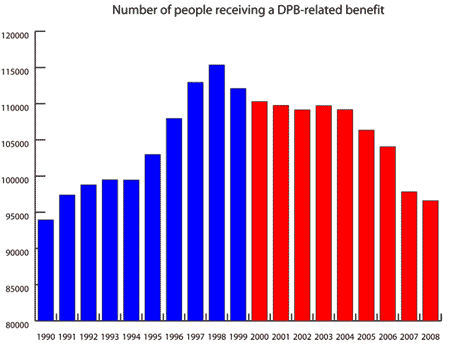
Parenting and paid work is a challenge at the best of times. Working and being a sole parent even more so. So it’s good to see effort being rewarded, and that a case managment approach is paying off for both recipients and WINZ. Will National keep the WINZ staff who are making a difference in their desire to streamline the public service? And what ARE National going to do about Working for Families? It must surely be time to start indicating where they stand on such an important policy area which is being distributed to three out of four families in NZ.
41 comments on “Fewer on sole parenting benefit ”
- Comments are now closed
- Comments are now closed
Recent Comments


- Your mandate is imaginary
 This open-for-business, under-new-management cliché-pockmarked government of Christopher Luxon is not the thing of beauty he imagines it to be. It is not the powerful expression of the will of the people that he asserts it to be. It is not a soaring eagle, it is a malodorous vulture. This newest poll should make ...5 hours ago
 - 14,000 unemployed under National
 The latest labour market statistics, showing a rise in unemployment. There are now 134,000 unemployed - 14,000 more than when the National government took office. Which is I guess what happens when the Reserve Bank causes a recession in an effort to Keep Wages Low. The previous government saw a ...7 hours ago
 - Bryce Edwards: Discontent and gloom dominate NZ’s political mood
 Three opinion polls have been released in the last two days, all showing that the new government is failing to hold their popular support. The usual honeymoon experienced during the first year of a first term government is entirely absent. The political mood is still gloomy and discontented, mainly due ...8 hours ago
 - Taking Tea with 42 & 38.
 National's Finance Minister once met a poor person.A scornful interview with National's finance guru who knows next to nothing about economics or people.There might have been something a bit familiar if that was the headline I’d gone with today. It would of course have been in tribute to the article ...8 hours ago
 - Beware political propaganda: statistics are pointing to Grant Robertson never protecting “Lives an...
 Rob MacCulloch writes – Throughout the pandemic, the new Vice-Chancellor-of-Otago-University-on-$629,000 per annum-Can-you-believe-it-and-Former-Finance-Minister Grant Robertson repeated the mantra over and over that he saved “lives and livelihoods”. As we update how this claim is faring over the course of time, the facts are increasingly speaking differently. NZ ...9 hours ago
 - Winding back the hands of history’s clockChris Trotter writes – IT’S A COMMONPLACE of political speeches, especially those delivered in acknowledgement of electoral victory: “We’ll govern for all New Zealanders.” On the face of it, the pledge is a strange one. Why would any political leader govern in ways that advantaged the huge ...9 hours ago
- Paula Bennett’s political appointment will challenge public confidence
 Bryce Edwards writes – The list of former National Party Ministers being given plum and important roles got longer this week with the appointment of former Deputy Prime Minister Paula Bennett as the chair of Pharmac. The Christopher Luxon-led Government has now made key appointments to Bill ...9 hours ago
 - Business confidence sliding into winter of discontent
 TL;DR: These are the six things that stood out to me in news and commentary on Aotearoa-NZ’s political economy at 10:06am on Wednesday, May 1:The Lead: Business confidence fell across the board in April, falling in some areas to levels last seen during the lockdowns because of a collapse in ...11 hours ago
 - Gordon Campbell on the coalition’s awful, not good, very bad poll results
 Over the past 36 hours, Christopher Luxon has been dong his best to portray the centre-right’s plummeting poll numbers as a mark of virtue. Allegedly, the negative verdicts are the result of hard economic times, and of a government bravely set out on a perilous rescue mission from which not ...12 hours ago
 - New HOP readers for future payment options
 Auckland Transport have started rolling out new HOP card readers around the network and over the next three months, all of them on buses, at train stations and ferry wharves will be replaced. The change itself is not that remarkable, with the new readers looking similar to what is already ...13 hours ago
 - 2024 Reading Summary: April (+ Writing Update)
 Completed reads for April: The Difference Engine, by William Gibson and Bruce Sterling Carnival of Saints, by George Herman The Snow Spider, by Jenny Nimmo Emlyn’s Moon, by Jenny Nimmo The Chestnut Soldier, by Jenny Nimmo Death Comes As the End, by Agatha Christie Lord of the Flies, by ...1 day ago
 - At a glance – Clearing up misconceptions regarding 'hide the decline'
 On February 14, 2023 we announced our Rebuttal Update Project. This included an ask for feedback about the added "At a glance" section in the updated basic rebuttal versions. This weekly blog post series highlights this new section of one of the updated basic rebuttal versions and serves as a ...1 day ago
 - Road photos
 Have a story to share about St Paul’s, but today just picturesPopular novels written at this desk by a young man who managed to bootstrap himself out of father’s imprisonment and his own young life in a workhouse Read more ...1 day ago
 - Bryce Edwards: Paula Bennett’s political appointment will challenge public confidenceThe list of former National Party Ministers being given plum and important roles got longer this week with the appointment of former Deputy Prime Minister Paula Bennett as the chair of Pharmac. The Christopher Luxon-led Government has now made key appointments to Bill English, Simon Bridges, Steven Joyce, Roger Sowry, ...1 day ago
- NZDF is still hostile to oversightNewsroom has a story today about National's (fortunately failed) effort to disestablish the newly-created Inspector-General of Defence. The creation of this agency was the key recommendation of the Inquiry into Operation Burnham, and a vital means of restoring credibility and social licence to an agency which had been caught lying ...1 day ago
- Winding Back The Hands Of History’s Clock.
 Holding On To The Present: The moment a political movement arises that attacks the whole idea of social progress, and announces its intention to wind back the hands of History’s clock, then democracy, along with its unwritten rules, is in mortal danger.IT’S A COMMONPLACE of political speeches, especially those delivered in ...1 day ago
 - Sweet Moderation? What Christopher Luxon Could Learn From The Germans.1 day ago
- A clear warningThe unpopular coalition government is currently rushing to repeal section 7AA of the Oranga Tamariki Act. The clause is Oranga Tamariki's Treaty clause, and was inserted after its systematic stealing of Māori children became a public scandal and resulted in physical resistance to further abductions. The clause created clear obligations ...1 day ago
- Poll results and Waitangi Tribunal report go unmentioned on the Beehive website – where racing tru...
 Buzz from the Beehive The government’s official website – which Point of Order monitors daily – not for the first time has nothing much to say today about political happenings that are grabbing media headlines. It makes no mention of the latest 1News-Verian poll, for example. This shows National down ...1 day ago
 - Listening To The Traffic.1 day ago
- Comity Be Damned! The State’s Legislative Arm Is Flexing Its Constitutional Muscles.Packing A Punch: The election of the present government, including in its ranks politicians dedicated to reasserting the rights of the legislature in shaping and determining the future of Māori and Pakeha in New Zealand, should have alerted the judiciary – including its anomalous appendage, the Waitangi Tribunal – that its ...1 day ago
- Ending The Quest.Dead Woman Walking: New Zealand’s media industry had been moving steadily towards disaster for all the years Melissa Lee had been National’s media and communications policy spokesperson, and yet, when the crisis finally broke, on her watch, she had nothing intelligent to offer. Christopher Luxon is a patient man - but he’s not ...1 day ago
- Will political polarisation intensify to the point where ‘normal’ government becomes impossible,...Chris Trotter writes – New Zealand politics is remarkably easy-going: dangerously so, one might even say. With the notable exception of John Key’s flat ruling-out of the NZ First Party in 2008, all parties capable of clearing MMP’s five-percent threshold, or winning one or more electorate seats, tend ...1 day ago
- Bernard’s pick 'n' mix for Tuesday, April 30
 TL;DR: Here’s my top 10 ‘pick ‘n’ mix of links to news, analysis and opinion articles as of 10:30am on Tuesday, May 30:Scoop: NZ 'close to the tipping point' of measles epidemic, health experts warn NZ Herald Benjamin PlummerHealth: 'Absurd and totally unacceptable': Man has to wait a year for ...1 day ago
 - Why Tory Whanau has the lowest approval rating in the countryBryce Edwards writes – Polling shows that Wellington Mayor Tory Whanau has the lowest approval rating of any mayor in the country. Siting at -12 per cent, the proportion of constituents who disapprove of her performance outweighs those who give her the thumbs up. This negative rating is ...1 day ago
- Worst poll result for a new Government in MMP history1 day ago
- Pinning down climate change's role in extreme weatherThis is a re-post from The Climate Brink by Andrew Dessler In the wake of any unusual weather event, someone inevitably asks, “Did climate change cause this?” In the most literal sense, that answer is almost always no. Climate change is never the sole cause of hurricanes, heat waves, droughts, or ...2 days ago
- Serving at Seymour's pleasure.
 Something odd happened yesterday, and I’d love to know if there’s more to it. If there was something which preempted what happened, or if it was simply a throwaway line in response to a journalist.Yesterday David Seymour was asked at a press conference what the process would be if the ...2 days ago
 - Webworm LA Pop-Up
 Hi,From time to time, I want to bring Webworm into the real world. We did it last year with the Jurassic Park event in New Zealand — which was a lot of fun!And so on Saturday May 11th, in Los Angeles, I am hosting a lil’ Webworm pop-up! I’ve been ...2 days ago
 - “Feel good” school is outEducation Minister Erica Standford yesterday unveiled a fundamental reform of the way our school pupils are taught. She would not exactly say so, but she is all but dismantling the so-called “inquiry” “feel good” method of teaching, which has ruled in our classrooms since a major review of the New ...2 days ago
- 6 Months in, surely our Report Card is “Ignored all warnings: recommend dismissal ASAP”?
 Exactly where are we seriously going with this government and its policies? That is, apart from following what may as well be a Truss-Lite approach on the purported economic “plan“, and Victorian-era regression when it comes to social policy. Oh it’ll work this time of course, we’re basically assured, “the ...2 days ago
 - Bread, and how it gets buttered
 Hey Uncle Dave, When the Poms joined the EEC, I wasn't one of those defeatists who said, Well, that’s it for the dairy job. And I was right, eh? The Chinese can’t get enough of our milk powder and eventually, the Poms came to their senses and backed up the ute ...2 days ago
 - Bryce Edwards: Why Tory Whanau has the lowest approval rating in the countryPolling shows that Wellington Mayor Tory Whanau has the lowest approval rating of any mayor in the country. Siting at -12 per cent, the proportion of constituents who disapprove of her performance outweighs those who give her the thumbs up. This negative rating is higher than for any other mayor ...2 days ago
- Justice for Gaza?The New York Times reports that the International Criminal Court is about to issue arrest warrants for Israeli officials, including Prime Minister Benjamin Netanyahu, over their genocide in Gaza: Israeli officials increasingly believe that the International Criminal Court is preparing to issue arrest warrants for senior government officials on ...2 days ago
- If there has been any fiddling with Pharmac’s funding, we can count on Paula to figure out the fis...Buzz from the Beehive Pharmac has been given a financial transfusion and a new chair to oversee its spending in the pharmaceutical business. Associate Health Minister David Seymour described the funding for Pharmac as “its largest ever budget of $6.294 billion over four years, fixing a $1.774 billion fiscal cliff”. ...2 days ago
- FastTrackWatch – The case for the Government’s Fast Track BillBryce Edwards writes – Many criticisms are being made of the Government’s Fast Track Approvals Bill, including by this writer. But as with everything in politics, every story has two sides, and both deserve attention. It’s important to understand what the Government is trying to achieve and its ...2 days ago
- Bernard’s pick 'n' mix for Monday, April 29
 TL;DR: Here’s my top 10 ‘pick ‘n’ mix of links to news, analysis and opinion articles as of 10:10am on Monday, April 29:Scoop: The children's ward at Rotorua Hospital will be missing a third of its beds as winter hits because Te Whatu Ora halted an upgrade partway through to ...2 days ago
 - Gordon Campbell on Iran killing its rappers, and searching for the invisible Dr. Retispan class=”dropcap”>As hideous as David Seymour can be, it is worth keeping in mind occasionally that there are even worse political figures (and regimes) out there. Iran for instance, is about to execute the country’s leading hip hop musician Toomaj Salehi, for writing and performing raps that “corrupt” the nation’s ...2 days ago
- Auckland Rail Electrification 10 years oldYesterday marked 10 years since the first electric train carried passengers in Auckland so it’s a good time to look back at it and the impact it has had. A brief history The first proposals for rail electrification in Auckland came in the 1920’s alongside the plans for earlier ...3 days ago
- Coalition's dirge of austerity and uncertainty is driving the economy into a deeper recession3 days ago
- Disability Funding or Tax Cuts.
 You make people evil to punish the paststuck inside a sequel with a rotating castThe following photos haven’t been generated with AI, or modified in any way. They are flesh and blood, human beings. On the left is Galatea Young, a young mum, and her daughter Fiadh who has Angelman ...3 days ago
 - Of the Goodness of Tolkien’s Eru
 April has been a quiet month at A Phuulish Fellow. I have had an exceptionally good reading month, and a decently productive writing month – for original fiction, anyway – but not much has caught my eye that suggested a blog article. It has been vaguely frustrating, to be honest. ...3 days ago
 - 2024 SkS Weekly Climate Change & Global Warming News Roundup #17A listing of 31 news and opinion articles we found interesting and shared on social media during the past week: Sun, April 21, 2024 thru Sat, April 27, 2024. Story of the week Anthropogenic climate change may be the ultimate shaggy dog story— but with a twist, because here ...3 days ago
- Pastor Who Abused People, Blames People
 Hi,I spent about a year on Webworm reporting on an abusive megachurch called Arise, and it made me want to stab my eyes out with a fork.I don’t regret that reporting in 2022 and 2023 — I am proud of it — but it made me angry.Over three main stories ...3 days ago
 - Vic Uni shows how under threat free speech isThe new Victoria University Vice-Chancellor decided to have a forum at the university about free speech and academic freedom as it is obviously a topical issue, and the Government is looking at legislating some carrots or sticks for universities to uphold their obligations under the Education and Training Act. They ...3 days ago
- Winston remembers Gettysburg.
 Do you remember when Melania Trump got caught out using a speech that sounded awfully like one Michelle Obama had given? Uncannily so.Well it turns out that Abraham Lincoln is to Winston Peters as Michelle was to Melania. With the ANZAC speech Uncle Winston gave at Gallipoli having much in ...4 days ago
 - 25
 She was born 25 years ago today in North Shore hospital. Her eyes were closed tightly shut, her mouth was silently moving. The whole theatre was all quiet intensity as they marked her a 2 on the APGAR test. A one-minute eternity later, she was an 8. The universe was ...4 days ago
 - Fact Brief – Is Antarctica gaining land ice?Skeptical Science is partnering with Gigafact to produce fact briefs — bite-sized fact checks of trending claims. This fact brief was written by Sue Bin Park in collaboration with members from our Skeptical Science team. You can submit claims you think need checking via the tipline. Is Antarctica gaining land ice? ...4 days ago
- Policing protests.
 Images of US students (and others) protesting and setting up tent cities on US university campuses have been broadcast world wide and clearly demonstrate the growing rifts in US society caused by US policy toward Israel and Israel’s prosecution of … Continue reading ...4 days ago
 - Open letter to Hon Paul GoldsmithBarrie Saunders writes – Dear Paul As the new Minister of Media and Communications, you will be inundated with heaps of free advice and special pleading, all in the national interest of course. For what it’s worth here is my assessment: Traditional broadcasting free to air content through ...4 days ago
- Bryce Edwards: FastTrackWatch – The Case for the Government’s Fast Track BillMany criticisms are being made of the Government’s Fast Track Approvals Bill, including by this writer. But as with everything in politics, every story has two sides, and both deserve attention. It’s important to understand what the Government is trying to achieve and its arguments for such a bold reform. ...4 days ago
- Luxon gets out his butcher’s knife – brieflyPeter Dunne writes – The great nineteenth British Prime Minister, William Gladstone, once observed that “the first essential for a Prime Minister is to be a good butcher.” When a later British Prime Minister, Harold Macmillan, sacked a third of his Cabinet in July 1962, in what became ...4 days ago
- More tax for lessEle Ludemann writes – New Zealanders had the OECD’s second highest tax increase last year: New Zealanders faced the second-biggest tax raises in the developed world last year, the Organisation for Economic Cooperation and Development (OECD) says. The intergovernmental agency said the average change in personal income tax ...4 days ago
- Real News vs Fake News.
 We all know something’s not right with our elections. The spread of misinformation, people being targeted with soundbites and emotional triggers that ignore the facts, even the truth, and influence their votes.The use of technology to produce deep fakes. How can you tell if something is real or not? Can ...5 days ago
 - Another way to roll
 Hello! Here comes the Saturday edition of More Than A Feilding, catching you up on the past week’s editions.Share ...5 days ago
 - Simon Clark: The climate lies you'll hear this yearThis video includes conclusions of the creator climate scientist Dr. Simon Clark. It is presented to our readers as an informed perspective. Please see video description for references (if any). This year you will be lied to! Simon Clark helps prebunk some misleading statements you'll hear about climate. The video includes ...5 days ago
- Cutting the Public Service
 It is all very well cutting the backrooms of public agencies but it may compromise the frontlines. One of the frustrations of the Productivity Commission’s 2017 review of universities is that while it observed that their non-academic staff were increasing faster than their academic staff, it did not bother to ...5 days ago
 - Luxon’s demoted ministers might take comfort from the British politician who bounced back after th...Buzz from the Beehive Two speeches delivered by Foreign Affairs Minister Winston Peters at Anzac Day ceremonies in Turkey are the only new posts on the government’s official website since the PM announced his Cabinet shake-up. In one of the speeches, Peters stated the obvious: we live in a troubled ...5 days ago
- This is how I roll over
 1. Which of these would you not expect to read in The Waikato Invader?a. Luxon is here to do business, don’t you worry about thatb. Mr KPI expects results, and you better believe itc. This decisive man of action is getting me all hot and excitedd. Melissa Lee is how ...5 days ago
 - The Waitangi Tribunal is not “a roving Commission”……it has a restricted jurisdiction which must not be abused: it is not an inquisition NOTE – this article was published before the High Court ruled that Karen Chhour does not have to appear before the Waitangi Tribunal Gary Judd writes – The High Court ...5 days ago
- Is Oranga Tamariki guilty of neglect?Lindsay Mitchell writes – One of reasons Oranga Tamariki exists is to prevent child neglect. But could the organisation itself be guilty of the same? Oranga Tamariki’s statistics show a decrease in the number and age of children in care. “There are less children ...5 days ago
- Three Strikes saw lower reoffendingDavid Farrar writes: Graeme Edgeler wrote in 2017: In the first five years after three strikes came into effect 5248 offenders received a ‘first strike’ (that is, a “stage-1 conviction” under the three strikes sentencing regime), and 68 offenders received a ‘second strike’. In the five years prior to ...5 days ago
- Luxon’s ruthless show of strength is perfect for our angry eraBryce Edwards writes – Prime Minister Christopher Luxon has surprised everyone with his ruthlessness in sacking two of his ministers from their crucial portfolios. Removing ministers for poor performance after only five months in the job just doesn’t normally happen in politics. That’s refreshing and will be extremely ...5 days ago
- 'Lacks attention to detail and is creating double-standards.'TL;DR: These are the six things that stood out to me in news and commentary on Aotearoa-NZ’s political economy in the two days to 6:06am on Thursday, April 25:Politics: PM Christopher Luxon has set up a dual standard for ministerial competence by demoting two National Cabinet ministers while leaving also-struggling ...6 days ago
- One Night Only!Hi,Today I mainly want to share some of your thoughts about the recent piece I wrote about success and failure, and the forces that seemingly guide our lives. But first, a quick bit of housekeeping: I am doing a Webworm popup in Los Angeles on Saturday May 11 at 2pm. ...6 days ago
- What did Melissa Lee do?It is hard to see what Melissa Lee might have done to “save” the media. National went into the election with no public media policy and appears not to have developed one subsequently. Lee claimed that she had prepared a policy paper before the election but it had been decided ...6 days ago
- Skeptical Science New Research for Week #17 2024Open access notables Ice acceleration and rotation in the Greenland Ice Sheet interior in recent decades, Løkkegaard et al., Communications Earth & Environment: In the past two decades, mass loss from the Greenland ice sheet has accelerated, partly due to the speedup of glaciers. However, uncertainty in speed derived from satellite products ...6 days ago
- Maori Party (with “disgust”) draws attention to Chhour’s race after the High Court rules on Wa...Buzz from the Beehive A statement from Children’s Minister Karen Chhour – yet to be posted on the Government’s official website – arrived in Point of Order’s email in-tray last night. It welcomes the High Court ruling on whether the Waitangi Tribunal can demand she appear before it. It does ...6 days ago
- Who’s Going Up The Media Mountain?Mr Bombastic: Ironically, the media the academic experts wanted is, in many ways, the media they got. In place of the tyrannical editors of yesteryear, advancing without fear or favour the interests of the ruling class; the New Zealand news media of today boasts a troop of enlightened journalists dedicated to ...6 days ago
- “That's how I roll”
 It's hard times try to make a livingYou wake up every morning in the unforgivingOut there somewhere in the cityThere's people living lives without mercy or pityI feel good, yeah I'm feeling fineI feel better then I have for the longest timeI think these pills have been good for meI ...7 days ago
 - “Comity” versus the rule of lawIn 1974, the US Supreme Court issued its decision in United States v. Nixon, finding that the President was not a King, but was subject to the law and was required to turn over the evidence of his wrongdoing to the courts. It was a landmark decision for the rule ...7 days ago
- Aotearoa: a live lab for failed Right-wing socio-economic zombie experiments once more…
 Every day now just seems to bring in more fresh meat for the grinder. In their relentlessly ideological drive to cut back on the “excessive bloat” (as they see it) of the previous Labour-led government, on the mountains of evidence accumulated in such a short period of time do not ...7 days ago
 - Water is at the heart of farmers’ struggle to survive in BeninThis is a re-post from Yale Climate Connections by Megan Valére Sosou Market gardening site of the Itchèléré de Itagui agricultural cooperative in Dassa-Zoumè (Image credit: Megan Valère Sossou) For the residents of Dassa-Zoumè, a city in the West African country of Benin, choosing between drinking water and having enough ...1 week ago
- At a time of media turmoil, Melissa had nothing to proclaim as Minister – and now she has been dem...Buzz from the Beehive
 Melissa Lee – as may be discerned from the screenshot above – has not been demoted for doing something seriously wrong as Minister of ... 1 week ago
 - These people are not our friends
 Morning in London Mother hugs beloved daughter outside the converted shoe factory in which she is living.Afternoon in London Travelling writer takes himself and his wrist down to A&E, just to be sure. Read more ...1 week ago


- Release: 130,000 cattle saved from live export
 Labour is calling for the Government to urgently rethink its coalition commitment to restart live animal exports, Labour animal welfare spokesperson Rachel Boyack said. ...7 hours ago
 - Central Bank makes clear Government is pouring fuel on housing crisis fire
 Today’s Financial Stability Report has once again highlighted that poverty and deep inequality are political choices - and this Government is choosing to make them worse. ...8 hours ago
 - New unemployment figures paint bleak pictureThe Green Party is calling on the Government to do more for our households in most need as unemployment rises and the cost of living crisis endures. ...9 hours ago
- Release: National’s job cuts already starting to bite as unemployment risesUnemployment is on the rise and it’s only going to get worse under this Government, Labour finance spokesperson Barbara Edmonds said. Stats NZ figures show the unemployment rate grew to 4.3 percent in the March quarter from 4 percent in the December quarter. “This is the second rise in unemployment ...9 hours ago
- Release: National hiking transport costs for families and young New ZealandersWeekly expenses will grow for more than 1.6 million New Zealanders as the Government ends free and half price public transport fares tomorrow. ...1 day ago
- Release: Labour welcomes EU free trade agreementThe New Zealand Labour Party welcomes the entering into force of the European Union and New Zealand free trade agreement. This agreement opens the door for a huge increase in trade opportunities with a market of 450 million people who are high value discerning consumers of New Zealand goods and ...1 day ago
- Surprise: Landlord tax cuts don’t trickle downThe Green Party is renewing its call for rent controls following reports of rental prices hitting an all-time high. ...1 day ago
- Release: $1.7b for no increase in access to medicineThe National-led Government continues its fiscal jiggery pokery with its Pharmac announcement today, Labour Health spokesperson Ayesha Verrall says. “The government has increased Pharmac funding but conceded it will only make minimal increases in access to medicine”, said Ayesha Verrall “This is far from the bold promises made to fund ...1 day ago
- Release: National should heed Tribunal warning and scrap coalition commitment with ACTThis afternoon’s interim Waitangi Tribunal report must be taken seriously as it affects our most vulnerable children, Labour children’s spokesperson Willow-Jean Prime. ...2 days ago
- Release: More accountability for preventable workplace deaths this Workers’ Memorial DayLabour is calling for more accountability for preventable workplace deaths because everybody who goes to work deserves to come home safely. ...2 days ago
- Gaza: Aotearoa Must Support Independent Investigation into Mass GravesTe Pāti Māori are demanding the New Zealand Government support an international independent investigation into mass graves that have been uncovered at two hospitals on the Gaza strip, following weeks of assault by Israeli troops. Among the 392 bodies that have been recovered, are children and elderly civilians. Many of ...5 days ago
- Release: Working together on consistent support for veterans this Anzac DayOur two-tiered system for veterans’ support is out of step with our closest partners, and all parties in Parliament should work together to fix it, Labour veterans’ affairs spokesperson Greg O’Connor said. ...1 week ago
- Release: Penny drops – but what about Seymour and Peters?Stripping two Ministers of their portfolios just six months into the job shows Christopher Luxon’s management style is lacking, Labour Leader Chris Hipkins said. ...1 week ago
- Another ‘Stolen Generation’ enabled by court ruling on Waitangi Tribunal summonsTonight’s court decision to overturn the summons of the Children’s Minister has enabled the Crown to continue making decisions about Māori without evidence, says Te Pāti Māori spokesperson for Children, Mariameno Kapa-Kingi. “The judicial system has this evening told the nation that this government can do whatever they want when ...1 week ago
- Release: Budget blunder shows Nicola Willis could cut recovery fundingIt appears Nicola Willis is about to pull the rug out from under the feet of local communities still dealing with the aftermath of last year’s severe weather, and local councils relying on funding to build back from these disasters. ...1 week ago
- Further environmental mismanagement on the cardsThe Government’s resource management reforms will add to the heavy and ever-growing burden this Government is loading on to our environment. ...1 week ago
- Release: RMA changes will be a disaster for environmentThe Government is making short-sighted changes to the Resource Management Act (RMA) that will take away environmental protection in favour of short-term profits, Labour’s environment spokesperson Rachel Brooking said today. ...1 week ago
- Release: Labour supports urgent changes to emergency management systemLabour welcomes the release of the report into the North Island weather events and looks forward to working with the Government to ensure that New Zealand is as prepared as it can be for the next natural disaster. ...1 week ago
- Release: Labour calls for New Zealand to recognise PalestineThe Labour Party has called for the New Zealand Government to recognise Palestine, as a material step towards progressing the two-State solution needed to achieve a lasting peace in the region. ...1 week ago
- Release: Three strikes law political posturing of worst kindThe Government is bringing back a law that has little evidential backing just to look tough, Labour justice spokesperson Duncan Webb said. ...1 week ago
- Release: Government cuts unbelievably target child exploitation, violent extremism, ports and airpor...Some of our country’s most important work, stopping the sexual exploitation of children and violent extremism could go along with staff on the frontline at ports and airports. ...1 week ago
- Three strikes has failed before and will fail againResurrecting the archaic three-strikes legislation is an unwelcome return to a failed American-style approach to justice. ...1 week ago
- Release: Environmental protection vital, not ‘onerous’The Government’s Fast Track Approvals Bill will give projects such as new coal mines a ‘get out of jail free’ card to wreak havoc on the environment, Labour Leader Chris Hipkins said today. ...1 week ago
- Ferris – Three Strikes targets those ‘too brown to be white’The government's decision to reintroduce Three Strikes is a destructive and ineffective piece of law-making that will only exacerbate an inherently biased and racist criminal justice system, said Te Pāti Māori Justice Spokesperson, Tākuta Ferris, today. During the time Three Strikes was in place in Aotearoa, Māori and Pasifika received ...1 week ago
- Release: Govt cuts doctors and nurses in hiring freezeCuts to frontline hospital staff are not only a broken election promise, it shows the reckless tax cuts have well and truly hit the frontline of the health system, says Labour Health spokesperson Ayesha Verrall. ...2 weeks ago
- Fast-track submissions period must be extendedThe Green Party has joined the call for public submissions on the fast-track legislation to be extended after the Ombudsman forced the Government to release the list of organisations invited to apply just hours before submissions close. ...2 weeks ago
- Release: Progress on climate will be undone by GovtNew Zealand’s good work at reducing climate emissions for three years in a row will be undone by the National government’s lack of ambition and scrapping programmes that were making a difference, Labour Party climate spokesperson Megan Woods said today. ...2 weeks ago
- Release: Dark day for Kiwi kids as a third of Govt cuts affect themNews that 1000 jobs at the Ministry of Education and Oranga Tamariki could go is devastating for future generations of New Zealanders. ...2 weeks ago
- Release: Alarm as Government signals further blow to school lunchesMore essential jobs could be on the chopping block, this time Ministry of Education staff on the school lunches team are set to find out whether they're in line to lose their jobs. ...2 weeks ago
- Oranga Tamariki cuts commit tamariki to state abuseTe Pāti Māori is disgusted at the confirmation that hundreds are set to lose their jobs at Oranga Tamariki, and the disestablishment of the Treaty Response Unit. “This act of absolute carelessness and out of touch decision making is committing tamariki to state abuse.” Said Te Pāti Māori Oranga Tamariki ...2 weeks ago
- Release: Quick, submit – stop Govt’s dodgy approvals billThe Government is trying to bring in a law that will allow Ministers to cut corners and kill off native species, Labour environment spokesperson Rachel Brooking said. ...2 weeks ago
- Government throws coal on the climate crisis fireThe Government’s policy announced today to ease consenting for coal mining will have a lasting impact across generations. ...2 weeks ago
- Release: Public transport costs to double as National looks at unaffordable roading project insteadCancelling urgently needed new Cook Strait ferries and hiking the cost of public transport for many Kiwis so that National can announce the prospect of another tunnel for Wellington is not making good choices, Labour Transport Spokesperson Tangi Utikere said. ...2 weeks ago
- Release: Cost of living in Auckland still not a priorityA laundry list of additional costs for Tāmaki Makarau Auckland shows the Minister for the city is not delivering for the people who live there, says Labour Auckland Issues spokesperson Shanan Halbert. ...2 weeks ago
- Te Pāti Māori to visit Queensland to strengthen ties with Māori in AustraliaTe Pāti Māori co-leader Rawiri Waititi, and Mema Paremata mō Tāmaki-Makaurau, Takutai Tarsh Kemp, will travel to the Gold Coast to strengthen ties with Māori in Australia next week (15-21 April). The visit, in the lead-up to the 9th Australian National Kapa haka Festival, will be an opportunity for both ...2 weeks ago
- Greens look to fast-track submissions on harmful lawThe Green Party has today launched a step-by-step guide to help New Zealanders make their voice heard on the Government’s democracy dodging and anti-environment fast track legislation. ...3 weeks ago
- Minister acknowledges passing of Sir Robert Martin (KNZM)
 New Zealand lost a true legend when internationally renowned disability advocate Sir Robert Martin (KNZM) passed away at his home in Whanganui last night, Disabilities Issues Minister Louise Upston says. “Our Government’s thoughts are with his wife Lynda, family and community, those he has worked with, the disability community in ...3 hours ago
 - Speech to New Zealand Institute of International Affairs, Parliament – Annual Lecture: Challenges ...Good evening – Before discussing the challenges and opportunities facing New Zealand’s foreign policy, we’d like to first acknowledge the New Zealand Institute of International Affairs. You have contributed to debates about New Zealand foreign policy over a long period of time, and we thank you for hosting us. ...4 hours ago
- Accelerating airport security linesFrom today, passengers travelling internationally from Auckland Airport will be able to keep laptops and liquids in their carry-on bags for security screening thanks to new technology, Transport Minister Simeon Brown says. “Creating a more efficient and seamless travel experience is important for holidaymakers and businesses, enabling faster movement through ...6 hours ago
- Community hui to talk about kina barrensPeople with an interest in the health of Northland’s marine ecosystems are invited to a public meeting to discuss how to deal with kina barrens, Oceans and Fisheries Minister Shane Jones says. Mr Jones will lead the discussion, which will take place on Friday, 10 May, at Awanui Hotel in ...11 hours ago
- Kiwi exporters win as NZ-EU FTA enters into forceKiwi exporters are $100 million better off today with the NZ EU FTA entering into force says Trade Minister Todd McClay. “This is all part of our plan to grow the economy. New Zealand's prosperity depends on international trade, making up 60 per cent of the country’s total economic activity. ...12 hours ago
- Mining resurgence a welcome signThere are heartening signs that the extractive sector is once again becoming an attractive prospect for investors and a source of economic prosperity for New Zealand, Resources Minister Shane Jones says. “The beginnings of a resurgence in extractive industries are apparent in media reports of the sector in the past ...13 hours ago
- Ō-Rākau Remembrance Bill passes first readingThe return of the historic Ō-Rākau battle site to the descendants of those who fought there moved one step closer today with the first reading of Te Pire mō Ō-Rākau, Te Pae o Maumahara / The Ō-Rākau Remembrance Bill. The Bill will entrust the 9.7-hectare battle site, five kilometres west ...1 day ago
- Government to boost public EV charging networkEnergy Minister Simeon Brown has announced 25 new high-speed EV charging hubs along key routes between major urban centres and outlined the Government’s plan to supercharge New Zealand’s EV infrastructure. The hubs will each have several chargers and be capable of charging at least four – and up to 10 ...1 day ago
- Residential Property Managers Bill to not progressThe coalition Government will not proceed with the previous Government’s plans to regulate residential property managers, Housing Minister Chris Bishop says. “I have written to the Chairperson of the Social Services and Community Committee to inform him that the Government does not intend to support the Residential Property Managers Bill ...1 day ago
- Independent review into disability support servicesThe Government has announced an independent review into the disability support system funded by the Ministry of Disabled People – Whaikaha. Disability Issues Minister Louise Upston says the review will look at what can be done to strengthen the long-term sustainability of Disability Support Services to provide disabled people and ...1 day ago
- Justice Minister updates UN on law & order planJustice Minister Paul Goldsmith has attended the Universal Periodic Review in Geneva and outlined the Government’s plan to restore law and order. “Speaking to the United Nations Human Rights Council provided us with an opportunity to present New Zealand’s human rights progress, priorities, and challenges, while responding to issues and ...1 day ago
- Ending emergency housing motels in RotoruaThe Government and Rotorua Lakes Council are committed to working closely together to end the use of contracted emergency housing motels in Rotorua. Associate Minister of Housing (Social Housing) Tama Potaka says the Government remains committed to ending the long-term use of contracted emergency housing motels in Rotorua by the ...2 days ago
- Trade Minister travels to Riyadh, OECD, and DubaiTrade Minister Todd McClay heads overseas today for high-level trade talks in the Gulf region, and a key OECD meeting in Paris. Mr McClay will travel to Riyadh to meet with counterparts from Saudi Arabia and the Gulf Cooperation Council (GCC). “New Zealand’s goods and services exports to the Gulf region ...2 days ago
- Education priorities focused on lifting achievementEducation Minister Erica Stanford has outlined six education priorities to deliver a world-leading education system that sets Kiwi kids up for future success. “I’m putting ambition, achievement and outcomes at the heart of our education system. I want every child to be inspired and engaged in their learning so they ...2 days ago
- NZTA App first step towards digital driver licenceThe new NZ Transport Agency (NZTA) App is a secure ‘one stop shop’ to provide the services drivers need, Transport Minister Simeon Brown and Digitising Government Minister Judith Collins say. “The NZTA App will enable an easier way for Kiwis to pay for Vehicle Registration and Road User Charges (RUC). ...2 days ago
- Supporting whānau out of emergency housingWhānau with tamariki growing up in emergency housing motels will be prioritised for social housing starting this week, says Associate Housing Minister Tama Potaka. “Giving these whānau a better opportunity to build healthy stable lives for themselves and future generations is an essential part of the Government’s goal of reducing ...2 days ago
- Tribute to Dave O'SullivanRacing Minister Winston Peters has paid tribute to an icon of the industry with the recent passing of Dave O’Sullivan (OBE). “Our sympathies are with the O’Sullivan family with the sad news of Dave O’Sullivan’s recent passing,” Mr Peters says. “His contribution to racing, initially as a jockey and then ...2 days ago
- Speech – Eid al-FitrAssalaamu alaikum, greetings to you all. Eid Mubarak, everyone! I want to extend my warmest wishes to you and everyone celebrating this joyous occasion. It is a pleasure to be here. I have enjoyed Eid celebrations at Parliament before, but this is my first time joining you as the Minister ...2 days ago
- Government saves access to medicinesAssociate Health Minister David Seymour has announced Pharmac’s largest ever budget of $6.294 billion over four years, fixing a $1.774 billion fiscal cliff. “Access to medicines is a crucial part of many Kiwis’ lives. We’ve committed to a budget allocation of $1.774 billion over four years so Kiwis are ...2 days ago
- Pharmac Chair appointedHon Paula Bennett has been appointed as member and chair of the Pharmac board, Associate Health Minister David Seymour announced today. "Pharmac is a critical part of New Zealand's health system and plays a significant role in ensuring that Kiwis have the best possible access to medicines,” says Mr Seymour. ...3 days ago
- Taking action on Fetal Alcohol Spectrum DisorderHundreds of New Zealand families affected by Fetal Alcohol Spectrum Disorder (FASD) will benefit from a new Government focus on prevention and treatment, says Health Minister Dr Shane Reti. “We know FASD is a leading cause of preventable intellectual and neurodevelopmental disability in New Zealand,” Dr Reti says. “Every day, ...4 days ago
- New sports complex opens in KaikoheRegional Development Minister Shane Jones today attended the official opening of Kaikohe’s new $14.7 million sports complex. “The completion of the Kaikohe Multi Sports Complex is a fantastic achievement for the Far North,” Mr Jones says. “This facility not only fulfils a long-held dream for local athletes, but also creates ...4 days ago
- Diplomacy needed more than everForeign Minister Winston Peters’ engagements in Türkiye this week underlined the importance of diplomacy to meet growing global challenges. “Returning to the Gallipoli Peninsula to represent New Zealand at Anzac commemorations was a sombre reminder of the critical importance of diplomacy for de-escalating conflicts and easing tensions,” Mr Peters ...5 days ago
- Anzac Commemorative Address, Buttes New British Cemetery BelgiumAmbassador Millar, Burgemeester, Vandepitte, Excellencies, military representatives, distinguished guests, ladies and gentlemen – good morning and welcome to this sacred Anzac Day dawn service. It is an honour to be here on behalf of the Government and people of New Zealand at Buttes New British Cemetery, Polygon Wood – a deeply ...5 days ago
- Anzac Commemorative Address – NZ National Service, Chunuk BairDistinguished guests - It is an honour to return once again to this site which, as the resting place for so many of our war-dead, has become a sacred place for generations of New Zealanders. Our presence here and at the other special spaces of Gallipoli is made ...6 days ago
- Anzac Commemorative Address – Dawn Service, Gallipoli, TürkiyeMai ia tawhiti pamamao, te moana nui a Kiwa, kua tae whakaiti mai matou, ki to koutou papa whenua. No koutou te tapuwae, no matou te tapuwae, kua honoa pumautia. Ko nga toa kua hinga nei, o te Waipounamu, o te Ika a Maui, he okioki tahi me o ...6 days ago
- PM announces changes to portfoliosPaul Goldsmith will take on responsibility for the Media and Communications portfolio, while Louise Upston will pick up the Disability Issues portfolio, Prime Minister Christopher Luxon announced today. “Our Government is relentlessly focused on getting New Zealand back on track. As issues change in prominence, I plan to adjust Ministerial ...1 week ago
- New catch limits for unique fishery areasRecreational catch limits will be reduced in areas of Fiordland and the Chatham Islands to help keep those fisheries healthy and sustainable, Oceans and Fisheries Minister Shane Jones says. The lower recreational daily catch limits for a range of finfish and shellfish species caught in the Fiordland Marine Area and ...1 week ago
- Minister welcomes hydrogen milestoneEnergy Minister Simeon Brown has welcomed an important milestone in New Zealand’s hydrogen future, with the opening of the country’s first network of hydrogen refuelling stations in Wiri. “I want to congratulate the team at Hiringa Energy and its partners K one W one (K1W1), Mitsui & Co New Zealand ...1 week ago
- Urgent changes to system through first RMA Amendment BillThe coalition Government is delivering on its commitment to improve resource management laws and give greater certainty to consent applicants, with a Bill to amend the Resource Management Act (RMA) expected to be introduced to Parliament next month. RMA Reform Minister Chris Bishop has today outlined the first RMA Amendment ...1 week ago
- Overseas decommissioning models consideredOverseas models for regulating the oil and gas sector, including their decommissioning regimes, are being carefully scrutinised as a potential template for New Zealand’s own sector, Resources Minister Shane Jones says. The Coalition Government is focused on rebuilding investor confidence in New Zealand’s energy sector as it looks to strengthen ...1 week ago
- Release of North Island Severe Weather Event InquiryEmergency Management and Recovery Minister Mark Mitchell has today released the Report of the Government Inquiry into the response to the North Island Severe Weather Events. “The report shows that New Zealand’s emergency management system is not fit-for-purpose and there are some significant gaps we need to address,” Mr Mitchell ...1 week ago
- Justice Minister to attend Human Rights CouncilJustice Minister Paul Goldsmith is today travelling to Europe where he’ll update the United Nations Human Rights Council on the Government’s work to restore law and order. “Attending the Universal Periodic Review in Geneva provides us with an opportunity to present New Zealand’s human rights progress, priorities, and challenges, while ...1 week ago
- Patterson reopens world’s largest wool scouring facilityAssociate Agriculture Minister, Mark Patterson, formally reopened the world’s largest wool processing facility today in Awatoto, Napier, following a $50 million rebuild and refurbishment project. “The reopening of this facility will significantly lift the economic opportunities available to New Zealand’s wool sector, which already accounts for 20 per cent of ...1 week ago
- Speech to the Southland Otago Regional Engineering Collective Summit, 18 April 2024Hon Andrew Bayly, Minister for Small Business and Manufacturing At the Southland Otago Regional Engineering Collective (SOREC) Summit, 18 April, Dunedin Ngā mihi nui, Ko Andrew Bayly aho, Ko Whanganui aho Good Afternoon and thank you for inviting me to open your summit today. I am delighted ...1 week ago
- Government to introduce revised Three Strikes lawThe Government is delivering on its commitment to bring back the Three Strikes legislation, Associate Justice Minister Nicole McKee announced today. “Our Government is committed to restoring law and order and enforcing appropriate consequences on criminals. We are making it clear that repeat serious violent or sexual offending is not ...1 week ago
- New diplomatic appointmentsForeign Minister Winston Peters has today announced four new diplomatic appointments for New Zealand’s overseas missions. “Our diplomats have a vital role in maintaining and protecting New Zealand’s interests around the world,” Mr Peters says. “I am pleased to announce the appointment of these senior diplomats from the ...1 week ago
- Humanitarian support for Ethiopia and SomaliaNew Zealand is contributing NZ$7 million to support communities affected by severe food insecurity and other urgent humanitarian needs in Ethiopia and Somalia, Foreign Minister Rt Hon Winston Peters announced today. “Over 21 million people are in need of humanitarian assistance across Ethiopia, with a further 6.9 million people ...1 week ago
- Arts Minister congratulates Mataaho CollectiveMinister for Arts, Culture and Heritage Paul Goldsmith is congratulating Mataaho Collective for winning the Golden Lion for best participant in the main exhibition at the Venice Biennale. "Congratulations to the Mataaho Collective for winning one of the world's most prestigious art prizes at the Venice Biennale. “It is good ...1 week ago
- Supporting better financial outcomes for KiwisThe Government is reforming financial services to improve access to home loans and other lending, and strengthen customer protections, Commerce and Consumer Affairs Minister Andrew Bayly and Housing Minister Chris Bishop announced today. “Our coalition Government is committed to rebuilding the economy and making life simpler by cutting red tape. We are ...2 weeks ago
- Live cattle exports help farmers diversify income – Associate Agriculture Minister
 The government is hoping live animal exports will resume next year, but with a strict gold standard in place. ...58 mins ago
 - Who were the real courtesans at the heart of Netflix’s Heeramandi?
 Source: The Conversation (Au and NZ) – By Radhika Raghav, Teaching Fellow, School of Humanities and Social Sciences, University of Otago Netflix Indian director Sanjay Leela Bhansali is known for his big-budget Bollywood production, featuring grand sets, star casts, meticulously choreographed dance sequences and lavish costumes, jewellery and furnishings. ...1 hour ago
 - Police Minister Mark Mitchell heads to Australia to discuss crime trends, youth offendersMark Mitchell will be chewing the fat with police chiefs as officers in this country talk openly about the appeal of crossing the Tasman. ...2 hours ago
- Te Kāhui Tika Tangata Human Rights Commission Pays Tribute To Sir Robert Martin MNZM
 Sir Robert devoted his life to disability rights after living in institutions in his younger years, says Kaihautū Tika Hauātanga | Disability Rights Commissioner Prudence Walker. ...3 hours ago
 - Passing Of Sir Robert Martin KNZMPeople First New Zealand Ngā Tāngata Tuatahi is deeply saddened by the passing of Life Member Sir Robert Martin KNZM. ...3 hours ago
- James Shaw's valedictory – and his new roleShaw has bowed out of Parliament, and has already revealed details of what he is doing next. ...3 hours ago
- James Shaw's valedictory – and his new rolesShaw has bowed out of Parliament, and has already revealed details of what he is doing next. ...3 hours ago
- AUKUS: Winston Peters says NZ 'long way' from deciding on Pillar 2Peters spoke about the military pact in an annual 'scene setter' speech at Parliament on Wednesday evening. ...3 hours ago
- National Cabinet has committed to a range of strategies to stop violence against women, but has it d...Source: The Conversation (Au and NZ) – By Anastasia Powell, Professor, Family and Sexual Violence, RMIT University Violence against women is not a women’s problem to solve, it is a whole of society problem to solve; and men in particular have to take responsibility. Those were the ...3 hours ago
- Is bioenergy ever truly green? It depends on 5 key questionsSource: The Conversation (Au and NZ) – By Jessica Allen, Senior Lecturer in Chemical and Renewable Energy Engineering, University of Newcastle Snapshot freddy/Shutterstock Plans to revive an old coal-fired power station using bioenergy are being considered in the Hunter region of New South Wales. Similar plans for the station ...4 hours ago
- Free school lunches scheme to get temporary funding until review is completeFunding for the scheme is set to continue for the "immediate few years" while officials work out what the alternative programme will look like. ...4 hours ago
- Taxpayers’ Union Slams Secret List Of Judges’ PerksResponding to the long-awaited release of judges’ special allowances, including free air travel and hotels for spouses, generous sabbaticals, and access to limousines, Taxpayers’ Union spokesman Alex Murphy said: “In what world does your employer ...4 hours ago
- Winston Peters expected to give update on AUKUS talks in speechAnalysis - The United States has unveiled plans to boost the weapons trade with Australia and the UK, on the same day that Winston Peters is expected to sketch NZ's position on AUKUS. ...4 hours ago
- Why did the Voice referendum fail? We crunched the data and found 6 reasonsSource: The Conversation (Au and NZ) – By Andrea Carson, Professor of Political Communication, Department of Politics, Media and Philosophy, La Trobe University Since Australia’s First Nations Voice to Parliament referendum in October 2023, diverse commentaries have sought to explain why it failed. But what does an analysis of media ...4 hours ago
- Court hears appeal of Waitangi Tribunal summons decision
 Lawyers representing two iwi as well as the Māori Women’s Welfare League on Wednesday asked the Court of Appeal to overturn last week’s High Court decision on the Waitangi Tribunal’s decision to summons Children’s Minister Karen Chhour. The Tribunal is currently investigating the Government’s decision to repeal section 7AA of ...5 hours ago
 - Former MPs Louisa Wall, Simon O'Connor claim to be targets of China-backed cyber attackThe spy agencies are being questioned after two former MPs claim they were never informed they were victims of a China-backed cyber-attack. ...5 hours ago
- Kāinga Ora home vacancies 'trending downwards' after minister's letterThe agency recently changed the way it counts vacancies so it is more accurate. ...5 hours ago
- Albanese government flags measures to tackle online misogyny in the battle against violence towards ...Source: The Conversation (Au and NZ) – By Michelle Grattan, Professorial Fellow, University of Canberra The Albanese government will introduce legislation to ban deepfake pornography and provide more funding for the eSafety Commission to pilot age-assurance technologies. The contribution of internet sites to gender-based violence was one major issue ...5 hours ago
- Average Hourly Earnings Up 5.2 Percent Annually – Stats NZAverage ordinary time hourly earnings, as measured by the Quarterly Employment Survey (QES), increased 5.2 percent in the year to the March 2024 quarter, according to figures released by Stats NZ today. Annual wage cost inflation, as measured by the ...6 hours ago
- Job scams are on the rise. What are they, and how can you protect yourself?Source: The Conversation (Au and NZ) – By Dimitrios Salampasis, FinTech Capability Lead | Senior Lecturer, Emerging Technologies and FinTech, Swinburne University of Technology Clem Onojeghuo/Unsplash In the digital era, the job market is increasingly becoming a minefield – demanding and difficult to navigate. According to the Australian Bureau ...6 hours ago
- Two Decades Of Youth Employment And Education – Stats NZAs of the March 2024 quarter, we can now look back on 20 years of data related to youth not in employment, education, or training (NEET), as collected by the Household Labour Force Survey (HLFS), according to figures released by Stats NZ today. "The ...6 hours ago
- May Day: The Biggest Threat To NZ Workers In 2024 Is Our GovernmentThousands of workers attended public events in Auckland, Wellington and Christchurch today to celebrate International Workers’ Day (May Day), but union representatives are urging caution and vigilance over the Government’s blatantly "anti-worker" ...6 hours ago
- Unemployment Rate At 4.3 Percent – Stats NZThe seasonally adjusted unemployment rate was 4.3 percent in the March 2024 quarter, compared with 4.0 percent in the previous quarter, according to figures released by Stats NZ today. ...6 hours ago
- David Seymour wants to stop 'lazily' categorising by raceThe ACT leader rails against "lazily looking at everyone through the lens of race" in latest episode of RNZ's new in depth interview show. ...6 hours ago
- Private Info Of New Zealanders Will Be Breached By Latest Government CutsThe PSA is warning the Government that the sensitive information of New Zealanders held by various agencies will fall into the wrong hands if the latest round of proposed cuts goes ahead. ...6 hours ago
- Curious Kids: how do sugar rushes work?Source: The Conversation (Au and NZ) – By Talitha Best, Professor of Psychology, CQUniversity Australia Victoria Rodriguez/Unsplash How do sugar rushes work? – W.H, age nine, from Canberra What a terrific question W.H! Let’s explore this, starting with some of the basics. What is sugar? ...7 hours ago
- Our research shows a strong link between unemployment and domestic violence: what does this mean for...Source: The Conversation (Au and NZ) – By Karinna Saxby, Research Fellow, Melbourne Institute of Applied Economic and Social Research, The University of Melbourne MART PRODUCTION/Pexels Increasing income support could help keep women and children safe according to new work demonstrating strong links between financial insecurity and domestic violence. ...7 hours ago
- From Gallipoli to Gaza: remembering the Anzacs not as a ‘coming of age’ tale but as a lesson for...ANALYSIS: By Olli Hellmann, University of Waikato When New Zealanders commemorate Anzac Day today on April 25, it’s not only to honour the soldiers who lost their lives in World War I and subsequent conflicts, but also to mark a defining event for national identity. The battle of Gallipoli against ...7 hours ago
- ‘A major shakeup’: the Optus outage has been investigated. What’s going to change now?Source: The Conversation (Au and NZ) – By Mark A Gregory, Associate Professor, School of Engineering, RMIT University The telecommunications industry faces a major shakeup following the release of the post-incident report on last November’s 12-hour Optus outage. Telecommunications companies will have to share more information with customers during future ...7 hours ago
- ‘There is some properly foul content in this book’: What a bookseller reads
 Welcome to The Spinoff Bookseller Confessional, in which we get to know Aotearoa’s booksellers. This week: Eden Denyer, bookseller at Unity Books Auckland. Weirdest question/request you’ve had on the shop floor A mother came in looking for anything we might have on Alaskan bison as that was her little boy’s ...7 hours ago
 - Unemployment Data Shows Need For Govt To Act NowNZCTU Economist Craig Renney said new data released by Statistics New Zealand shows the need for Government to act now, with unemployment rising from 3.4% to 4.3%. ...7 hours ago
- Polls are nothing if not a bit of political theatre The outpouring of anger over Maiki Sherman’s hyperbolic presentation of this week’s ‘nightmare’ poll is itself an overreaction, argues Stewart Sowman-Lund. Politicians love nothing more than to pretend they don’t care about polls. This week, deputy prime minister Winston Peters said he didn’t give a “rat’s derriere” about a TVNZ ...7 hours ago
- Ngāti Kahungunu becomes NZ’s first iwi to call for a Gaza ceasefireAsia Pacific Report Ngāti Kahungunu in Aotearoa New Zealand’s Hawkes Bay region has become the first indigenous Māori iwi (tribe) to sign a resolution calling for a “ceasefire in Palestine”, reports Te Ao Māori News. Reporter Te Aniwaniwa Paterson talked to Te Otāne Huata, who has been organising peace rallies ...8 hours ago
- PNG businesses want grants, not loans over Black Wednesday riotsBy Dale Luma in Port Moresby “We want grants and not concessional loans,” is the crisp message from Papua New Guinea businesses directly affected by the Black Wednesday looting four months ago. The businesses, which lost millions after the January 10 rioting and looting, say they need grants as part ...8 hours ago
- Pay bump for politicians: What you need to knowExplainer - MPs are about to get a pay bump, but is it fair and how does it compare to other countries? ...8 hours ago
- School lunches funding likely to be time-limitedIt's an approach to funding the government has spent months criticising Labour over - calling them "fiscal cliffs" . ...9 hours ago
- Cum chairs, stolen pay and shitting bans: Workers share their horror stories with usHappy May Day. Join a union. Q: What’s worse than a staff break room where the only place to sit and have a cup of tea is on a teetering stack of old pornography magazines? A: Your boss replacing the magazine stacks with chairs that are “heartily encrusted with ...9 hours ago
- Landlord Government Once Again Pushes Renters Into The ColdThe Coalition is trying to axe yet another opportunity to improve rentals by dropping the Residential Property Managers Bill. ...10 hours ago
- Ready, set, go in Solomons PM race – Jeremiah Manele vs Matthew WaleBy Koroi Hawkins, RNZ Pacific editor Former opposition leader Matthew Wale has been announced as the second prime ministerial candidate ahead of the election in Solomon Islands tomorrow. He will face off against former foreign affairs minister Jeremiah Manele, who was announced by the Coalition for National Unity and Transformation ...10 hours ago
- Unemployment rate rises to 4.3%Fewer jobs are created and immigration is increasing the size of the workforce, Stats NZ says. ...10 hours ago
- The art of the three-day birthdayWe get but one birthday a year – why not make it last as long as possible by scheduling as many meals with friends and family as you can? This is an excerpt from our weekly food newsletter, The Boil Up. How do you celebrate your birthday? Do you celebrate at ...11 hours ago
- If the industry is to survive, journalists need to convince the public of their worthA Koi Tū discussion paper released today proposes sweeping changes to New Zealand’s media industry. The principal’s key author, Gavin Ellis, explains how journalists have a key role to play in making others value their role in society. This is an abridged version of a piece first published on knightlyviews.com ...11 hours ago
- Government Risks Wellbeing Of Māori With Proposed Cuts To Te Puni KōkiriThe Government’s spending cuts are again targeting support for Māori with proposed reform of the agency charged with advising on Māori wellbeing and development. ...11 hours ago
- What just happened to Bonza? Why new budget airlines always struggle in AustraliaSource: The Conversation (Au and NZ) – By Ian Douglas, Honorary Senior Lecturer, UNSW Aviation., UNSW Sydney The history of budget jet airlines in Australia is a long road littered with broken dreams. New entrants have consistently struggled to get a foothold. Low-cost carrier Bonza has just become the industry’s ...11 hours ago
- Free trade deal with the European Union comes into forceThe European Union ambassador says the FTA will have immediate wins for kiwifruit, apple, and onion growers. ...12 hours ago
- Violence against women is both a legal and cultural problem. What can we do to address it?Source: The Conversation (Au and NZ) – By Rosalind Dixon, Director, Gilbert + Tobin Centre of Public Law, UNSW Sydney Australia is finally having a sustained conversation about violence against women and what we can do about it. It is more than time. Australian women and girls continue to experience ...12 hours ago
- GP clinics are going to pay more payroll tax, which could reduce bulk billingSource: The Conversation (Au and NZ) – By Stephen Duckett, Honorary Enterprise Professor, School of Population and Global Health, and Department of General Practice and Primary Care, The University of Melbourne stockfour/Shutterstock Preliminary bulk billing data released this week shows a 2.1% rise in bulk billing up to March. ...12 hours ago
- ‘Make me a sandwich’: our survey’s disturbing picture of how some boys treat their teachersSource: The Conversation (Au and NZ) – By Samantha Schulz, Senior Lecturer, University of Adelaide Australia is once again grappling with how we can stop gendered violence in our country. Protests over the weekend show there is enormous community anger over the number of women who are dying and National ...12 hours ago
- Australians lose $5,200 a minute to scammers. There’s a simple thing the government could do to re...Source: The Conversation (Au and NZ) – By Peter Martin, Visiting Fellow, Crawford School of Public Policy, Australian National University AnastasiaDudka/Shutterstock What if the government was doing everything it could to stop thieves making off with our money, except the one thing that could really work? That’s how it ...12 hours ago
- Psychological drama, wilderness reality and everyone’s favourite dog: the best of streaming this M...Source: The Conversation (Au and NZ) – By Erin Harrington, Senior Lecturer in English and Cultural Studies, University of Canterbury The Conversation It seems to be a time of old favourites. This month our experts have recommended two new seasons – the second season of Alone Australia (although ...12 hours ago
- Te Tiriti o Waitangi could be heading home after 'long and arduous journey'After 184 years, Te Tiriti o Waitangi may be on its way home. ...13 hours ago
- The Eta Aquariid meteor shower is about to peak and could be the best this century – here’s how ...Source: The Conversation (Au and NZ) – By Jonti Horner, Professor (Astrophysics), University of Southern Queensland A bright Eta Aquariid meteor photobombed this photo of comet C/2020 F8 (SWAN) in May 2020. Jonti Horner Meteors – commonly known as shooting stars – can be seen on any night of the ...13 hours ago
- Wondering what Australia might look like in a hotter world? Take a glimpse into the distant pastSource: The Conversation (Au and NZ) – By Tim Flannery, Honorary fellow, The University of Melbourne Shutterstock Current concentrations of carbon dioxide (CO₂) in Earth’s atmosphere are unprecedented in human history. But CO₂ levels today, and those that might occur in coming decades, did occur millions of years ago. ...13 hours ago
- Foreign minister speech tipped to shed light on Aukus involvementWinston Peters has been keen to dismiss speculation on our involvement in Aukus but will give a speech tonight on the direction of our foreign policy, writes Anna Rawhiti-Connell in this excerpt from The Bulletin, The Spinoff’s morning news round-up. To receive The Bulletin in full each weekday, sign up here. ...13 hours ago
- Will New Zealand’s school phone ban work? Let’s see what it does for students’ curiositySource: The Conversation (Au and NZ) – By Patrick Usmar, Lecturer in Critical Media Literacies, Auckland University of Technology Getty Images With the coalition government’s ban of student mobile phones in New Zealand schools coming into effect this week, reaction has ranged from the sceptical (kids will just get ...13 hours ago
- School's struggle with asbestos removal: 'It's destroyed me'An Auckland school's efforts to get rid of asbestos has been so tough its principal thought of quitting the job. ...14 hours ago
- Hospital hiring has to go through head office in 'short term' budget moveHospitals around the country are not allowed to make a single hiring decision without the approval of Te Whatu Ora's head office, including for cleaners and administration staff. ...14 hours ago
- Urgent democratic need to save NZ’s journalism ecosystemA new report on protecting journalism and democracy in New Zealand recommends a levy be charged on global platforms like Facebook and Google to fund media firms undertaking public interest reporting. It also calls for the reinstatement of a powerful Broadcasting Commission to distribute public funding for journalism and other ...14 hours ago
- Unions Celebrate May Day During Tough Time For Working PeopleOn International Workers' Day, also known as May Day, the New Zealand Council of Trade Unions Te Kauae Kaimahi and the wider union movement are celebrating the proud history of the labour movement during a tough time for working people. ...15 hours ago
- 'Never a right time' – MPs respond to pay rise newsThe pay rises are not particularly great timing when the public is doing it tough, ACT Party leader David Seymour says. ...16 hours ago
- The highs and lows of James Shaw’s 10 years in parliamentFrom bills to beards, a walk through the former Green co-leader’s time in politics. After close to a decade in politics, James Shaw is preparing to bid farewell to parliament. Tonight will see the former minister deliver his valedictory address, certain to be a speech filled with Shaw’s trademark wit ...16 hours ago
- Efeso Collins deserved better than what parliament offered yesterdayTwo months ago, MPs unanimously voted to give themselves a week off in Efeso Collins’ honour. On Tuesday, most were too busy to give even an hour of their time. The day Fa’anānā Efeso Collins died, parliament felt different. In a building that operates at a breakneck pace, everyone stopped ...16 hours ago
- What you need to know about the world’s biggest election, happening right nowIndia’s election involves hundreds of millions of people and is a months-long affair. Here’s how voting works and what’s at stake. The biggest-ever election in world history started on April 19, with more than 10% of the world’s population eligible to vote. Elections in India, the world’s most populous country ...16 hours ago
- When the doghouse is an upgrade, ECE is in troubleOpinion: The impression from the carpark is very inviting. The area is well fenced but barred so there is easy visibility of loved ones. Inside, the spaces are welcoming and clean and staff are friendly and clearly comfortable. I am greeted by ‘Kim’. She has worked here for three years, ...16 hours ago
- Daily crossword, Wednesday 1 MayThe post Daily crossword, Wednesday 1 May appeared first on Newsroom. ...16 hours ago
- Boards, don’t just wait for the axe to fallOpinion: Community organisation board members need to step up their strategic thinking The post Boards, don’t just wait for the axe to fall appeared first on Newsroom. ...16 hours ago
- We have an emergency emergencyAfter the Christchurch earthquake, the then-national civil defence boss compared his experience to “putting a team on the rugby field who have never ever played together before”. Now, eight years later – and following a damning inquiry into the emergency response of cyclones Gabrielle, Hale and the Auckland anniversary weekend floods – ...16 hours ago
- A body in Devonport“I had just come off the end of a major robbery case which I had been working on for six months when I got a call on the afternoon of September 1, 1992, that some remains had been found at a building site in Devonport, so I drove over with ...16 hours ago
- Newsroom daily quiz, Wednesday 1 MayLoading…(function(i,s,o,g,r,a,m){var ql=document.querySelectorAll('A,DIV,A[data-quiz],DIV[data-quiz]'); if(ql){if(ql.length){for(var k=0;k<ql.length;k++){ql[k].id='quiz-embed-'+k;ql[k].href="javascript:var i=document.getElementById('quiz-embed-"+k+"');try{qz.startQuiz(i)}catch(e){i.start=1;i.style.cursor='wait';i.style.opacity='0.5'};void(0);"}}};i['QP']=r;i[r]=i[r]||function(){(i[r].q=i[r].q||[]).push(arguments)},i[r].l=1*new Date();a=s.createElement(o),m=s.getElementsByTagName(o)[0];a.async=1;a.src=g;m.parentNode.insertBefore(a,m)})(window,document,'script','https://take.quiz-maker.com/3012/CDN/quiz-embed-v1.js','qp'); Got a good quiz question? Send Newsroom your questions. The post Newsroom daily quiz, Wednesday 1 May appeared first on Newsroom. ...16 hours ago
- Beef and beliefs: EU diplomat on the NZ relationshipBrussels’ man in Wellington on our newly active trade deal and the shared values underpinning ties The post Beef and beliefs: EU diplomat on the NZ relationship appeared first on Newsroom. ...16 hours ago
- If not journalists, then who?Comment: Journalists are very good at telling other people’s stories, but they fall well short when writing about their own profession. Perhaps that is why it is so undervalued. Every successive poll on the public’s attitude toward journalism is more alarming than the last. In the last month we have ...16 hours ago
- Preterm babies deserve better careOpinion: A young Māori woman and her Pacific partner arrive at their local hospital by ambulance. She has gone into labour at just under 24 weeks, but the couple haven’t recognised the symptoms – and don’t know the risks of premature birth for their baby. By the time they arrive, ...16 hours ago
- Bishop backtracks after fast-track backlashBehind closed doors, NZ First will be arguing fiercely against any watering down of the ministerial decision-making powers in the Bill The post Bishop backtracks after fast-track backlash appeared first on Newsroom. ...16 hours ago
- Boy in the Water: Mum speaks publicly for first timeEmotional scenes played out in the Invercargill courthouse on the first two days of the coronial inquest into the death of Gore toddler Lachlan Jones, in which the boy’s mother was accused of disposing of her son’s body. The second season of Newsroom’s award-nominated podcast The Boy in the Water ...16 hours ago
- Pacific alliance condemns France over bid to ‘derail’ Kanaky decolonisationAsia Pacific Report A Pacific civil society alliance has condemned French neocolonial policies in Kanaky New Caledonia, saying Paris is set on “maintaining the status quo” and denying the indigenous Kanak people their inalienable right to self-determination. The Pacific Regional Non-Governmental Organisations (PRNGOs) Alliance, representing some 15 groups, said in ...19 hours ago
So why is having “three out of four” families on a welfare benefit a good thing ? The cost of administering WFF must be vastly more expensive than simply not taking the money off taxpayers in the first place. The application process is arduous and resource intensive for both the taxpayer and the MSD.
While I can see that MSD having to employee large numbers of application-takers reduces unemployment it doesn’t really seem to be a very productive use of taxpayer resources.
Dropping DPB numbers good? Hmm. The reality is that the welfare system has moved away from providing reasonable support to the unemployed (whether DPB or others) and now caters to people in work on low incomes.
Being forced to take demeaning part time jobs (20 hours per week) to access components of the WFF package to support your kids is not something to be crowed about.
Those most in need are cast adrift these days. Not what the welfare system was initiated for methinks.
so there we have the tory response: too many people AND too few are receiving benefits – tory logic I guess!
“So why is having “three out of four’ families on a welfare benefit a good thing ? The cost of administering WFF must be vastly more expensive than simply not taking the money off taxpayers in the first place. The application process is arduous and resource intensive for both the taxpayer and the MSD.”
Here is where I disagree. Targeted relief where it is needed most costs far less than a general across the board entitlement policy. It would be far more difficult (and open to distortion) for employers to carry out this function, not to mention increase compliance costs – so the IRD and MSD have created a one-stop-shop.
An across the board tax cut may alleviate those excessively concerned with entitlement, but has a high opportunity cost forgone in social objectives unable to be pursued to sate anti-tax Soothsayers.
The application process, which you have incorrectly described as arduous – is in fact not at all – no more arduous than applying for a student loan, passport, IRD number – all of which I’m sure you would agree are necessary.
I corrected a HTML flaw in the post. One of the paragraphs started beneath the jpeg.
Dancer
Can you define 3 out of 4 families. Is it like Dr. Cullen claiming that as at the end of 2006 there was 12% of earners paying the top tax bracket based? He based the number on working age people, not people who actually pay tax.
Is WFF based on the number of people who are of child bearing age or the number of people who actually have children?
You see when Dr. Cullens 12% shifts to 16% (as at end of 2006) when the number of actual workers is considered, so is WFF really only going to perhaps 10% of people of child bearing age?
Statistics, people so easily fooled. All this graph shows is that people who have been claiming solo parent benefit have had better fortune under WFF. They ain’t out working and because they are claiming WFF they are not registered as unemployed. Hence record unemployment – easy to see when you give us a graph like that.
Burt, I can’t make any sense of your comment. Try again in the morning.
rOb
Good one. Might be you that needs to try again in the morning. I guess the idea of basing a percentage (12%, 16% or 75%) on two numbers where one number has no relation to the other is a tough concept for people who just nod yes yes to everything he says.
WTF has the number of ‘working age people’ got to do with the number of people paying the top tax bracket? The number of tax payers is very relavent, not the number of people who happen to be the correct age, that’s just bullshit.
So, given claiming 75% of families is a good thing (the higher the number of people receiving welfare the better – bugger me but Cullen and you lot think so) then what is 75% based on? Is it really the number of eligible people or is it the number of eligible people earning under a combined threshold or some other distortion to stoke the numbers. (like the 12% bollocks claim which was actually 16% as at end of tax year 2006, about two years ago!)
The graph, sudden dips coincide with progressive launch of WFF policy. So logical assumption is that the employment market didn’t change that fast sa all the graph shows is people being counted under a different class of welfare? What’s changed? People claim WFF rather than a solo parents benefit – whoopee!
The reduction of those on the dpb is absolutely nothing to do with a case management approach. What has happened is that hundreds of people on the dpb were working and their benefit was abated as a result and they were only getting $60-70 a week from WINZ.
So, why not keep their job and get the $60.00 In work payment instead and cancel their benefit. Many are not working any longer hours – some are only working 20 hours – are not financially better off, they are just having their $60 paid for by teh taxpayer via IRD as an In Work Payment, instead of a tax payer funded WINZ benefit.
rOb
This sort of stuff is just straightening the deckchairs. Society is experiencing a level of random violence that was completely unknown in NZ just a few short years ago. Inflation and interest rates are making people lives hard and we are seeing the effects in society – NOW.
It’s an election year and basics have gone up 25%, have wages? Will wages? So what’s gonna happen rOb, are we going to crow that we have an nebulous number of people (75% of families) on the super benefit product from the Labour led govt and claim that it’s a super weapon against National OR are we gonna be realistic and talk about what’s really screwing up this country? Why productivity is stagnating? Why wealth divisions have been made wider by bias tax treatment for residential investment properties?
Why waiting lists are growing and why education is producing such alarming anomalies in outcomes from school to school.
Oh and with regards to the drop in unemployment bneefit nunbers, thats because those who have not gone onto the sickness and invalids benefits are on another benefit. Its called a training benfit .
and One in five registered unemployed are on a training benefit.
Burt: The graph, sudden dips coincide with progressive launch of WFF policy. So logical assumption is that the employment market didn’t change that fast sa all the graph shows is people being counted under a different class of welfare? What’s changed? People claim WFF rather than a solo parents benefit – whoopee!
Well Burt you can go with your “logical” assumptions, or you can actually do a bit of homework and make less of a fool of yourself. You don’t “claim WFF rather than a solo parents benefit – whoopee!” Burt, being on the benefit just entitles you to one of the four components of WFF:
http://www.ird.govt.nz/wff-tax-credits/entitlement/who-qualifies/tested-benefits/
So you are (sorry, as usual) wrong on the basic facts, and also wrong on the effect of WFF:
http://www.scoop.co.nz/stories/PA0804/S00314.htm
Consider yourself whapped with the cluestick Burt.
Dave: Oh and with regards to the drop in unemployment bneefit nunbers, thats because those who have not gone onto the sickness and invalids benefits are on another benefit. Its called a training benfit . and One in five registered unemployed are on a training benefit.
On your blog you give figures:
For example, at the end of June, 23000 were in receipt of an unemployment benefit and 6368 were in receipt of a training benefit
Sorry, this is nonsense. Labour inherited 161,128 unemployed in December 1999. It is now down under 20,000. Those 140,000 plus people did not move into 6,368 training positions did they Dave? Please stop telling lies on your blog.
Nor did they move to other benefits. The number of working age people on benefits is at an all time low. Check out the Ministry of Social Development stats:
http://www.msd.govt.nz/media-information/benefit-factsheets/national-benefit-factsheets.html
Summary: Unemployment benefit numbers at lowest since 1979, working age people on benefits at a low and falling, Dave lying on his blog.
Being forced to take demeaning part time jobs (20 hours per week) to access components of the WFF package to support your kids is not something to be crowed about.
Yes it is. People remaining on welfare because they consider unskilled work “demeaning” would be nothing to crow about. People who consider work beneath them should try begging, prostitution or petty crime instead – they’d soon find what’s really demeaning.
Rob are you trying to tell me that official figures are nonsense? If so youre an idiot. Do your own research properly. THis took about 15 minutes..
You linked to December figures and made some oirrelevant assumptins. You didnt say that The number on main benefits have gone UP from September to December and the numbers of the Unemployment beenefit have remained constant. You didnt say that, did you??? Nor did you say that dpb numbers have increased by 1,000 every quarter since June, the invalids benefit numbers increased by 10,000 since June, but sickness benefit numbers increased by only 1000 because so many of those on the sickness benefit were transferred to the invalids benefit.
Of course I meant the recent drop on unemployment numbers, and thats clearly seasonal since December, not since 1980 – just like in my previous comment I was talking about the recent drop in dpb cases.
In terms of benefit numbers : at the end of December 270,000 were receiving a benefit, up from 263,000 in September, and 261,000 in June
Gee, its gone up from June until December, and benefit nunbers ALWAYS go down between December to march due to seasonal cycles.
This is where I said that Unemployment benefit numbers have remained constant, but should fall substantially in the current quarter as unemployed students get jobs.
And I have been proved right yet again.
And I havent even mentioned the huge increase in numbers compared to 1999 of those who are students. Those benefit fact sheets you linked to are are to December, the latest announcemnt is based on other figures.
There is only one benefit that WFF has assisted in reducing – and thats the dpb for reasons Ive already outlined. The invalids benefit is at an all time high – why would more than 1000 teenagers be on an invalids benefit?
Rob are you trying to tell me that official figures are nonsense? If so youre an idiot. Do your own research properly. THis took about 15 minutes..
Maybe you should have taken 20 minutes and spent some time understanding what you were reading Dave. Please let’s have the sources for your figures so we can have a look.
Please check out the MSD link in my post – number of working age adults on all benefits is at a low and falling, unemployment is at its lowest since 1979, and all this while the population is growing.
If you have some figures for benefits increasing, they probably include superannuation. NZ has a growing and ageing population, so the number on super goes up, that’s why I (like mot people) cite figures for working age people.
Dave, I think that you are so blinded by ideological confusion that you genuinely can’t see simple facts on this issue. Please read my previous post to you again, and try and understand what you are reading.
Under Labour thousands more working kiwi familes have been moved on to welfare.
I would much rather be rewarded for production not reproduction thanks.
I’m glad Cullen has finally had to swallow the Tax dead rat. But will keep his promise this time?
mike. WfF is a tax credit. If you think a tax break is welfare, well, I guess nothing will please you.
Have to agree with deemac – what we see here is tories complaining both that there are too many and too few people receiving benefits.
a couple of comments in reply – WfF is paid through the tax system. While some would like to see it as a welfare payment it is better described as a tax rebate. If anyone is curious or wants to see if they or their friends are eligible then http://www.workingforfamilies.govt.nz/ is the site to visit.
As to the number of families who access working for families the website above says greater financial support is available for:
– almost all families with children, earning under $70,000 a year
– many families with children, earning up to $100,000 a year
There’s also a useful report which looks at the effects of reforms in 2003-5 which says: “With Working for Families and the changes introduced with the 2002 reform, the number of people receiving DPB has fallen substantially. The Household Labour Force Survey shows that the proportion of sole parents who are working full-time has increased rapidly and in the year to June 2007 was at its highest level in the history of the survey.” http://www.msd.govt.nz/work-areas/families-whanau/dpb-widows-reform.html
And as to the claim that people are shifting between benefits, Ruth Dyson provided some useful figures in an answer to a question in the house:
Dyson:”In the last 8 years, 8.8 percent of all unemployment benefit cancellations were the result of a transfer to the sickness benefit, and less than one-third of 1 percent of all unemployment benefit cancellations were the result of a transfer to the invalids benefit. Those figures should finally put to rest the accusation that the Opposition spokesperson on social welfare consistently makes that these outstanding figures of the reduction in those on the unemployment benefit are as a result of a transfer to another benefit. That is not true; they are the result of people moving into paid work.” http://www.parliament.nz/en-NZ/PB/Debates/QOA/2/d/0/48HansQ_20080416_00000776-11-Unemployment-Benefit-Reports.htm
BUT my real question is when will be find out what National’s policy on Working for Families is – it’s clearly having a far reaching impact and we still don’t know whether National will keep it, or if they’d change it and how.
(and thanks for fixing my graph – i’m still learning how to do this sort of stuff!)
Excellent work Dancer and rOb: proves conclusively what those of us working in the field have known for a long time, ie that Labour has made huge progress in the alleviation of hardship for those who most need it.
Salient feature of this thread is the graphic demonstration of the incredible lengths and distortions that tory apologists like burt and dave will stoop to in their relentless efforts to grasp any straw whatsoever in order to push their depressing, pessimistic “New Zealand sucks” message. A disgraceful insult not only to the readers’ intelligence, but to the many dedicated people who work in this area.
Dancer
Excellent rebuttal of National’s accusation of transfer from unemployment to sickness. I had been wondering myself, because, unlike blind and obedient National supporters I do question my Party of interest on their work.
I do say ‘blind’ because in the area I am in 75% will vote National, yet no one knew about the truth from John Key’s mouth “we would love to see wages drop”. Truth could be that they would be happy about that.
I see employers are already reducing pay to cover the 1% of employer payment to Kiwisaver. Talk about corrupt fraud, since they were getting a tax cut of that 1% anyway. Maybe they think National is already the Government, so they know they will get away with it.
The Working for Families package has earned its place as encouraging Kiwis into work for proper advantage.
Mike – many women are realising there is no reward for reproducing too. The reproduction rate of children which no doubt you would pick as worthy children is going down. It’s all about money, now, thanks to Douglas and Richardson. The other women, whose children you probably wouldn’t feel are worthy, are merely following religious dogma which says that’s all women are meant for because no one wants them for anything else.
I want to make a number of points;
Your chart represents only the top of the graph which creates an illusion of substantial change.
Many people who were receiving a partial DPB payment due to working now receive an In Work payment contributing to the reduced numbers.
There are now more single parents on sickness and invalid benefits.
In the year 2006 alone 500 recipients moved on to Super.
But the exit rates have fallen for those with children over 14 and those with;
– no qualifications
– who were teenagers when their oldest child was born
– who had already spent a large proportion of their time in the benefit system
– Maori and Pacific recipients
We are not reforming the DPB in any way that will prevent more people with these characteristics (or who will develop them) from entering the system in the first place.
In September 1999 there were 2,687 18-19 year-olds on the DPB. By September 2007 the number had increased by 15 percent to 3,093. Additionally there are typically six or seven hundred 16 and 17 year-old teenage parents receiving the Emergency Maintenance Allowance at any given time. These are the people who will stay on the DPB long term.
Nearly half of the Auckland region Work and Income Centres experienced a rise in DPB numbers during 2007. Typically centres are in the most deprived areas like Mangere, Clendon, Glen Innes and Manukau. Other rural towns and cities with high Maori populations have also experienced increases – Hamilton, Hastings, Kawerau and Ngaruwahia for instance.
The young, poorly educated and unskilled continue to gravitate to the DPB. Not having experienced stability or security themselves, the parenting skills of these mothers are often inadequate or absent. Many will become long-term welfare dependants and so the cycle goes on.
And finally I agree with psycho milt. There should be nobody on a benefit because they consider the available work demeaning. These people rely on the services provided by those prepared to do ‘demeaning’ work.
Someone may have already pointed this out, but
Dave: “some are only working 20 hours – are not financially better off, they are just having their $60 paid for by teh (sic) taxpayer”
No, they are having at most $15.20 paid by the tax payer, as someone working 20 hours a week for minimum wage pays $46.80 a week in tax, they are just getting their own tax back plus a little extra.
And in every case that worker is also paying GST, so a chunk of that $15.20 is also coming from the tax that person pays on groceries etc, “the taxpayer” is paying about $12 of that 60 at a conservative estimate.
Interestingly, if the minimum wage was $15 (as the CTU and ILO reccomend) that person would get the same amount as $12*20-hours in-work-payment, then that persons tax could (rather than going back into their pocket) fund heath, education etc.
WFF is basically a form of corporate welfare, subsidising employers paying low wages with tax money that could better be spent for the good of society.
Lindsay,
Do you mind explaining what you mean by the following:
“We are not reforming the DPB in any way that will prevent more people with these characteristics (or who will develop them) from entering the system in the first place.”
Is this advocating a reform of New Zealand’s welfare system to not cater to those who are without qualifications, teenage parents, long term benefit recipients, or Maori and Pacific Islanders?
Perhaps I’ve misunderstood, or you haven’t articulated it accurately, but I wouldn’t imagine it is the welfare system that needs reform to stop these people entering it, but other areas such as education, and targetting of long-term unemployed.
Providing more resources to those who are likely to be long-term benefit recipients is the way to go. This can be tangibles, such as childcare or workplace training and apprenticeships.
IN the interests of teh ful picture..
If you have some figures for benefits increasing, they probably include superannuation
No they dont include super – super is not a main benefit – and they are sourced from the link that you provided to benefit fact sheets. So thanks for being so helpful.
NZ has a growing and ageing population, so the number on super goes up
Thats why 500 beneficiaries became eligible for super in 2006.
WfF is paid through the tax system
Except if you are on a main benefit – then it is paid for by DWI.
The Household Labour Force Survey shows that the proportion of sole parents who are working full-time has increased rapidly
That was to do with worktesting, not WFF. For those who had older children over the age of 10, full time work decreased to part time and for those over 14 exit rates have fallen.
“Dropping DPB numbers good? Hmm. The reality is that the welfare system has moved away from providing reasonable support to the unemployed (whether DPB or others) and now caters to people in work on low incomes.”
That’s be cause we now have a free labor market, which has resulted in massive wage differential’s between workers who are deemed to be “low skilled” and “high skilled”. If we had centralised collective bargaining (like they do in AUS) as we had prior to National’s 1991 Employment Contracts Act we arguably wouldn’t need WFF, because the wage differential would be much smaller. But seeing as National chose to scrap the awards system, the government has been forced to do what it used to do – make sure that low-skilled workers can feed and house their families.
Never been called a Tory before! That’s kind of funny. My point is that benefit levels are punitively low and so people on DPB are forced in some instances to take low paid part time work with crap conditions.
And because they must be working 20 hours, they become very compliant workers. In the cleaning and service industries, where a lot of these people work, there is a penchant on the part of bosses to randomly cut worker’s hours (ie for no genuine business reason). So if your WFF income depends upon you having 20 hours work (and paying secondary tax by the way), and your boss cuts you down to 19 hours….
Lindsay
While on the DPB, a friend of mine was heavily involved in a sport, and after taking coaching courses et cetera coached three teams, was a treasurer, secretary, counsellor and personal budgeter for many families who needed financial help, because she has always budgeted. She taught them all, parents and children, about teamwork. (One of those valuable volunteer coaches you Conservatives grieve is being lost). She homeschooled as well.
She was then told to get a job because her second child (to the ex husband in case you’re wondering) was over 18. She did that but had to give up her sport involvement. There was no time.
She does enough work hours for a comfortable lifestyle, but without her in those other years at least 200 to 300 people would not have survived the ‘it’s all about me’ years of the Act and National Party moneymen. And they certainly would not have learned about teamwork or loyalty.
She is just one of thousands of people who have or are contributing to our society. Not like one of those employers who through Kiwisaver 1% tax rorts are defrauding their employees, and have accountants to claw back any tax payments through creative accounting.
I was happy to pay my taxes for what she accomplished for people struggling in my country. Less people for me to worry about a few years down the track.
You never look inside the lives of people you condemn with your blanket judgmental attitude, do you Lindsay? Just your National mantra.
Also the fact that you are a woman probably helps National with your condemnation of the DPB. Judith Collins is a useful token in that role as well.
(A bit like a rapist having a woman lawyer which gives the impression that if a woman is defending the rapist, maybe he’s not bad after all.)
Matthew, The DPB acts as an incentive. A small number will intentionally get pregnant to secure an income. But a larger number will simply fail to avoid pregnancy because the prospect of motherhood on the benefit is no worse – and possibly better – than working at a low paid job. DPB shouldn’t be available as a lifestyle. All that is needed is a period of temporary assistance. I would rather to see babies raised by the family, or adopted out if that isn’t possible. As for separating couples, they might think a bit harder about what commitment to each other and their children means. Ultimately your child is your responsibility. Until we get back to a broad acceptance that this is the case then children will continue to suffer the consequences of a long-term welfare upbringing.
I agree that education needs reform as well. As for childcare there is a huge resource not being used. The 40,000-odd women on the DPB who are caring for just one child.
Lindsay Mitchell wants a world where young women live in fear, young mothers are forced to adopt out their children and battered wives have no means independent support to get themselves and their children out of a violent or abusive relationship- and she bases all this on nothing more than prejudice about the DPB incentivising ‘irresponsible’ pregnancy.
Lindsey: As far as I’m aware the majority on the DPB are parents taking care of children after failed marriages. They are also only on the DPB for a few years. That has certainly been the case around the people I know who have been on the DPB.
If you know different, then how about some numbers rather than supposition.
Lindsay.
a) you’ve never presented any evidence of people ‘breeding for money’ (I think that’s a Key quote, I’ll have to do a search for it)
b) DPB numbers are falling
c) even if there were small numbers of abuse of the system (and you have no evidence of the size of any such problem) that would not be a reason to throw the baby out with the bathwater. The DPB has allowed tens of thousands of women to survive and look after their children in modest circumstances, rather than in poverty. It has formed a safety blanket for tens of thousands of women and children escaping abusive men. And all that in a system costs you less than a $1.50 a day, Lindsay.
60% of DPB recipients have been on a benefit for less than 4 years http://www.msd.govt.nz/documents/media-information/benefit-factsheets/december-2007/fact-sheet-dpb-07-dec-31.doc
Steve: What also caught my eye was the age profile.
The current age profile in the link that SP provided for Dec 2007
1819 years 3.3%
2024 years 15.2%
2539 years 49.4%
4054 years 27.2%
5564 years 4.8%
Thats what I’d expect. Widespread abuse of the DPB by teenage mothers is yet another myth. 75 % of recipients are in the 25-54 age group. That group is also where the majority of divorces and seperations happen.
In other words the DPB is doing exactly what it is intended to do.
James, My suggestion was temporary assistance. Unfortunately women with a secure income and state-funded home frequently attract the sort of men who will abuse them because he doesn’t have to support her. Are you aware that as long as a female can prove that her ‘partner’ is abusing her mentally or physically – ie the relationship is ‘not after the nature of a marriage’- she can continue to receive welfare. So much for the DPB helping women escape abusive relationships. In a desperate irony it now pays the worst sort of partner to hang around.
Ancient Geek, The average time spent on the DPB is near to 7 years. The figure commonly touted is 3 and a half but that is based on continuous stay. Many cycle on and off the benefit. Seven years doesn’t count time spent on other benefits as well – often as a consequence of never completing an education or acquiring skills. Australian research by Professor Bob Gregory showed dependent women spent an average of 12 years on welfare. This is why we have the ‘feminisation’ of poverty. The status of DPB recipients is roughly 40 percent single, 25 percent separated from a de facto, 31 percent separated, 3 percent divorced.
Steve, I can only present anecdotal evidence from my experience volunteering, from letters teachers have written to me, from letters plunket and maternity nurses have written to me, from what teenage parent counsellors and teachers have said. As well, last year New Zealand Medical Association deputy chairman, Don Simmers, said that too many women are contemplating pregnancy ON a benefit. Statistics show that thousands of babies are born onto benefits each year. At July 2005 26,126 children had been added to a current benefit. I have already dealt with why the numbers have fallen.
The financial cost is the least of my worries. I have been watching and working with this problem for years. We need to grasp the bigger picture. The decline in family formation and longevity, which has driven up all sorts of negative statistics is, in some part, attributable to the DPB.
Ancient Geek, With any DPB population snapshot, only a small percentage are teenagers because recipients are spread across a wide range of age-bands. But, and this is crucial, as many as half (and possibly a majority) started on welfare as teenagers. Look at it another way. If 100 percent of recipients were teenagers, the situation would be a vast improvement because, for this to be so, all would leave the DPB when turning twenty! They would only require state support for 2 or 3 years instead of 15 or 20 not uncommon for early-starters.
At December 2006 at least 37,600 or 37 percent of current DPB recipients had first received a benefit as a teenager. If complete benefit histories could be accessed the percentage is likely to be much higher but MSD (accessible) records only go back to 1993.
Steve, As already stated those figures apply only to each continuous spell on a benefit and at June 2007 43,866 were on their second, third, fourth etc spell.
Lindsay, thanks for the comment. I find it contentious to claim women have children specifically to get an increased benefit, or avoid work – you’re implying they’re smart enough to realise the benefits of having a child, yet fail to consider the other implications. Still, such claims (from both sides) are always innacurate at best, based upon what I’ll explain below.
There is a need to strike a balance between the ‘prepetuation’ of the benefit cycle, with the requirement for a benefit itself.
I believe we can safely assume there will always be young women who get pregnant without the ability to support the child on their own, and often without their family willing or able to assist. Your point raises the question – what effect does the availability of the DPB have on the rate of pregnancies in the aforementioned circumstances?
The problem with what you have raised is that any figures used will include all women in thse circumstances, and then blame it on the availability of the DPB. This is clearly a false premise – these things happen with or without a benefit.
The marginal cost, therefore, of a benefit – based upon the greater number of women requiring the benefit purely due to its availability – is difficult to determine, although I can imagine you could look at pregnancy rates in comparable countries that differ in benefits available to young mothers. I don’t think you’ll find much difference that can be purely attributed to the benefit.
Taking this all into consideration, I find it logical to conclude that the availability of a benefit doesn’t have a huge influence on teen/unsupported pregnancy – as said, it’s always going to happen.
As a society, we must decide what to do in these circumstances. I’d advocate childcare and training, in tandem, to assist younf mothers into work where appropriate. Making a benefit temporary, more difficult to access, restrictive in value, or otherwise detrimental to the recipient, will also have a negative impact on the child – that’s where any prepetuation will occur.
The problem you’re stating is unlikely to be significant enough to require drastic measures that will affect those genuinely in need – throwing out the baby with the bath water, as it were.
Lindsey: If what you’re suggesting is true – then you’d expect to see a high proportion as long stay in the DPB. Looking at SP’s link again.
Proportion continuously receiving current benefit
Less than one year 26.8%
Between one and four years 36.1%
Between four and ten years 25.5%
10 years or more 11.6%
So 11 odd percent at 10 years. Probably a bit higher than I’d like. I’d prefer parents to reenter the workforce faster than that. But it has been quite hard in the past with the higher unemployment levels. It took my sister a while after her seperation – about 4 or 5 years to get her pair of under-5’s to scholl and to retrain.
To get the effect you’re talking about – high percentages of long stayers on the DPB. You’d have to assume some kind of conspiracy that is dropping people on and off the DPB purely to fudge these figures.
It doesn’t seem likely as the DPB is one of the largest benefits around, and there’d be a hell of a lot of screaming it that did happen.
I’ve never seen it happen. If it did I’d have expected that my mother would be grilling me. She works at womans refuge where that kind of thing would be pretty obvious. As a Labour member paying my $15 per year, she considers that I am of course responsible for all government policy 🙂
Frankly I think you are stretching it
Ancient Geek, I get my information from MSD under the OIA. People are constantly moving on and off the DPB. There are around 30-35,000 accepted new applications each year. The turnover is large. It’s not a conspiracy. The percentage on the DPB now, who started on welfare as teenagers, weren’t necessarily on it continuously. But the point I am trying to get across is that starting on welfare as a teenager is a strong predictor of high benefit usage over a lifetime.
Matthew, Apart from the US there appears to be a reasonably strong association with benefit systems and teenage birth rates, or benefit systems and ex-nuptial birth rates. NZ and the UK are remarkably similar in both respects. On the other hand check out Sweden. There is no DPB equivalent in Sweden. Of all the children born in 2005 only 1,604 or 1.5 percent were to mothers under 20. In New Zealand there were 4,130 births to teenagers making up 7.2 percent all births in the same year. In New Zealand at least 18,000 custodial single parents either receiving or entitled to receive child support were under 25. This compares to only 5,500 in Sweden. But it is a difficult endeavour comparing countries with different ethnic make-ups and different mores and values. Southern Europe is still strongly affected by Catholic traditions, for instance. Libertad Gonzales however managed to demonstrate that the level of benefit was associated with the rate of single motherhood across Europe however.
Our teenage birth rate in the lowest socio-economic area is ten times that of the highest. The poorest girls are more likely to proceed with a pregnancy, if not more likely to get pregnant in the first place. They have less to lose in terms of future prospects and they are surrounded by others who have made the same choice. It’s ‘normal’ to go on a benefit.
I’d agree with that, and it is something that has to be worked on. It is a pattern of behaviour and extra effort and resources need to go into that group for education and workforce training. Perferably before they get pregnant. I’d favour getting family planning directly into the schools for extended periods in early puberty.
My issue is that focusing on a what is probably a relatively small percentage (looking at the under 20’s) who may be on the DPB for extended periods is a problem in itself. In the 1990’s it proved to be the classic way of penalising everyone on the DPB by treating it as a punative system.
I remember vividly my sister getting totally pissed off with having to go to social welfare (or whatever its name was at the time) to have an meaningless appointment. She was having to cut classes at her course at tech to go and wait for long periods of time at the office to talk to a social worker about how she was doing at tech. This was while she was trying to fit a 2-year retraining to get back into the workforce, around 2 small children going to daycare or school. This was common issue amongst a number of my friends who wound up with failed marriages.
As far as I’m concerned that was a procedure that was specifically designed to be punative for the group you’re talking about. But it was one of the most stupid and pointless wastes of my taxes I could imagine for the majority of people on the DPB, who were on it only for a few years, and were actively moving back into the workforce.
So whenever I hear people talking about the DPB