 The fundamental question
Written By:
- Date published:
10:17 am, November 7th, 2008 - 45 comments
Categories: Deep stuff, election 2008, workers' rights -
Tags:
The fundamental question of politics is how the wealth of society should be divided among the members of society. We live in a capitalist society. That means it is the people who own the capital (businesses, factories, farms) who own the things that are made and get to choose how to divide the wealth between themselves and the people who work in their businesses and factories, and on the farms. Governments can change this balance by giving workers more rights or fewer rights, rising or lowering the minimum wage, taking wealth off those who get most and using it to provide public service free for everyone.
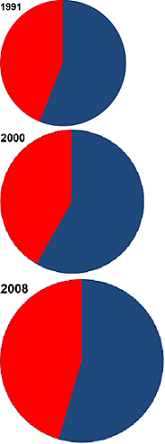 These graphs show the economy, the annual amount of wealth produced by our society. It is divided into the amount that is paid to workers in wages and salaries (in red) and the part kept by the owners of capital (in blue). Notice how the portion going to workers fell when National from when National started governing in 1991 to 2000 when Labour came to power and how the workers’ share has grown since then.
Fundamentally, that’s the choice between Labour and National.
National was founded by and continues to be run and backed by the owners of capital – businessmen and farmers. In their natural self-interest, they have a political party that makes sure they get a bigger share of the wealth by not placing restrictions on the use of capital for the individual gain of the owners, lowering taxes and cutting public services, and weakening the power of workers to demand a larger share.
Labour was established by and continues to be run and backed by people from the workers’ rights movement. In their natural self-interest, they have a political party that makes sure they get a bigger share of the wealth by restricting capital so that it acts in the broader interest of society, redistribution of wealth to poorer workers through taxation and public services, and strengthening the power of workers to demand a larger share.
When National says it wants ‘change’ it is actually saying it wants to restore a time when the balance was more in favour of the owners of capital. When Labour says it offers ‘stability’ it is actually saying it offers to continue a gradual evolution of the balance in favour of those who do the work.
The size of the circle grows over the years as the economy grows. One fundamental of National-type parties is to promise to make the economy grow faster to make up for the fact that those who do the work, most people, get a smaller share of the economy when they govern. However, Labour also wants to grow the economy as the easiest way to increase workers’ wealth without facing resistance from the capitalist class. When you compare their records, it has been Labour that has grown the economy faster while also growing the share that goes to workers.
The Greens argue (and Labour agrees to an extent) that, while giving a fairer share to workers is important, we must also make sure that in growing our wealth we don’t destroy the foundations of that wealth, our environment. If we abuse our natural resources, the amount of wealth we have will start to decrease. Moreover, they argue we shouldn’t be so obsessed with creating more ‘stuff’ in the first place.
The Maori Party argues that, while giving a fairer share to workers is important, the capitalist/worker divide is not he only one in society. They argue that as well as not getting a fair share as workers, Maori don’t get a fair share because they are Maori and deserve a fairer share.
ACT argues the market is the only fair way. The Progressives basically agree with Labour. United Future does what’s best for Peter Dunne’s pay packet.
45 comments on “The fundamental question ”
- Comments are now closed
Links to post
- Comments are now closed
Recent Comments


- Why India is key to heading off climate catastrophe
 This is a re-post from Yale Climate Connections A farmworker cleans the solar panels of a solar water pump in the village of Jagadhri, Haryana Country, India. (Photo credit: Prashanth Vishwanathan/ IWMI) Decisions made in India over the next few years will play a key role in global ...2 hours ago
 - Meanwhile “… the disturbing trend of increasing violence towards children continues to worsen”
 Lindsay Mitchell writes – The Children’s Minister, Karen Chhour, intends to repeal Section 7AA from the Oranga Tamariki Act 1989 because it creates conflict between claimed Crown Treaty obligations and the child’s best interests. In her words, “Oranga Tamariki’s governing principles and its act should be colour ...2 hours ago
 - New Zealand’s geopolitical friendly fire has its limitsGeoffrey Miller writes – The gloves are off. That might seem to be the undertone of surprisingly tough talk from New Zealand’s foreign and trade ministers. Winston Peters, the foreign minister, may be facing legal action after making allegations about former Australian foreign minister Bob Carr on Radio New Zealand. ...3 hours ago
- The post-Covid economy: is it in another long stagnation – and if so, why?Brian Easton writes – This is about the time that the Treasury will be locking up its economic forecasts to be published in the 2024 Budget Economic and Fiscal Update (BEFU) on budget day, 30 May. I am not privy to what they will be (I will report on them ...3 hours ago
- On the LTP 2024 Feedback
 A few weeks ago Auckland Council released the results of consultation on the Long Term Plan (LTP) that occurred in March. With almost 28,000 submissions, it received the most feedback of any LTP in Auckland. It covered a wide range of topics soliciting feedback on different areas of council funded ...5 hours ago
 - Bernard’s pick 'n' mix for Monday, May 6
 TL;DR: Winston Peters is reported to have won a budget increase for MFAT. David Seymour wanted his Ministry of Regulation to be three times bigger than the Productivity Commission. Simeon Brown is appointing a Crown Monitor to Watercare to protect the Claytons Crown Guarantee he had to give ratings agencies ...7 hours ago
 - Geoffrey Miller: New Zealand’s geopolitical friendly fire has its limits
 The gloves are off. That might seem to be the undertone of surprisingly tough talk from New Zealand’s foreign and trade ministers. Winston Peters, the foreign minister, may be facing legal action after making allegations about former Australian foreign minister Bob Carr on Radio New Zealand. Carr had made highly ...8 hours ago
 - I could be a Florist.
 I could be a florist'Round the corner from Rye LaneI'll be giving daisies to craziesBut, baby, I'll wrap you up real safe Oh, I can give you flowers At the end of every dayFor the center of your table, a rainbowIn case you have people 'round to stay Depending on ...8 hours ago
 - The Kaka’s diary for the week to May 12 and beyond
 TL;DR: The six key events to watch in Aotearoa-NZ’s political economy in the week to May 12 include:PM Christopher Luxon is scheduled to hold a post-Cabinet news conference at 4 pm today. Finance Minister Nicola Willis will give a pre-budget speech on Thursday.Parliament sits from Question Time at 2pm on ...8 hours ago
 - Willis on defence
 The price of the foreign affairs “reset” is now becoming apparent, with Defence set to get a funding boost in the Budget. Finance Minister Nicola Willis has confirmed that it will be one of the few votes, apart from Health and Education and possibly Police, which will get an increase ...9 hours ago
 - 2024 SkS Weekly Climate Change & Global Warming News Roundup #18A listing of 26 news and opinion articles we found interesting and shared on social media during the past week: Sun, April 28, 2024 thru Sat, May 4, 2024. Story of the week "It’s straight out of Big Tobacco’s playbook. In fact, research by John Cook and his colleagues ...18 hours ago
- A prerequisite for Vulture Capitalism.
 Yesterday I received come lovely feedback following my Star Wars themed newsletter. A few people mentioned they’d enjoyed reading the personal part at the beginning.I often begin newsletters with some memories, or general thoughts, before commencing the main topic. This hopefully sets the mood and provides some context in which ...1 day ago
 - Early evening, April 30
 April 30 was going to be the day we’d be calling Mum from London to wish her a happy birthday. Then it became the day we would be going to St. Paul's at Evensong to remember her. The aim of the cathedral builders was to find a way to make their ...1 day ago
 - Do Newsroom’s staff think they’re culturally superior to the rest of us? Are they arguing that A...Rob MacCulloch writes – Can’t remember the last book by a Kiwi author you read? Think the NZ government should spend less on the arts in favor of helping the homeless? If so, as far as Newsroom is concerned, you probably deserve to be called a cultural ignoramus ...2 days ago
- Fun minor grudgesEric Crampton writes – Grudges are bad. Better to move on. But it can be fun to keep a couple of really trivial ones, so you’re not tempted to have other ones. For example, because of the rootkit fiasco of 2005, no Sony products in our household. ...2 days ago
- Bernard’s dawn chorus for Saturday, May 4 and pick ‘n’ mix for the weekend
 A new report warns an estimated third of the adult population have unmet need for health care. Photo: Lynn Grieveson / The KākāHere’s the six key things I learned about Aotaroa’s political economy this week around housing, climate and poverty:Politics - Three opinion polls confirmed support for PM Christopher Luxon ...2 days ago
 - The Dark Side and the Rebel Alliance.
 Today is May the fourth. Which was just a regular day when my mother took me to see the newly released Star Wars at the Odeon in Rotorua. The queue was right around the corner. Some years later this day became known as Star Wars Day, the date being a ...2 days ago
 - Imaginary mandate, imaginary leadership
 Hello! Here comes the Saturday edition of More Than A Feilding, catching you up on the past week’s editions.ShareVerity, Ilfracombe ...2 days ago
 - Winston Peters delivers a speech about NZ’s relationship with China but media focus on Bob Carr’...
 Buzz from the Beehive Much more media attention is being paid to something Winston Peters said about former Australian Foreign Minister Bob Carr than to a speech he delivered to the New Zealand China Council. One word is missing from the speech: AUKUS. But AUKUS loomed large in his considerations ...3 days ago
 - The Post-Covid Economy
 Is the economy in another long stagnation? If so, why?This is about the time that the Treasury will be locking up its economic forecasts to be published in the 2024 Budget Economic and Fiscal Update (BEFU) on budget day, 30 May. I am not privy to what they will be ...3 days ago
 - An awkward coincidence!
 The annual list of who's been bribing our politicians is out, and journalists will no doubt be poring over it to find the juiciest and dirtiest bribes. The government's fast-track invite list is likely to be a particular focus, and we already know of one company on the list which ...3 days ago
 - The Israel/Palestinian metastasis.
 In the weeks after the October 7 Hamas attacks on Southern Israel I wrote about the possible 2nd, 3rd and even 4th order effects of the conflict. These included new fronts being opened in the West Bank (with Hamas), Golan … Continue reading ...3 days ago
 - 27,000That's the number of submissions received on National's corrupt Muldoonist fast-track legislation. Except its higher than that, because the number doesn't include form submissions, such as the 15,000 people who supported Forest & Bird's submission, or the 14,000 who supported Greenpeace. And so many people want to appear in person ...3 days ago
- MPs’ salaries – when is the best time to increase them?Peter Dunne writes – It is one of the oldest truisms that there is never a good time for MPs to get a pay rise. This week’s announcement of pay raises of around 2.8% backdated to last October could hardly have come at a worse time, with the ...3 days ago
- Genter under fireDavid Farrar writes – Newshub reports: Newshub can reveal a fresh allegation of intimidation against Green MP Julie-Anne Genter. Genter is subject to a disciplinary process for aggressively waving a book in the face of National Minister Matt Doocey in the House – but it’s not the first time ...3 days ago
- New Treasury paper on the productivity slowdown supports the downgrading of forecastsThe Treasury has published a paper today on the global productivity slowdown and how it is playing out in New Zealand: The productivity slowdown: implications for the Treasury’s forecasts and projections. The Treasury Paper examines recent trends in productivity and the potential drivers of the slowdown. Productivity for the whole economy ...3 days ago
- Bernard’s pick 'n' mix for Friday, May 3
 TL;DR: Here’s my top 10 ‘pick ‘n’ mix of links to news, analysis and opinion articles as of 9:26 am on Friday, May 3:Climate 'Ministerial override must go' - Hearings begin over fast-track bill RNZ Kate GreenPopulation: Labour hire firm struggling to find staff as Australia lures away workers. HireStaff ...3 days ago
 - Weekly Roundup 3-May-2024Here we are in May already! And here are a few of the stories that caught our eye this week. This Week on Greater Auckland On Monday, Matt highlighted that it’s been a decade since Auckland’s rail system was electrified. On Wednesday, Matt looked at AT’s rollout of new ways ...3 days ago
- The Hoon around the week to May 33 days ago
- Pamphlets at Ten Paces.
 These puppet strings don't pull themselvesYou're thinking thoughts from someone elseHow much time do you think you have?Are you prepared for what comes next?The debating chamber can be a trying place for an opposition MP. What with the person in charge, the speaker, typically being an MP from the governing ...3 days ago
 - A land without pier
 The land around Lyme Regis, where Meryl Streep once stood, in a hood, on the Cobb, is falling into the sea.MerylThe land around Lyme Regis, around the Cobb that made it rich, has always been falling slowly but surely into the sea. Read more ...3 days ago
 - Skeptical Science New Research for Week #18 2024Open access notables Generative AI tools can enhance climate literacy but must be checked for biases and inaccuracies, Atkins et al., Communications Earth & Environment: In the face of climate change, climate literacy is becoming increasingly important. With wide access to generative AI tools, such as OpenAI’s ChatGPT, we explore the potential ...4 days ago
- Ruckus over AUKUS – Labour demands Peters step down as Foreign Minister, but he still had the job ...Buzz from the Beehive Foreign Affairs Minister Winston Peters was bound to win headlines when he set out his thinking about AUKUS in his speech to the New Zealand Institute of International Affairs. The headlines became bigger when – during an interview on RNZ’s Morning Report today – he criticised ...4 days ago
- Secrecy undermines participationThe Post reports on how the government is refusing to release its advice on its corrupt Muldoonist fast-track law, instead using the "soon to be publicly available" refusal ground to hide it until after select committee submissions on the bill have closed. Fast-track Minister Chris Bishop's excuse? “It's not ...4 days ago
- Agribusiness following oil and gas playbookAs pressure on it grows, the livestock industry’s approach to the transition to Net Zero is increasingly being compared to that of fossil fuel interests. Photo: Lynn Grieveson / Getty ImagesTL;DR: Here’s the top five news items of note in climate news for Aotearoa-NZ this week, and a discussion above ...4 days ago
- Here’s hoping they aren’t counting on a 100 per cent acceptance…The New Zealand Herald reports – Stats NZ has offered a voluntary redundancy scheme to all of its workers as a way to give staff some control over their “future” amidst widespread job losses in the public sector. In an update to staff this morning, seen by the Herald, Statistics New Zealand ...4 days ago
- Gordon Campbell on unemployment, Winston Peters’ low boiling point and music criticismOn Werewolf/Scoop, I usually do two long form political columns a week. From now on, there will be an extra column each week about music and movies. But first, some late-breaking political events: The rise in unemployment numbers for the March quarter was bigger than expected – and especially sharp ...4 days ago
- TVNZ and poll results4 days ago
- Mana or MoneyMuriel Newman writes – When Meridian Energy was seeking resource consents for a West Coast hydro dam proposal in 2010, local Maori “strenuously” objected, claiming their mana was inextricably linked to ‘their’ river and could be damaged. After receiving a financial payment from the company, however, the Ngai Tahu ...4 days ago
- Bernard’s pick 'n' mix for Thursday, May 2
 TL;DR: Here’s my top 10 ‘pick ‘n’ mix of links to news, analysis and opinion articles as of 11:10 am on Thursday, May 2:Scoop: Government sits on official advice on fast-track consent. The Ombudsman is investigating after official briefings on the contentious regime were held back despite requests from Forest ...4 days ago
 - The Art of taking no ResponsibilityAlwyn Poole writes – “An SEP,’ he said, ‘is something that we can’t see, or don’t see, or our brain doesn’t let us see, because we think that it’s somebody else’s problem. That’s what SEP means. Somebody Else’s Problem. The brain just edits it out, it’s like a ...4 days ago
- The shabby “Parliamentary urgency” ploy – shaky foundations and why our democracy needs trustOur trust in our political institutions is fast eroding, according to a Maxim Institute discussion paper, Shaky Foundations: Why our democracy needs trust. The paper – released today – raises concerns about declining trust in New Zealand’s political institutions and democratic processes, and the role that the overuse of Parliamentary urgency ...4 days ago
- Jones has made plain he isn’t fond of frogs (not the dim-witted ones, at least) – and now we lea...This article was prepared for publication yesterday. More ministerial announcements have been posted on the government’s official website since it was written. We will report on these later today …. Buzz from the Beehive There we were, thinking the environment is in trouble, when along came Jones. Shane Jones. ...4 days ago
- Infrastructure & home building slumping on Govt funding freeze4 days ago
- Brainwashed People Think Everyone Else is Brainwashed
 Hi,I am just going to state something very obvious: American police are fucking crazy.That was a photo gracing the New York Times this morning, showing New York City police “entering Columbia University last night after receiving a request from the school.”Apparently in America, protesting the deaths of tens of thousands ...4 days ago
 - Peters’ real foreign policy threat is Helen ClarkWinston Peters’ much anticipated foreign policy speech last night was a work of two halves. Much of it was a standard “boilerplate” Foreign Ministry overview of the state of the world. There was some hardening up of rhetoric with talk of “benign” becoming “malign” and old truths giving way to ...4 days ago
- NZ’s trans lobby is fighting a rearguard action
 Graham Adams assesses the fallout of the Cass Review — The press release last Thursday from the UN Special Rapporteur on violence against women and girls didn’t make the mainstream news in New Zealand but it really should have. The startling title of Reem Alsalem’s statement — “Implementation of ‘Cass ...5 days ago
 - Your mandate is imaginary
 This open-for-business, under-new-management cliché-pockmarked government of Christopher Luxon is not the thing of beauty he imagines it to be. It is not the powerful expression of the will of the people that he asserts it to be. It is not a soaring eagle, it is a malodorous vulture. This newest poll should make ...5 days ago
 - 14,000 unemployed under NationalThe latest labour market statistics, showing a rise in unemployment. There are now 134,000 unemployed - 14,000 more than when the National government took office. Which is I guess what happens when the Reserve Bank causes a recession in an effort to Keep Wages Low. The previous government saw a ...5 days ago
- Bryce Edwards: Discontent and gloom dominate NZ’s political moodThree opinion polls have been released in the last two days, all showing that the new government is failing to hold their popular support. The usual honeymoon experienced during the first year of a first term government is entirely absent. The political mood is still gloomy and discontented, mainly due ...5 days ago
- Taking Tea with 42 & 38.
 National's Finance Minister once met a poor person.A scornful interview with National's finance guru who knows next to nothing about economics or people.There might have been something a bit familiar if that was the headline I’d gone with today. It would of course have been in tribute to the article ...5 days ago
 - Beware political propaganda: statistics are pointing to Grant Robertson never protecting “Lives an...Rob MacCulloch writes – Throughout the pandemic, the new Vice-Chancellor-of-Otago-University-on-$629,000 per annum-Can-you-believe-it-and-Former-Finance-Minister Grant Robertson repeated the mantra over and over that he saved “lives and livelihoods”. As we update how this claim is faring over the course of time, the facts are increasingly speaking differently. NZ ...5 days ago
- Winding back the hands of history’s clockChris Trotter writes – IT’S A COMMONPLACE of political speeches, especially those delivered in acknowledgement of electoral victory: “We’ll govern for all New Zealanders.” On the face of it, the pledge is a strange one. Why would any political leader govern in ways that advantaged the huge ...5 days ago
- Paula Bennett’s political appointment will challenge public confidence
 Bryce Edwards writes – The list of former National Party Ministers being given plum and important roles got longer this week with the appointment of former Deputy Prime Minister Paula Bennett as the chair of Pharmac. The Christopher Luxon-led Government has now made key appointments to Bill ...5 days ago
 - Business confidence sliding into winter of discontentTL;DR: These are the six things that stood out to me in news and commentary on Aotearoa-NZ’s political economy at 10:06am on Wednesday, May 1:The Lead: Business confidence fell across the board in April, falling in some areas to levels last seen during the lockdowns because of a collapse in ...5 days ago
- Gordon Campbell on the coalition’s awful, not good, very bad poll resultsOver the past 36 hours, Christopher Luxon has been dong his best to portray the centre-right’s plummeting poll numbers as a mark of virtue. Allegedly, the negative verdicts are the result of hard economic times, and of a government bravely set out on a perilous rescue mission from which not ...5 days ago
- New HOP readers for future payment optionsAuckland Transport have started rolling out new HOP card readers around the network and over the next three months, all of them on buses, at train stations and ferry wharves will be replaced. The change itself is not that remarkable, with the new readers looking similar to what is already ...5 days ago
- 2024 Reading Summary: April (+ Writing Update)
 Completed reads for April: The Difference Engine, by William Gibson and Bruce Sterling Carnival of Saints, by George Herman The Snow Spider, by Jenny Nimmo Emlyn’s Moon, by Jenny Nimmo The Chestnut Soldier, by Jenny Nimmo Death Comes As the End, by Agatha Christie Lord of the Flies, by ...6 days ago
 - At a glance – Clearing up misconceptions regarding 'hide the decline'On February 14, 2023 we announced our Rebuttal Update Project. This included an ask for feedback about the added "At a glance" section in the updated basic rebuttal versions. This weekly blog post series highlights this new section of one of the updated basic rebuttal versions and serves as a ...6 days ago
- Road photos
 Have a story to share about St Paul’s, but today just picturesPopular novels written at this desk by a young man who managed to bootstrap himself out of father’s imprisonment and his own young life in a workhouse Read more ...6 days ago
 - Bryce Edwards: Paula Bennett’s political appointment will challenge public confidenceThe list of former National Party Ministers being given plum and important roles got longer this week with the appointment of former Deputy Prime Minister Paula Bennett as the chair of Pharmac. The Christopher Luxon-led Government has now made key appointments to Bill English, Simon Bridges, Steven Joyce, Roger Sowry, ...6 days ago
- NZDF is still hostile to oversightNewsroom has a story today about National's (fortunately failed) effort to disestablish the newly-created Inspector-General of Defence. The creation of this agency was the key recommendation of the Inquiry into Operation Burnham, and a vital means of restoring credibility and social licence to an agency which had been caught lying ...6 days ago
- Winding Back The Hands Of History’s Clock.
 Holding On To The Present: The moment a political movement arises that attacks the whole idea of social progress, and announces its intention to wind back the hands of History’s clock, then democracy, along with its unwritten rules, is in mortal danger.IT’S A COMMONPLACE of political speeches, especially those delivered in ...6 days ago
 - Sweet Moderation? What Christopher Luxon Could Learn From The Germans.6 days ago
- A clear warningThe unpopular coalition government is currently rushing to repeal section 7AA of the Oranga Tamariki Act. The clause is Oranga Tamariki's Treaty clause, and was inserted after its systematic stealing of Māori children became a public scandal and resulted in physical resistance to further abductions. The clause created clear obligations ...6 days ago
- Poll results and Waitangi Tribunal report go unmentioned on the Beehive website – where racing tru...Buzz from the Beehive The government’s official website – which Point of Order monitors daily – not for the first time has nothing much to say today about political happenings that are grabbing media headlines. It makes no mention of the latest 1News-Verian poll, for example. This shows National down ...6 days ago
- Listening To The Traffic.6 days ago
- Comity Be Damned! The State’s Legislative Arm Is Flexing Its Constitutional Muscles.Packing A Punch: The election of the present government, including in its ranks politicians dedicated to reasserting the rights of the legislature in shaping and determining the future of Māori and Pakeha in New Zealand, should have alerted the judiciary – including its anomalous appendage, the Waitangi Tribunal – that its ...6 days ago
- Ending The Quest.Dead Woman Walking: New Zealand’s media industry had been moving steadily towards disaster for all the years Melissa Lee had been National’s media and communications policy spokesperson, and yet, when the crisis finally broke, on her watch, she had nothing intelligent to offer. Christopher Luxon is a patient man - but he’s not ...6 days ago
- Will political polarisation intensify to the point where ‘normal’ government becomes impossible,...Chris Trotter writes – New Zealand politics is remarkably easy-going: dangerously so, one might even say. With the notable exception of John Key’s flat ruling-out of the NZ First Party in 2008, all parties capable of clearing MMP’s five-percent threshold, or winning one or more electorate seats, tend ...6 days ago
- Bernard’s pick 'n' mix for Tuesday, April 30
 TL;DR: Here’s my top 10 ‘pick ‘n’ mix of links to news, analysis and opinion articles as of 10:30am on Tuesday, May 30:Scoop: NZ 'close to the tipping point' of measles epidemic, health experts warn NZ Herald Benjamin PlummerHealth: 'Absurd and totally unacceptable': Man has to wait a year for ...6 days ago
 - Why Tory Whanau has the lowest approval rating in the countryBryce Edwards writes – Polling shows that Wellington Mayor Tory Whanau has the lowest approval rating of any mayor in the country. Siting at -12 per cent, the proportion of constituents who disapprove of her performance outweighs those who give her the thumbs up. This negative rating is ...6 days ago
- Worst poll result for a new Government in MMP history6 days ago
- Pinning down climate change's role in extreme weatherThis is a re-post from The Climate Brink by Andrew Dessler In the wake of any unusual weather event, someone inevitably asks, “Did climate change cause this?” In the most literal sense, that answer is almost always no. Climate change is never the sole cause of hurricanes, heat waves, droughts, or ...6 days ago
- Serving at Seymour's pleasure.
 Something odd happened yesterday, and I’d love to know if there’s more to it. If there was something which preempted what happened, or if it was simply a throwaway line in response to a journalist.Yesterday David Seymour was asked at a press conference what the process would be if the ...6 days ago


- Release: Labour calls for fast track list to be released
 Ministers must front up about which projects it will push through under its Fast Track Approvals legislation, Labour environment spokesperson Rachel Brooking said today. ...5 hours ago
 - Release: National gaslights women fighting for equal payNational has scrapped the pay equity taskforce that fights for equal pay for women and looks at ethnic pay gaps. ...4 days ago
- Release: More job cuts, fewer houses under NationalThe Government is again adding to New Zealand’s growing unemployment, this time cutting jobs at the agencies responsible for urban development and growing much needed housing stock. ...4 days ago
- Release: Children fall deeper through the cracks in Govt cutsWith Minister Karen Chhour indicating in the House today that she either doesn’t know or care about the frontline cuts she’s making to Oranga Tamariki, we risk seeing more and more of our children falling through the cracks. ...4 days ago
- Release: Labour honours memory of Sir Robert MartinThe Labour Party is saddened to learn of the death of Sir Robert Martin, a globally renowned disability advocate who led the way for disability rights both in New Zealand and internationally. ...4 days ago
- Release: 130,000 cattle saved from live exportLabour is calling for the Government to urgently rethink its coalition commitment to restart live animal exports, Labour animal welfare spokesperson Rachel Boyack said. ...5 days ago
- Central Bank makes clear Government is pouring fuel on housing crisis fire
 Today’s Financial Stability Report has once again highlighted that poverty and deep inequality are political choices - and this Government is choosing to make them worse. ...5 days ago
 - New unemployment figures paint bleak pictureThe Green Party is calling on the Government to do more for our households in most need as unemployment rises and the cost of living crisis endures. ...5 days ago
- Release: National’s job cuts already starting to bite as unemployment risesUnemployment is on the rise and it’s only going to get worse under this Government, Labour finance spokesperson Barbara Edmonds said. Stats NZ figures show the unemployment rate grew to 4.3 percent in the March quarter from 4 percent in the December quarter. “This is the second rise in unemployment ...5 days ago
- Release: National hiking transport costs for families and young New ZealandersWeekly expenses will grow for more than 1.6 million New Zealanders as the Government ends free and half price public transport fares tomorrow. ...6 days ago
- Release: Labour welcomes EU free trade agreementThe New Zealand Labour Party welcomes the entering into force of the European Union and New Zealand free trade agreement. This agreement opens the door for a huge increase in trade opportunities with a market of 450 million people who are high value discerning consumers of New Zealand goods and ...6 days ago
- Surprise: Landlord tax cuts don’t trickle downThe Green Party is renewing its call for rent controls following reports of rental prices hitting an all-time high. ...6 days ago
- Release: $1.7b for no increase in access to medicineThe National-led Government continues its fiscal jiggery pokery with its Pharmac announcement today, Labour Health spokesperson Ayesha Verrall says. “The government has increased Pharmac funding but conceded it will only make minimal increases in access to medicine”, said Ayesha Verrall “This is far from the bold promises made to fund ...6 days ago
- Release: National should heed Tribunal warning and scrap coalition commitment with ACTThis afternoon’s interim Waitangi Tribunal report must be taken seriously as it affects our most vulnerable children, Labour children’s spokesperson Willow-Jean Prime. ...7 days ago
- Release: More accountability for preventable workplace deaths this Workers’ Memorial DayLabour is calling for more accountability for preventable workplace deaths because everybody who goes to work deserves to come home safely. ...1 week ago
- Gaza: Aotearoa Must Support Independent Investigation into Mass GravesTe Pāti Māori are demanding the New Zealand Government support an international independent investigation into mass graves that have been uncovered at two hospitals on the Gaza strip, following weeks of assault by Israeli troops. Among the 392 bodies that have been recovered, are children and elderly civilians. Many of ...1 week ago
- Release: Working together on consistent support for veterans this Anzac DayOur two-tiered system for veterans’ support is out of step with our closest partners, and all parties in Parliament should work together to fix it, Labour veterans’ affairs spokesperson Greg O’Connor said. ...2 weeks ago
- Release: Penny drops – but what about Seymour and Peters?Stripping two Ministers of their portfolios just six months into the job shows Christopher Luxon’s management style is lacking, Labour Leader Chris Hipkins said. ...2 weeks ago
- Another ‘Stolen Generation’ enabled by court ruling on Waitangi Tribunal summonsTonight’s court decision to overturn the summons of the Children’s Minister has enabled the Crown to continue making decisions about Māori without evidence, says Te Pāti Māori spokesperson for Children, Mariameno Kapa-Kingi. “The judicial system has this evening told the nation that this government can do whatever they want when ...2 weeks ago
- Release: Budget blunder shows Nicola Willis could cut recovery fundingIt appears Nicola Willis is about to pull the rug out from under the feet of local communities still dealing with the aftermath of last year’s severe weather, and local councils relying on funding to build back from these disasters. ...2 weeks ago
- Further environmental mismanagement on the cardsThe Government’s resource management reforms will add to the heavy and ever-growing burden this Government is loading on to our environment. ...2 weeks ago
- Release: RMA changes will be a disaster for environmentThe Government is making short-sighted changes to the Resource Management Act (RMA) that will take away environmental protection in favour of short-term profits, Labour’s environment spokesperson Rachel Brooking said today. ...2 weeks ago
- Release: Labour supports urgent changes to emergency management systemLabour welcomes the release of the report into the North Island weather events and looks forward to working with the Government to ensure that New Zealand is as prepared as it can be for the next natural disaster. ...2 weeks ago
- Release: Labour calls for New Zealand to recognise PalestineThe Labour Party has called for the New Zealand Government to recognise Palestine, as a material step towards progressing the two-State solution needed to achieve a lasting peace in the region. ...2 weeks ago
- Release: Three strikes law political posturing of worst kindThe Government is bringing back a law that has little evidential backing just to look tough, Labour justice spokesperson Duncan Webb said. ...2 weeks ago
- Release: Government cuts unbelievably target child exploitation, violent extremism, ports and airpor...Some of our country’s most important work, stopping the sexual exploitation of children and violent extremism could go along with staff on the frontline at ports and airports. ...2 weeks ago
- Three strikes has failed before and will fail againResurrecting the archaic three-strikes legislation is an unwelcome return to a failed American-style approach to justice. ...2 weeks ago
- Release: Environmental protection vital, not ‘onerous’The Government’s Fast Track Approvals Bill will give projects such as new coal mines a ‘get out of jail free’ card to wreak havoc on the environment, Labour Leader Chris Hipkins said today. ...2 weeks ago
- Ferris – Three Strikes targets those ‘too brown to be white’The government's decision to reintroduce Three Strikes is a destructive and ineffective piece of law-making that will only exacerbate an inherently biased and racist criminal justice system, said Te Pāti Māori Justice Spokesperson, Tākuta Ferris, today. During the time Three Strikes was in place in Aotearoa, Māori and Pasifika received ...2 weeks ago
- Release: Govt cuts doctors and nurses in hiring freezeCuts to frontline hospital staff are not only a broken election promise, it shows the reckless tax cuts have well and truly hit the frontline of the health system, says Labour Health spokesperson Ayesha Verrall. ...2 weeks ago
- Fast-track submissions period must be extendedThe Green Party has joined the call for public submissions on the fast-track legislation to be extended after the Ombudsman forced the Government to release the list of organisations invited to apply just hours before submissions close. ...2 weeks ago
- Release: Progress on climate will be undone by GovtNew Zealand’s good work at reducing climate emissions for three years in a row will be undone by the National government’s lack of ambition and scrapping programmes that were making a difference, Labour Party climate spokesperson Megan Woods said today. ...2 weeks ago
- Release: Dark day for Kiwi kids as a third of Govt cuts affect themNews that 1000 jobs at the Ministry of Education and Oranga Tamariki could go is devastating for future generations of New Zealanders. ...3 weeks ago
- Release: Alarm as Government signals further blow to school lunchesMore essential jobs could be on the chopping block, this time Ministry of Education staff on the school lunches team are set to find out whether they're in line to lose their jobs. ...3 weeks ago
- Oranga Tamariki cuts commit tamariki to state abuseTe Pāti Māori is disgusted at the confirmation that hundreds are set to lose their jobs at Oranga Tamariki, and the disestablishment of the Treaty Response Unit. “This act of absolute carelessness and out of touch decision making is committing tamariki to state abuse.” Said Te Pāti Māori Oranga Tamariki ...3 weeks ago
- Release: Quick, submit – stop Govt’s dodgy approvals billThe Government is trying to bring in a law that will allow Ministers to cut corners and kill off native species, Labour environment spokesperson Rachel Brooking said. ...3 weeks ago
- Agreement delivers Local Water Done Well for Auckland
 The Government has delivered on its election promise to provide a financially sustainable model for Auckland under its Local Water Done Well plan. The plan, which has been unanimously endorsed by Auckland Council’s Governing Body, will see Aucklanders avoid the previously projected 25.8 per cent water rates increases while retaining ...1 day ago
 - Gaza and the Pacific on the agenda with GermanyForeign Minister Winston Peters discussed the need for an immediate ceasefire in Gaza, and enhanced cooperation in the Pacific with German Foreign Minister Annalena Baerbock during her first official visit to New Zealand today. "New Zealand and Germany enjoy shared interests and values, including the rule of law, democracy, respect for the international system ...2 days ago
- Decision allows for housing growth in Western Bay of PlentyThe Minister Responsible for RMA Reform, Chris Bishop today released his decision on four recommendations referred to him by the Western Bay of Plenty District Council, opening the door to housing growth in the area. The Council’s Plan Change 92 allows more homes to be built in existing and new ...3 days ago
- Speech to New Zealand China CouncilThank you, John McKinnon and the New Zealand China Council for the invitation to speak to you today. Thank you too, all members of the China Council. Your effort has played an essential role in helping to build, shape, and grow a balanced and resilient relationship between our two ...3 days ago
- Modern insurance law will protect Kiwi householdsThe Government is modernising insurance law to better protect Kiwis and provide security in the event of a disaster, Commerce and Consumer Affairs Minister Andrew Bayly announced today. “These reforms are long overdue. New Zealand’s insurance law is complicated and dated, some of which is more than 100 years old. ...4 days ago
- Government recommits to equal payThe coalition Government is refreshing its approach to supporting pay equity claims as time-limited funding for the Pay Equity Taskforce comes to an end, Public Service Minister Nicola Willis says. “Three years ago, the then-government introduced changes to the Equal Pay Act to support pay equity bargaining. The changes were ...4 days ago
- Transforming how our children learn to readStructured literacy will change the way New Zealand children learn to read - improving achievement and setting students up for success, Education Minister Erica Stanford says. “Being able to read and write is a fundamental life skill that too many young people are missing out on. Recent data shows that ...4 days ago
- NZ not backing down in Canada dairy disputeTrade Minister Todd McClay says Canada’s refusal to comply in full with a CPTPP trade dispute ruling in our favour over dairy trade is cynical and New Zealand has no intention of backing down. Mr McClay said he has asked for urgent legal advice in respect of our ‘next move’ ...4 days ago
- Stronger oversight for our most vulnerable childrenThe rights of our children and young people will be enhanced by changes the coalition Government will make to strengthen oversight of the Oranga Tamariki system, including restoring a single Children’s Commissioner. “The Government is committed to delivering better public services that care for our most at-risk young people and ...4 days ago
- Streamlining Building Consent ChangesThe Government is making it easier for minor changes to be made to a building consent so building a home is easier and more affordable, Building and Construction Minister Chris Penk says. “The coalition Government is focused on making it easier and cheaper to build homes so we can ...4 days ago
- Minister acknowledges passing of Sir Robert Martin (KNZM)New Zealand lost a true legend when internationally renowned disability advocate Sir Robert Martin (KNZM) passed away at his home in Whanganui last night, Disabilities Issues Minister Louise Upston says. “Our Government’s thoughts are with his wife Lynda, family and community, those he has worked with, the disability community in ...5 days ago
- Speech to New Zealand Institute of International Affairs, Parliament – Annual Lecture: Challenges ...Good evening – Before discussing the challenges and opportunities facing New Zealand’s foreign policy, we’d like to first acknowledge the New Zealand Institute of International Affairs. You have contributed to debates about New Zealand foreign policy over a long period of time, and we thank you for hosting us. ...5 days ago
- Accelerating airport security linesFrom today, passengers travelling internationally from Auckland Airport will be able to keep laptops and liquids in their carry-on bags for security screening thanks to new technology, Transport Minister Simeon Brown says. “Creating a more efficient and seamless travel experience is important for holidaymakers and businesses, enabling faster movement through ...5 days ago
- Community hui to talk about kina barrensPeople with an interest in the health of Northland’s marine ecosystems are invited to a public meeting to discuss how to deal with kina barrens, Oceans and Fisheries Minister Shane Jones says. Mr Jones will lead the discussion, which will take place on Friday, 10 May, at Awanui Hotel in ...5 days ago
- Kiwi exporters win as NZ-EU FTA enters into forceKiwi exporters are $100 million better off today with the NZ EU FTA entering into force says Trade Minister Todd McClay. “This is all part of our plan to grow the economy. New Zealand's prosperity depends on international trade, making up 60 per cent of the country’s total economic activity. ...5 days ago
- Mining resurgence a welcome signThere are heartening signs that the extractive sector is once again becoming an attractive prospect for investors and a source of economic prosperity for New Zealand, Resources Minister Shane Jones says. “The beginnings of a resurgence in extractive industries are apparent in media reports of the sector in the past ...5 days ago
- Ō-Rākau Remembrance Bill passes first readingThe return of the historic Ō-Rākau battle site to the descendants of those who fought there moved one step closer today with the first reading of Te Pire mō Ō-Rākau, Te Pae o Maumahara / The Ō-Rākau Remembrance Bill. The Bill will entrust the 9.7-hectare battle site, five kilometres west ...6 days ago
- Government to boost public EV charging networkEnergy Minister Simeon Brown has announced 25 new high-speed EV charging hubs along key routes between major urban centres and outlined the Government’s plan to supercharge New Zealand’s EV infrastructure. The hubs will each have several chargers and be capable of charging at least four – and up to 10 ...6 days ago
- Residential Property Managers Bill to not progressThe coalition Government will not proceed with the previous Government’s plans to regulate residential property managers, Housing Minister Chris Bishop says. “I have written to the Chairperson of the Social Services and Community Committee to inform him that the Government does not intend to support the Residential Property Managers Bill ...6 days ago
- Independent review into disability support servicesThe Government has announced an independent review into the disability support system funded by the Ministry of Disabled People – Whaikaha. Disability Issues Minister Louise Upston says the review will look at what can be done to strengthen the long-term sustainability of Disability Support Services to provide disabled people and ...6 days ago
- Justice Minister updates UN on law & order planJustice Minister Paul Goldsmith has attended the Universal Periodic Review in Geneva and outlined the Government’s plan to restore law and order. “Speaking to the United Nations Human Rights Council provided us with an opportunity to present New Zealand’s human rights progress, priorities, and challenges, while responding to issues and ...6 days ago
- Ending emergency housing motels in RotoruaThe Government and Rotorua Lakes Council are committed to working closely together to end the use of contracted emergency housing motels in Rotorua. Associate Minister of Housing (Social Housing) Tama Potaka says the Government remains committed to ending the long-term use of contracted emergency housing motels in Rotorua by the ...6 days ago
- Trade Minister travels to Riyadh, OECD, and DubaiTrade Minister Todd McClay heads overseas today for high-level trade talks in the Gulf region, and a key OECD meeting in Paris. Mr McClay will travel to Riyadh to meet with counterparts from Saudi Arabia and the Gulf Cooperation Council (GCC). “New Zealand’s goods and services exports to the Gulf region ...7 days ago
- Education priorities focused on lifting achievementEducation Minister Erica Stanford has outlined six education priorities to deliver a world-leading education system that sets Kiwi kids up for future success. “I’m putting ambition, achievement and outcomes at the heart of our education system. I want every child to be inspired and engaged in their learning so they ...7 days ago
- NZTA App first step towards digital driver licenceThe new NZ Transport Agency (NZTA) App is a secure ‘one stop shop’ to provide the services drivers need, Transport Minister Simeon Brown and Digitising Government Minister Judith Collins say. “The NZTA App will enable an easier way for Kiwis to pay for Vehicle Registration and Road User Charges (RUC). ...7 days ago
- Supporting whānau out of emergency housingWhānau with tamariki growing up in emergency housing motels will be prioritised for social housing starting this week, says Associate Housing Minister Tama Potaka. “Giving these whānau a better opportunity to build healthy stable lives for themselves and future generations is an essential part of the Government’s goal of reducing ...7 days ago
- Tribute to Dave O'SullivanRacing Minister Winston Peters has paid tribute to an icon of the industry with the recent passing of Dave O’Sullivan (OBE). “Our sympathies are with the O’Sullivan family with the sad news of Dave O’Sullivan’s recent passing,” Mr Peters says. “His contribution to racing, initially as a jockey and then ...1 week ago
- Speech – Eid al-FitrAssalaamu alaikum, greetings to you all. Eid Mubarak, everyone! I want to extend my warmest wishes to you and everyone celebrating this joyous occasion. It is a pleasure to be here. I have enjoyed Eid celebrations at Parliament before, but this is my first time joining you as the Minister ...1 week ago
- Government saves access to medicinesAssociate Health Minister David Seymour has announced Pharmac’s largest ever budget of $6.294 billion over four years, fixing a $1.774 billion fiscal cliff. “Access to medicines is a crucial part of many Kiwis’ lives. We’ve committed to a budget allocation of $1.774 billion over four years so Kiwis are ...1 week ago
- Pharmac Chair appointedHon Paula Bennett has been appointed as member and chair of the Pharmac board, Associate Health Minister David Seymour announced today. "Pharmac is a critical part of New Zealand's health system and plays a significant role in ensuring that Kiwis have the best possible access to medicines,” says Mr Seymour. ...1 week ago
- Taking action on Fetal Alcohol Spectrum DisorderHundreds of New Zealand families affected by Fetal Alcohol Spectrum Disorder (FASD) will benefit from a new Government focus on prevention and treatment, says Health Minister Dr Shane Reti. “We know FASD is a leading cause of preventable intellectual and neurodevelopmental disability in New Zealand,” Dr Reti says. “Every day, ...1 week ago
- New sports complex opens in KaikoheRegional Development Minister Shane Jones today attended the official opening of Kaikohe’s new $14.7 million sports complex. “The completion of the Kaikohe Multi Sports Complex is a fantastic achievement for the Far North,” Mr Jones says. “This facility not only fulfils a long-held dream for local athletes, but also creates ...1 week ago
- Diplomacy needed more than everForeign Minister Winston Peters’ engagements in Türkiye this week underlined the importance of diplomacy to meet growing global challenges. “Returning to the Gallipoli Peninsula to represent New Zealand at Anzac commemorations was a sombre reminder of the critical importance of diplomacy for de-escalating conflicts and easing tensions,” Mr Peters ...1 week ago
- Anzac Commemorative Address, Buttes New British Cemetery BelgiumAmbassador Millar, Burgemeester, Vandepitte, Excellencies, military representatives, distinguished guests, ladies and gentlemen – good morning and welcome to this sacred Anzac Day dawn service. It is an honour to be here on behalf of the Government and people of New Zealand at Buttes New British Cemetery, Polygon Wood – a deeply ...1 week ago
- Anzac Commemorative Address – NZ National Service, Chunuk BairDistinguished guests - It is an honour to return once again to this site which, as the resting place for so many of our war-dead, has become a sacred place for generations of New Zealanders. Our presence here and at the other special spaces of Gallipoli is made ...2 weeks ago
- Anzac Commemorative Address – Dawn Service, Gallipoli, TürkiyeMai ia tawhiti pamamao, te moana nui a Kiwa, kua tae whakaiti mai matou, ki to koutou papa whenua. No koutou te tapuwae, no matou te tapuwae, kua honoa pumautia. Ko nga toa kua hinga nei, o te Waipounamu, o te Ika a Maui, he okioki tahi me o ...2 weeks ago
- PM announces changes to portfoliosPaul Goldsmith will take on responsibility for the Media and Communications portfolio, while Louise Upston will pick up the Disability Issues portfolio, Prime Minister Christopher Luxon announced today. “Our Government is relentlessly focused on getting New Zealand back on track. As issues change in prominence, I plan to adjust Ministerial ...2 weeks ago
- New catch limits for unique fishery areasRecreational catch limits will be reduced in areas of Fiordland and the Chatham Islands to help keep those fisheries healthy and sustainable, Oceans and Fisheries Minister Shane Jones says. The lower recreational daily catch limits for a range of finfish and shellfish species caught in the Fiordland Marine Area and ...2 weeks ago
- Minister welcomes hydrogen milestoneEnergy Minister Simeon Brown has welcomed an important milestone in New Zealand’s hydrogen future, with the opening of the country’s first network of hydrogen refuelling stations in Wiri. “I want to congratulate the team at Hiringa Energy and its partners K one W one (K1W1), Mitsui & Co New Zealand ...2 weeks ago
- Urgent changes to system through first RMA Amendment BillThe coalition Government is delivering on its commitment to improve resource management laws and give greater certainty to consent applicants, with a Bill to amend the Resource Management Act (RMA) expected to be introduced to Parliament next month. RMA Reform Minister Chris Bishop has today outlined the first RMA Amendment ...2 weeks ago
- ‘Don’t mistake Pacific leaders AUKUS quietness’ as support for NZ, says academic
 By Eleisha Foon, RNZ Pacific senior journalist A Pacific regionalism academic has called out New Zealand’s Foreign Affairs Minister Winston Peters for withholding information from the public on AUKUS and says the security deal “raises serious questions for the Pacific region”. Auckland University of Technology academic Dr Marco de Jong ...59 mins ago
 - Labour says Government's water plan will see some councils 'left out in the cold'
 Meanwhile, the party and National are also odds about whose plan to fix the pipes will cost more. ...1 hour ago
 - The climate cost of your digital life
 How worried should we be about the cloud? This is an excerpt from our weekly environmental newsletter Future Proof. Sign up here. I currently have a few thousand unread emails languishing in my inbox, mostly old marketing newsletters and piles of unread science journal press releases. I have a similar number ...1 hour ago
 - Three fact-checking challenges in Southeast AsiaSource: The Conversation (Au and NZ) – By Nuurrianti Jalli, Assistant Professor of Communication Studies College of Arts and Sciences Department of Languages, Literature, and Communication Studies, Northern State University Amid the COVID-19 pandemic, Southeast Asian governments not only have to deal with the virus but also with the false ...1 hour ago
- Houston area’s flood problems offer lessons for cities trying to adapt to a changing climateSource: The Conversation (Au and NZ) – By Richard B. (Ricky) Rood, Professor Emeritus of Climate and Space Sciences and Engineering, University of Michigan Pavement can leave floodwater with nowhere to go. Chengyue Lao/Xinhua via Getty Images Scenes from the Houston area looked like the aftermath of a hurricane in ...1 hour ago
- The scaling back of Saudi Arabia’s proposed urban mega-project sends a clear warning to other woul...Source: The Conversation (Au and NZ) – By David Murakami Wood, Professor of Critical Surveillance and Securities Studies, L’Université d’Ottawa/University of Ottawa The skyline of Riyadh, the capital and largest city of the Kingdom of Saudia Arabia. (Shutterstock) There is a long history of planned city building by both governments ...1 hour ago
- Many immigrants to the US are fleeing violence and persecution − here’s how the federal governme...Source: The Conversation (Au and NZ) – By Karen Jacobsen, Henry J. Leir Chair in Global Migration, Fletcher School of Law & Diplomacy, Tufts University The men’s dormitory at a new center for asylum-seekers in Portland, Maine. Ben McCanna/Portland Press Herald via Getty Images Immigration has become a defining issue ...1 hour ago
- LIVE TODAY: A View from Afar – A Moment of FrictionThe LIVE Recording of A View from Afar podcast will begin today at 12:45pm May 6, 2024 (NZST) which is Sunday evening, 8:30pm (USEST). In an analytical essay titled ‘A moment of friction’ political scientist Dr Paul Buchanan wrote how we are living within a decisive moment of ...2 hours ago
- How to make the most of oyster seasonThe Boil Up’s Lucinda Bennett considers the oyster – from freshness to pearls to the joy of shucking your own. This is an excerpt from our weekly food newsletter, The Boil Up. In Carmen Maria Machado’s short story ‘Eight Bites’, a woman begins her last supper before bariatric surgery with “a cavalcade ...2 hours ago
- Auckland University staff appeal over Gaza protest in solidarity with studentsAsia Pacific Report A group of 65 Auckland University academics have written an open letter to vice-chancellor Dawn Freshwater criticising the institution’s stance over students protesting in solidarity with Palestine. They have called on her administration to “support” the students who were denied permission to establish an “overnight encampment” by ...3 hours ago
- How the Student Volunteer Army is helping high schoolers give backThe Student Volunteer Army is on the march, generating approximately 1.6 million hours of volunteering from roughly 35,000 secondary school students in just five years. For Rebekah Brown, the pathway to volunteering started with her singing coach. With a passion for the arts, the suggestion to volunteer at Acting Antics, ...4 hours ago
- Here’s what happened when I replaced my personality with the Meta AI chatbot for a dayKeeping up with online communication can be exhausting, so Fran Barclay enlisted the help of Meta’s new ‘intelligent assistant’ to respond to all her messages. Could her mates tell the difference? For centuries, technology has ruled the ways in which we communicate. From the dawn of written language, to the ...4 hours ago
- MP Jamie Arbuckle to keep two jobs – and two salariesJamie Arbuckle, a councillor who has become an member of parliament, says he has settled into having two roles so comfortably he's going to keep both pay cheques. ...4 hours ago
- What Australia can learn from Latin America when it comes to tackling violence against womenSource: The Conversation (Au and NZ) – By Luis Gómez Romero, Senior Lecturer in Human Rights, Constitutional Law and Legal Theory, University of Wollongong Fifty years ago, Australian feminist Anne Summers denounced “the ideology of sexism” governing over so many women’s lives. Unfortunately, sexism is as lethal today as it ...5 hours ago
- A tax on sugary drinks can make us healthier. It’s time for Australia to introduce oneSource: The Conversation (Au and NZ) – By Peter Breadon, Program Director, Health and Aged Care, Grattan Institute Leah Newhouse/Pexels Sugary drinks cause weight gain and increase the risk of a range of diseases, including diabetes. The evidence shows that well-designed taxes can reduce sugary drink sales, cause ...5 hours ago
- As New Zealand CBDs evolve post-pandemic, repurposing old or empty spaces should be on the drawing b...Source: The Conversation (Au and NZ) – By Jose Antonio Lara-Hernandez, Senior Researcher in Architecture, Auckland University of Technology Getty Images The COVID-19 pandemic and the hybrid work patterns it fostered have changed the way we think about office space, and central business districts in general. While fears ...5 hours ago
- Nuclear power makes no sense for Australia – but it’s a useful diversion from real climate actio...Source: The Conversation (Au and NZ) – By Adam Simpson, Senior Lecturer, International Studies, University of South Australia Wlad74, Shutterstock Opposition leader Peter Dutton argues Australia needs nuclear power to achieve net zero emissions by 2050. But nuclear power is not feasible for Australia. It is too slow, too ...5 hours ago
- Australian churches collectively raise billions of dollars a year – why aren’t they taxed?Source: The Conversation (Au and NZ) – By Dale Boccabella, Associate Professor of Taxation Law, UNSW Sydney There’s a good reason your local volunteer-run netball club doesn’t pay tax. In Australia, various nonprofit organisations are exempt from paying income tax, including those that do charitable work, such as churches. ...5 hours ago
- Real comedy, real trauma: how Baby Reindeer and Feel Good are forging a new television genreSource: The Conversation (Au and NZ) – By Marina Deller, Casual Academic, Creative Writing and English Literature, Flinders University Netflix Comedy is opening up spaces for silences to be broken and trauma stories to be told. In 2018, Hannah Gadsby started a revolution with Nanette, asking audiences to rethink ...5 hours ago
- Tense office dynamics draining your soul? Kink can help with thatThe workplace can be a minefield of bad comms and passive aggression. Kinksters can help you navigate it. A friend and colleague recently gave me a compliment I loved. They told me I’d always been good at emotional communication and making people feel comfortable. “But I feel like it’s really ...5 hours ago
- Old, more polluting ships serving NZ could be a barrier to climate goalsThe Climate Change Commission is floating the idea of bringing international shipping into New Zealand's carbon-cutting targets. ...7 hours ago
- A week on, the school phone ban is (mostly) winning praiseEven if some students are now just texting on their laptops. Stewart Sowman-Lund writes in this excerpt from The Bulletin, The Spinoff’s morning news round-up. To receive The Bulletin in full each weekday, sign up here. ...7 hours ago
- Could Wellington be the next region to ink a water deal with the government?Councils from Horowhenua, Kāpiti, Wairarapa, the Hutt Valley, Porirua and Wellington City will meet this Friday to work together on a plan for a Greater Wellington region water deal. ...7 hours ago
- Award-Winning Musician Ria Hall Announces Candidacy For Mayor Of Tauranga
 Renowned musician, advocate, and proud born and raised daughter of Tauranga, Ria Hall, is announcing her candidacy for Mayor of Tauranga and Pāpāmoa Ward for the upcoming election on July 20th. ...9 hours ago
 - Teachers don’t want the new histories curriculum to be ‘rebalanced’The new Aotearoa histories curriculum is rich with potential. There’s still work to be done, but the education minister’s criticisms about ‘balance’ miss the mark, argues primary school teacher Jessie Moss. In 2015, Ōtorohanga College students presented to parliament a petition signed by more than 10,000 people calling for a ...9 hours ago
- At last! The kiwi is getting its comeuppance For too long our so-called national bird has maintained its stranglehold on the economy of regional New Zealand. Thanks to the fast track legislation, we will have our revenge. Theories abound on what ails New Zealand’s economy. National leader Chris Luxon has posited that we’re negative, wet, whiny, and inward-looking; ...9 hours ago
- An obscure climate accounting decision with billion-dollar consequences
 Opinion: For a country that trades on its reputation as a trustworthy international counterpart, we must follow through on our climate commitments – or face serious financial risks The post An obscure climate accounting decision with billion-dollar consequences appeared first on Newsroom. ...9 hours ago
 - Officials set aside environmental benefits of waste-to-energy facilityA $350 million waste incinerator is a step closer, but questions marks remain over its environmental benefits The post Officials set aside environmental benefits of waste-to-energy facility appeared first on Newsroom. ...9 hours ago
- Auckland’s decades-old stadium shuffleIf building one of Auckland’s possible waterfront stadiums was funded privately, it would need to hold a sold-out Ed Sherran concert every weekday for 25 years. That’s Rob Hamlin’s finding – he’s a senior marketing lecturer at the University of Otago. “It’s not going to happen; forget about it,” he ...9 hours ago
- Federated Farmers’ support for fast-track bill ‘ambiguous’Fed Farmers’ oral and written submissions on the fast-track bill contain no definitive indication of the group’s support. Board member Mark Hooper clarifies. The post Federated Farmers’ support for fast-track bill ‘ambiguous’ appeared first on Newsroom. ...9 hours ago
- How advertising, not social media, killed traditional journalismComment: The debate over the future relationship between news and social media is bringing us closer to a long-overdue reckoning. Social media isn’t trying to kill journalism, because social media has never really cared about journalism. Social media is resolutely in the attention business. News propels some attention — perhaps ...9 hours ago
- Daily crossword, Monday 6 MayThe post Daily crossword, Monday 6 May appeared first on Newsroom. ...9 hours ago
- Political donations: people power no match for big businessAnalysis: Experts are renewing their calls for a cap on donations as the gap between the left and the right widens The post Political donations: people power no match for big business appeared first on Newsroom. ...9 hours ago
- Newsroom daily quiz, Monday 6 MayLoading…(function(i,s,o,g,r,a,m){var ql=document.querySelectorAll('A,DIV,A[data-quiz],DIV[data-quiz]'); if(ql){if(ql.length){for(var k=0;k<ql.length;k++){ql[k].id='quiz-embed-'+k;ql[k].href="javascript:var i=document.getElementById('quiz-embed-"+k+"');try{qz.startQuiz(i)}catch(e){i.start=1;i.style.cursor='wait';i.style.opacity='0.5'};void(0);"}}};i['QP']=r;i[r]=i[r]||function(){(i[r].q=i[r].q||[]).push(arguments)},i[r].l=1*new Date();a=s.createElement(o),m=s.getElementsByTagName(o)[0];a.async=1;a.src=g;m.parentNode.insertBefore(a,m)})(window,document,'script','https://take.quiz-maker.com/3012/CDN/quiz-embed-v1.js','qp'); Got a good quiz question? Send Newsroom your questions. The post Newsroom daily quiz, Monday 6 May appeared first on Newsroom. ...9 hours ago
- New Kiwi gymnast flips for Olympic dreamFor the past 12 years, Georgia-Rose Brown has balanced on the brink of making an Olympic Games – but always landed gracefully on the wrong side. Reaching the Olympics is a dream the gymnast has harboured since she was a six-year-old; a dream that would dwindle every four years, yet ...9 hours ago
- Rent controls are far from being ‘economically illiterate’Opinion: There are many ways to regulate for rental increases, depending on the market conditions The post Rent controls are far from being ‘economically illiterate’ appeared first on Newsroom. ...9 hours ago
- Southland stream life wiped out by single contaminant dumpAn investigation is underway into how freshwater crayfish, trout and thousands of eels were killed when pollution from private land ended up in a healthy stream The post Southland stream life wiped out by single contaminant dump appeared first on Newsroom. ...9 hours ago
- An incident at Glenmark station in CanterburyLate one afternoon in March 1860 a man in a thin green velveteen jacket and a wide-awake hat arrived on foot at a sheep station named Glenmark, about 65 kilometres north of Christchurch. The man was in his mid-fifties but he looked older. Several people who met him that day ...9 hours ago
- Students on social work, nursing and teaching placements to get weekly $319.50 means tested Prac Pay...Source: The Conversation (Au and NZ) – By Michelle Grattan, Professorial Fellow, University of Canberra A new Commonwealth Prac Payment will provide students with $319.50 a week when they are on clinical and professional placements. The payment will be means tested and start from July 1 next year, which ...13 hours ago
- Auckland Palestine rally honours Gaza journalists for freedom awardAsia Pacific Report About 500 people honoured Palestinian journalists in the heart of the New Zealand city of Auckland today for their brave coverage of Israel’s War on Gaza, now in its seventh month with almost 35,000 people killed, mostly women and children. Marking the annual May 3 World Press ...15 hours ago
- GCSB foreign spying capability under scrutinyThe Government Communications Security Bureau denies hosting a foreign spying capability flagged by the watchdog, differentiating it from the system recently criticised. ...22 hours ago
- Auckland academics call out university stance over pro-Palestine protestRNZ News A group of academic staff at New Zealand’s largest university have expressed concern at the administration’s move to block a protest encampment that was planned to take place on campus calling for support for the rights of Palestinians. This week, the University of Auckland warned that while it ...1 day ago
- Auckland's new water plan unveiled by Mayor Wayne Brown and Local Government Minister Simeon Br...The government claims Aucklanders will avoid a projected 25.8 percent water rates increase with the coalition's Local Water Done Well plan. ...1 day ago
- 'Māori Seabed, For Shore!' – Two decades on from the largest hīkoi in a generationTwenty years has passed since the historic hīkoi against the controversial Foreshore and Seabed Act reached Parliament. ...1 day ago
- An Ode to .. Julie Anne GenterGenterwocky After a hard days marching, Sir Doocey calls in at the Village Tavern For a pint of ale and a pork pie. The grim villagers stare at him. “Do not be travelling on the forest road,” warns a crusty old beak. “And why is that, antique peasant?” Grins Sir ...1 day ago
- National aims high while struggling to take offPolitical conferences after a party returns to power are usually a chance for some healthy, even unhealthy backslapping. Yet National Party president Sylvia Wood’s address to its mainland representatives on Saturday hardly contained the unalloyed delight that one might have expected following National’s escape from the wilderness of opposition. Yes, ...1 day ago
- Real journalists can lead the war against deepfakesComment: Almost half the world is voting in national elections this year and artificial intelligence is the elephant in the room. There are genuine fears AI-generated or AI-edited deepfakes will potentially manipulate election outcomes not just in the US and UK, but critically in countries such as India. For that ...1 day ago
- Meet the cast of Married at First Sight NZ for 2024Ahead of the reality franchise’s return to New Zealand, allow us to introduce the eight brides and grooms. Chuck on a veil and tie back your man bun, because it’s time to say “I do” to a new season of Married at First Sight NZ. The reality TV “social experiment” ...1 day ago
- The good news is the government plans to cancel $3 billion in student debt. The bad news is indexati...Source: The Conversation (Au and NZ) – By Andrew Norton, Professor in the Practice of Higher Education Policy, Australian National University Every year on June 1, student debt in Australia is indexed to inflation. In 2023, high inflation pushed the indexation rate to 7.1%, the highest since 1990. This ...1 day ago
- Albanese government to wipe $3 billion in student debt, benefitting three million peopleSource: The Conversation (Au and NZ) – By Michelle Grattan, Professorial Fellow, University of Canberra Changes in the May 14 budget will cut the student debt of more than three million people, wiping more than $3 billion from what people owe. The government will cap the HELP indexation rate ...2 days ago
- ICC demands end to threats against court amid Gaza war probeAsia Pacific Report The prosecutor’s office at the International Criminal Court (ICC) has appealed for an end to what it calls intimidation of its staff, saying such threats could constitute an offence against the “administration of justice” by the world’s permanent war crimes court. The Hague-based office of ICC Prosecutor ...2 days ago
- New Caledonia’s women sit-in to support smeared Kanak journalistBy Patrick Decloitre, RNZ Pacific correspondent French Pacific desk A women’s union in New Caledonia has staged a sit-in protest this week to support senior Kanak indigenous journalist Thérèse Waia, who works for public broadcaster Nouvelle-Calédonie la Première, after a smear attack by critics. The peaceful demonstration was held on ...2 days ago
- New Zealand signs deal with Germany on Antarctica cooperationThe memorandum of understanding with Germany's Alfred Wegener Institute is expected to foster cooperation between the two polar science bodies. ...2 days ago
- NZ food safety agency monitoring Indian spice mix recallsNew Zealand Food Safety is monitoring overseas recalls of Indian packaged spice products manufactured by MDH and Everest due to concerns over a cancer-causing pesticide. ...2 days ago
- Fiji’s media freedom ranking jumps, Papua New Guinea’s plummetsBy Stephen Wright and Stefan Armbruster of BenarNews Fiji’s ranking in a global press freedom index has jumped into the top tier of countries with free or mostly free media after its government last year repealed a draconian law that threatened journalists with prison for doing their jobs. Fiji’s improvement ...2 days ago
- The Boy in the Water: ‘I just can’t do this anymore’We might be in Invercargill but all anyone can talk about is Gore. Specifically, Salford Street. That’s where three-year-old Lachlan Jones lived, south of the centre of town, between the A&P Showgrounds and the Mataura River. Roughly 1.2 km away from the single level home he lived in with his ...2 days ago
- 'Data is the new oil': Call to save jobs of data security guardsNew Zealanders' data is at risk with the government's "unintelligent" proposal to cut information security jobs, the Privacy Foundation says. ...2 days ago
- The Secret Diary of .. Coalition Sheriff LuxonMONDAY I lined up the latest round of civil servants from city hall against the wall, and signalled for the firing squad to drop their rifles. I stepped up onto a wooden crate to look at the office workers in the eye. But that didn’t feel right, so I found ...2 days ago
- Liam Hewson seeks answers in natureKeen hiker and second-year MSc student Liam Hewson wears two hats when he’s in the great outdoors. “The scientist in me appreciates nature and goes, ‘Oh, there’s that thing and there’s another thing,’ but then the tramper and the outdoorsy person in me thinks, ‘Cool bush.’” Born and bred in ...2 days ago
- Dan Carter won’t stop kickingAfter a long and illustrious career as a goal kicker, Dan Carter’s favourite way to unwind is… kicking goals. Why can’t he get enough of it? And what it’s like to watch him do it for an hour straight? A semicircle of people wielding cameras and phones has formed in ...2 days ago
- ‘Everybody rolls their eyes’: Dame Susan Devoy’s guilty TV pleasureDame Susan Devoy takes us through her life in television, including late night ER debriefs, her proudest CTI moment and the show she watches in secret. Quite aside from her four world champion squash titles, Dame Susan Devoy will likely go down in history as one of the best Celebrity ...2 days ago
- Dunedin’s secondhand bookshops, ranked and reviewedHera Lindsay Bird reveals the best places in Ōtepoti to score more for your apocalypse-prep book hoard. Sometimes I get the feeling I’ve been killed in a car crash, and this second half of my life is just the brain unspooling itself, like one of those episodes of a hospital ...2 days ago
- Review: High Country is the ideal crime drama for a cold winter nightThreeNow’s new murder mystery series takes us on a dark, damp journey into the Australian wilderness. This is an excerpt from our weekly pop culture newsletter Rec Room. Sign up here. High Country is ThreeNow’s new Australian eight-part crime drama, set in a remote part of the Victorian highlands. It tells ...2 days ago
- Welcome to The WeekendIntroducing a new way to read The Spinoff every weekend. After nearly 10 years of being an online magazine, we’re finally embracing the weekend liftout. Despite our best efforts to convince you otherwise, writers and editors at The Spinoff don’t work weekend. It is through the sheer power of technology ...2 days ago
- Tips and tricks for when your therapist looks like your dadTip one: let yourself be nurtured by this big old man. Tip two: don’t ask him to adopt you. So, you’ve arrived at your first session with a new therapist. He tells you to make yourself comfortable and you opt for the tweed armchair, hoping it makes you look like ...2 days ago
- The Sunday Essay: The books that electrify and consume youI didn’t know books could open you back up; that there were books that stayed with you, where reading was like a chemical event. I knew nothing. The Sunday Essay is made possible thanks to the support of Creative New Zealand. Not too long ago, I was listening to the American ...2 days ago
- The Enhanced games, where drug use isn’t cheatingFormer Olympic swimmer James Magnussen has already started training for the Enhanced games, though says he won’t start taking performance enhancing substances until about nine months out from the competition. The Australian world champion was the first athlete to be announced by Enhanced, but he says the organisation has had ...2 days ago
- Short story: The boat in the shed, by Kyle MewburnEveryone thinks he’s dead. Every day they expect his body to be washed up along the coast. Most likely up Karitane way, the way the tide’s running. But nobody’ll be too surprised if his body’s never found. Even in death he wouldn’t have wished for such attention. He would have ...2 days ago
- USP Council votes to bring controversial VC back to FijiCouncil members voted 21 to 4 in favour of Ahluwalia returning to the Laucala campus following a much-awaited meeting in Vanuatu this week. It comes as USP and its two unions — the Association of the University of the South Pacific Staff (AUSPS) and the Administration and Support Staff Union ...3 days ago
- Public health expert urges govt to focus on disease preventionThe government needs to step up in the wake of a report showing a third of Kiwis have unmet health needs, Professor Boyd Swinburn says. ...3 days ago
- Figures like Andrew Tate may help spread misogyny. But they’re amplifying – not causing – the ...Source: The Conversation (Au and NZ) – By Nicola Henry, Professor & Australian Research Council Future Fellow, Social and Global Studies Centre, RMIT University Shutterstock Following an emergency meeting of the National Cabinet this week, Prime Minister Anthony Albanese has announced a raft of measures to tackle the problem ...3 days ago
- Free speech debate back on as Victoria University expands diversity on panelA perceived right-wing bias and concerns about panellist diversity have pushed Victoria University to reformat its debate. ...3 days ago
- Week in Politics: Polls, pay rises and a Green MP in troubleAnalysis - A poll showing the opposition is more popular than the government raises questions, politicians go through their 'trial by pay rise' and a Green MP loses her cool in the debating chamber. ...3 days ago
- Māori win customary title over Tokomaru Bay on East CoastThe entire stretch of Tokomaru Bay on the East Coast will be subject to a joint customary marine title for two hapū, and extending up to four miles out to sea. A High Court judge has found the two groups, who during the case settled a dispute over boundaries for ...3 days ago
- Universal’s music is returning to TikTok, ending a spat that hurt fans more than anyoneSource: The Conversation (Au and NZ) – By James Hall, Lecturer, Media & Cultural Studies, Edith Cowan University A longstanding feud between TikTok and Universal Music Group seems to have finally reached an end, with both parties signing a deal that will see Universal-backed music returned to the social media ...3 days ago
It would be interesting to see the number of people in the red section versus the number of people in the blue section.
There are 2 million people in work (so in the red slice). The remaining 1 million adults are not all in the blue blue, probalby most aren’t – most are benefacires, stay at home parents, or students.
There’s actually a third, small slice, people whose incomes are government payments – benefits of super. That’s pretty steady at about 10%.
there is overlap between the red and blue slices too. some, probably most, people who own capital also get a wage or salary, and some people who earn a wage or salary also own capital. But the people who own most of the capital are a very small group – off the top of my head I think it’s the wealthiest 10% of adults (300,000) who control 50% of the wealth.
Yep, I’d like to see the approx. numbers of people too . . .
lol @ “United Future does what’s best for Peter Dunne’s pay packet” thats the most truthful piece of information in the media coverage of this election!!!
It is an awful pity that so many good, hard working people have been duped by JK into believing that our country is going to hell in a hand basket. Western Society has been structured so that we are self-destructive as a species, so crime and other bad things will get progressively worse as the population grows.
So, fundmentally, it does not matter who you vote for, because at the end of the day, with the monetary system in place, the rich will get richer, the poor will get poorer. That can plainly be seen. Do some research, i suggest zeitgeist.com and watch the documentry zeitgeist and zeitgeist addendum
It is very enlightening
Good luck to the left tomorrow, at least their hearts are in the right place (their rib cage) not where the right keep theirs (in their wallet)
Kia Kaha Aotearoa
We don’t need a more evenly divided pie. We need a bigger pie. A small pie that is evenly divided will most likely provide less to workers than a larger pie that may be less evenly divided in favour of businesses. Businesses will use the capital to grow their business and create more jobs and wealth for workers.
That, my friends, is the primary difference between National and Labour.
[Labour has grown the eocnomy faster than National did in the 1990s. So a fairer divide and a parger pie – 2-0 for Labour? SP]
Steve Pierson: Your fundamental question is only half the issue. The other half is how to increase the wealth of society. It is not a fixed cake, varying only due to the cycles of the world. The size of the cake depends on economic policy and political and economic institutions.
And that is my fundamental disagreement with you. Yes we need fairness, support, citizenship and the rest. But we also need productivity, innovation, reward and growth. History (and current events) shows that is what has made western societies successful.
If you can’t put any priority on increasing the size of the pie, you might as well go back to the stone age. And if it’s all due to international currents, how do you explain that we have dropped down two places on the OECD ladder, and used to be much higher?
My 2c worth.
[read the post, I talk about growth. If growth is over overridding importance to you, you should vote Labour on its record. SP]
tsmithfield
November 7, 2008 at 10:39 am
” Businesses will use the capital to grow their business and create more jobs and wealth for workers. ”
If you can show me ONE documented example (in NZ) where this has EVER led to better pay and conditions for workers without the involvement of government regulation and/or unions I would be very, very surprised?
Feel free to trickle down your own leg, mate, but keep your crackpot theories to yourself!
trickle down your own leg. puntastic
new zealand is still an area of recent settlement where we grow stuff and nobody will invest unless they absolutely have to
(mainly because they cant trust kiwis)
trying to make a silk purse out of a sows ear in these conditions is akin to a severe delusion bordering on psychosis but eternally useful for beating political opponents with
better for kiwis to learn to live within our limitations instead of the never ending promises of more stuff
just look at the highways on sunday afternoons and you will see that kiwis have more stuff than they know what to do with
I mean all they do is drive round and go home again
they cant actually do anything useful
that is the next big thing
show kiwis how to do something useful
not promise them more trade goods
sorry about not getting the typos before I published, that’s what you get when I don’t sleep mroe than 6 hours for nights on end. Corrected now.
A little knowledge is a dangerous thing. See http://www.stats.govt.nz/NR/rdonlyres/61D5633A-FC9C-4794-BFA9-23578BE9EC5A/35293/nayemar07revgdpbreakdown1.xls for the data. All this shows is that the New Zealand economy is becoming more capital intensive (a good thing because it is probably a means to increased productivity). As to how many on each side – I’d hazard a guess that there are more on the capital side since a glance at Table 2.2 shows imputed returns from owner occupied accommodation represents 12% of the total “surplus to capital”.
[more capital is good (as long as its environmentally sustainable), that doesn’t mean though that the owners of capital should get a larger share of the wealth. SP]
randal – can you do haiku? Your posts have a vaguely lyrical quality to them.
john, what program does your link open with, can’t seem to open it.
vinsin – MS Excel. Or openoffice…
bummer don’t have either of those and don’t have time to read it, must go and do my special vote and get back out on the streets. Get out there people! There isn’t long to go.
Not sure if supposed to do this but Russell Brown has a great summary of the Clark years at Public Address; heartwarming:
http://www.publicaddress.net/5486#post5486
United Future does what’s best for Peter Dunne’s pay packet.
It costs a lot to keep a man like that in hairspray.
Deedub “If you can show me ONE documented example (in NZ) where this has EVER led to better pay and conditions for workers without the involvement of government regulation and/or unions I would be very, very surprised?”
Deedub, you obviously have little experience in the real world. I run a small business. I also employ a number of people. My house is mortgaged up to the hilt for the business. Despite the fact that I am taking all the risks, I actually pay my workers better than myself and pay them at the top of the pay bracket in order to retain them. None of our people see the need to belong to a union and are very happy with their working conditions.
There are lots of small businesses out there like mine.
In contrast, from what I have seen, unions very often cost their workers money. For instance, it is common for them to sacrifice the wages of their members to strike for an extra 1% although the amount sacrificed in wages will never be recovered even if they are successful in getting the increase.
Tell me, have you ever tried to run your own business? I would be interested to know.
SP “Labour has grown the eocnomy faster than National did in the 1990s. So a fairer divide and a parger pie – 2-0 for Labour? SP”
Na. The pie for the whole world was growing over the same time. The pie couldn’t help but grow, despite Labour. If Labour is to take credit for the growth in the pie, it also needs to take credit for the recent crash in the world markets. You can’t have it both ways.
[NZ out grew Aussie, the Uk, Japan, and US under Labour, it was behind them under National see this link http://www.thestandard.org.nz/nz-growing-faster-than-aussie-us-japan-and-uk/ .SP]
tsmithfield. your ilk has tried these arguments a hundred times on this blog and i’ve provided the data to counter them – you’ll notice righties that hav been arond a while, like HS, don’t bother running these disproven lines anymore. go to our archives and look at the posts on economy and wages to learn more
Ianmac – Russell Brown sums up Labours term in government well, but his comment to liking Chris Finlayson because hes an academic was strange, watching some of his speeches in the debating chamber he came over one of the nastier tories reminding me of Tim Stamper out of house of cards for some reason..
SP “NZ out grew Aussie, the Uk, Japan, and US under Labour, it was behind them under National see this link”
Considering that we produce mainly milk and food, it is scarcely surprising that we would grow quickly given the high world demand for these things over the last decade. Look at how milk prices have gone for goodness sake.
Rather than just point to the figures, SP, how about making some sort of linkage between what Labour has done and what has happened; i.e. show me cause and effect. All you have done is talk about the effect that happened while Labour was lucky enough to be in charge.
well, tsmithfeild. if it’s all about luck, why would National be better? I don’t have time to give you the same facts I’ve given out a hundred times, read the workers rights posts to see how National’s policy made the recessions in the 1990s worse by letting unemplyoment rise, cutting spending, and cutting benefits.
Wake Up Aotearoa,
“Western Society has been structured so that we are self-destructive as a species, so crime and other bad things will get progressively worse as the population grows.”
Can you point to a society where crime and bad things did not get progressively worse as the population grew? My understanding was that western society is actually relatively peaceful:
http://pinker.wjh.harvard.edu/articles/media/2007_03_19_New%20Republic.pdf
SP “well, tsmithfeild. if it’s all about luck, why would National be better?”
SP, from my perspective as a small business person, the amount of compliance we are required to fund is ridiculous. I spend at least 20k per year on compliance (GST, tax etc). That is a good part of another salary. From what I have seen, Labour is going to make this worse for small business people (compulsary redundancy etc). These types of things are total disincentives for employing more people and growing a business. If National can reduce the compliance cost side of things it will make it a lot easier for me.
mp..yes
but you have to pay!
tsmithfiled
dont you read the newspapers
New Zealand has some of the lowest compliance costs in the whole world
THE WHOLE WORLD!
if you cant keep up with them then you should not be in business
the requirements are not that dificult or onerous and are free of the corrup[tion found elsewhere in the world
count your blessings
and
relying on natoinal isa false hope too
they want more tax from you
this is not the USA but a finely tuned micro economy with very little room to move and JOhnKeys and the rest of the nats are salivating at the thought of getting their hands on the controls
watchout
you just might get what you wish for!
The story of the Nats using their Research Unit to look for dirt on Peter Davies at the same time Key was despising Labour for using the Research unit to check John Key’s credibility is published on-line on the NBReview
http://www.nbr.co.nz/article/national-used-oia-dig-dirt-clarks-husband-37481#comment-6363
And to be aired on Alt Tv tonight but too late of course.
Randal: “if you cant keep up with them then you should not be in business
the requirements are not that dificult or onerous and are free of the corrup[tion”
So you have actually tried being in business, Randal?
Actually, I could tolerate a Labour government if they were governing alone, although I would never actually vote for one. What really scares me is your prospective bedfellows and the influence they are likely to have. It will be compliance on steriods IMO.
On the last day before the election, you could do a much better job of presenting those graphs. I look at them and its not obvious what the trends are that are so good or bad. Might I suggest you get a copy of “How to Lie with Statistics” by Darrell Huff – the best book ever written about the statistics.
Try doing those graphs as a histogram, percentages up the side, y scale starts at 40% – and you’ll be sweet. Throw in fatness of the bars to illustrate size of the economy and you’re laughing.
The book also talks a lot about confusing correlation with causation or with outcomes – if you control GDP growth for factors beyond Govt control the growth isnt that remarkable – (we just happened to be concentrated in one of the highest performing commodity sectors over the last 10 years) with a huge comparative advantage (pasture versus corn) and got lucky. Adjust the data for luck and the story is very different (think productivity of capital – got worse under Labour. Think value of commodity exports versus value of services and value added goods exported etc).
The compliance cost issue is interesting.
I suspect that NZ does have relatively low compliance costs. No problem with that.
I also suspect that NZ’s economy is quite different to the other economies so that there are a lot more small businesses/owner operated types than other economies. To these types of business, compliance costs do matter. To larger corporates, it matters little as they have the staff, expertise and grunt.
Unfortunately, we repeatedly see anti-employer and business sentiment all in aid of doing the best for the worker. That’s great when you are a unionist, student or academic. When it comes to paying bills, people actually want jobs. The reality is that unionists, students and academics don’t actually create a lot of jobs.
Yes there needs to be a balance. But unless the “workers” work with the “capitalists”, we will all be worse off, particularly the workers.
One of the reason the righties don’t argue back is that your positions are fixed and based on graphs that will be constructed to prove your point. You valid criticisms of poor policies in the past aside, I suspect you haven’t been in the position of creating a productive enterprise or directly paying staff yourself which is why your opinions are rather prescriptive.
How do you know that the workers won’t? The extra income may be enough for them to start their own business (Not that workers aren’t already in business).
Yes, we do need all of those but our present socio-political system actually prevents a hell of a lot of them. A couple of examples to make the point:
Example 1:
The IBM PC: Launched in 1981 by IBM using off the shelf parts it became the default standard because it was easily reproducible. Other machines such as the Amiga and the Mac were much better but, due to being proprietary, couldn’t be copied by other firms. This led to all the innovation going into the PC and is a good example of the market actually working.
Example 2:
MS Windows: Bound by copyright and patents it’s almost impossible to produce a Windows compatible OS. Even if you managed to produce an OS that was compatible and didn’t infringe upon those patents and copyright you would find yourself dragged through court to prove it. So, unless you’ve got a few million $$$ to spare for frivolous court cases you won’t be getting to market. All innovation is controlled by MS. This is an example of market failure brought about by the capitalistic system we exist in. If the governments of the world really wanted to break MS’s monopoly then they would be legislating for Windows (and all other OS’s) to become an open standard.
Labour and their coalition partners are already working on it and will probably do a better job of it than National will. This is proven by history.
DTB
Example 3: Any state controlled economy – North Korea, Cuba, NZ under Muldoon!
Example 2 is riddled with holes. What about Apple? I assume you are using Firefox? What about Google and Google Apps? OpenOffice? MySQL?
What about TCO? The biggest issue with migrating away from MS is not licensing – there are plenty of products equal to MS. The biggest cost is the training followed by compatibility (which is where there are some valid grounds).
Organisations stay with MS not because they are forced to by MS but because it is convenient, easier, and while licensing costs are higher, total costs (at least in the medium term) are lower.
Steve –
In my view, this analysis is all a bit simplistic. I’m not convinced the modern world is an ongoing struggle between workers/captialists along the starkly-drawn lines you propose.
If you are correct, though, you’ve ignored one important question – How do you compensate people for taking risks…?
The owners of capital take greater risks than people who sell their labour only. They take on bank loans, they employ other people, they risk their own accumulated weath in opening new businesses.
Someone who works for a wage would never have to actually pay out money in order to work. New business owners, on the other hand, might go years without drawing money out. Some businesses might totally fail, forcing their owners to sell up their own homes.
I am not saying one is better than the other. We need both types of people to have a functioning economy.
However, the greater risk-taking means that the rewards of being a capitalists must be, on average, higher.
Why risk your own house, why work for nothing, if on average you ended up exactly the same as the bloke down the road who never took any of those risks?
sorry tssmithfiled
I used to vote natoinal too but they are far too scary now.
if they could only adjust their policies to reality they might stand a chance but I cant see myself or any other sane person voting for them now
and my original contention still stands
if you are smart enough to run a business then you should be smart enough to fill in a few forms
Labour has grown the economy by pushing housing prices out of reach of ordinary New Zealanders, including the workers you cite in your commentary.
Example 2: MS Windows
Why does “Windows compatibility” matter? Linuxheads don’t give a toss.
I work at an MS site. We use Windows because it is streets ahead of anything else out there. It is massively well supported and is a lot simpler to install and maintain than anything in the Linux world so far.
“[NZ out grew Aussie, the Uk, Japan, and US under Labour, it was behind them under National see this link ]
Inflation in NZ under Labour has outstripped National. The cost of housing has skyrocketed, the cost of electricity, For you low income “red” slice those are big chunks of their weekly income. Meanwhile Labour takes the hundreds of millions out of Meridian, the biggest power SOE to pay for Kiwirail and other election promises.
Also the Labour Party lied when they said doctors’ fees have been cut. Mine haven’t gone down at all.
Swampy electricity prices can’t have skyrocketed, Max Bradford told me they would come down under competition ??
Nah, the fundamental question is why would National be so keen to repeal the EFA IF they win?
Could it perhaps be that they will have to show the identity of all their donors thereby revealing just who actually backs them?
Tis a crying shame that no ones really done any further investigation into why they’re incredible keen to repeal it, whereas the greens want it to go even further.
Re the Maori Party – everything about them I fundamentally disagree with. Your point that “They argue that as well as not getting a fair share as workers, Maori don?t get a fair share because they are Maori and deserve a fairer share.” you also forgot to mention that if it weren’t for colonialism Maori would have
Turiana Turia makes me sick with her racial and divisive politics. If Maori really want to get a fairer share, howsabout the majority actually do something
swamp it is not labours fault that you have to se your psychonalyst 5 times a week
get a grip man
harden up
Also the Labour Party lied when they said doctors’ fees have been cut. Mine haven’t gone down at all.
funny mine has gone from $50 to $16 hmmmm
perhaps you should shop around
tsmithfield: Your argument is kind of simple and very anecdotal. Do you think it should be easy to own and operate your own business? It completely goes against the concept of capitalism.
Capitalism in it’s basic format relies on workers and the market can only survive if the people in it are buying goods. The people who own the factories, farms, etc want people to work for them so that the people will buy their goods and ensure there is little competition in the marketplace. This is basic Fordist philosophy and is still very much in use today.
If it were easy to start up a business, pay staff and get rich; then everyone would do it – which means there would be a very large amount of competition and a saturated market. True capitalism is difficult for the capitalists (the people owning the business), and easier for the worker. This encourages people to work instead of creating more competition.
This is easily highlighted in anecdotal story after anecdotal story (JK being one of them) where a poor kid with nous and intellect struggled through adversity to become a very rich person. It requires lots of luck, skill, passion and above all risk.
So, your argument therefore is flawed! You want a growing labour-force with higher incomes for those labourers because it will ensure the market-rate for staff is kept competitive and also ensures there is less competition in the market for your business. It also will encourage more buying of products and goods, which helps keep an economy ticking well.
Then again – if you can’t handle the jandal – get off the beach if you know what I mean.
tsmithfield “Tell me, have you ever tried to run your own business? I would be interested to know.”
Yep, I have been involved in a few businesses over the years. I’ve also been an employee, a contractor, unemployed, and I’m currently self-employed.
It’s irrelevant to this discussion. And my point has been eloquently made by many people above.
You’re dreaming if you think a National government will do a THING for small business, mate. They’re all about their big, multi-national mates.